
Table of Contents
Context: Following directions from the Ministry of Home Affairs (MHA), the BSF has asked its field units to explore the feasibility of deploying reptiles such as snakes and crocodiles along the India–Bangladesh border.
| Facts About the India and Bangladesh Border | |
| Length | India shares a 4,096.7 km border with Bangladesh (one of the longest land borders India has). |
| States Covered | Passes through West Bengal, Assam, Meghalaya, Tripura and Mizoram. |
| Terrain Challenges |
|
| Security Concerns | Border faces issues such as illegal migration, cattle smuggling, human trafficking, and cross-border crime. |
| Technological Surveillance |
India uses floodlighting, smart fencing, sensors, drones and river patrols to monitor vulnerable areas. |
India and Bangladesh Border Dispute
A 4096-kilometre border separates Bangladesh and India. 180 kilometres of this are located along the river. The 6.5 km stretch near Comilla on the Tripura border needs to be delimited for the Indo-Bangladesh boundary to be considered fully delineated. Various parts of the boundary between India and Bangladesh are the subject of a dispute. As a result, unprovoked shootings at the border persist and periodically intensify to catch the attention of higher administrative levels.
India and Bangladesh are more than just neighbours. They are united by an umbilical bond of kinship and ethnicity. Due to our shared history, culture, language, physical proximity, and love of music, literature, and the arts, India places a great priority on its bilateral relations with Bangladesh. The National Anthems of Bangladesh and India were also composed by Rabindranath Tagore. Together, the two countries can significantly contribute to the growth and prosperity of the entire subcontinent and beyond.
| About the Reptile Fencing Proposal |
|
India and Bangladesh Relationship: Background
This special bond between the two neighbouring countries is built on a firm belief in democratic ideals, liberalism, equality, secularism, and mutual respect for sovereignty and integrity. The two countries’ developing and multifaceted interactions are a reflection of their friendly relationship. The two nations have consolidated their connections over the past 40 years and created a strong institutional framework to encourage bilateral cooperation in all areas.
Bangladesh was originally acknowledged as a separate and independent state by India. Bangladesh and India forged diplomatic ties as soon as the country gained independence in December 1971. SAARC, BIMSTEC, IORA, and the Commonwealth all share Bangladesh and India as members.
The Relationship Evolved
India and Bangladesh have a strong relationship based on shared cultural, linguistic, and historical ties. Their bond was shaped by events like the Partition of India in 1947, which caused significant family separations. India played a crucial role in Bangladesh’s independence during its Liberation War in 1971 and was the first country to recognise it as a separate nation. Bangladesh’s Liberation Day on December 16 is celebrated as “Vijay Diwas” in India, reflecting their shared sacrifices. Recently, India’s Prime Minister described their relationship as a “Sonali Adhyay” (golden phase).
Read about: India-Pakistan Border Dispute
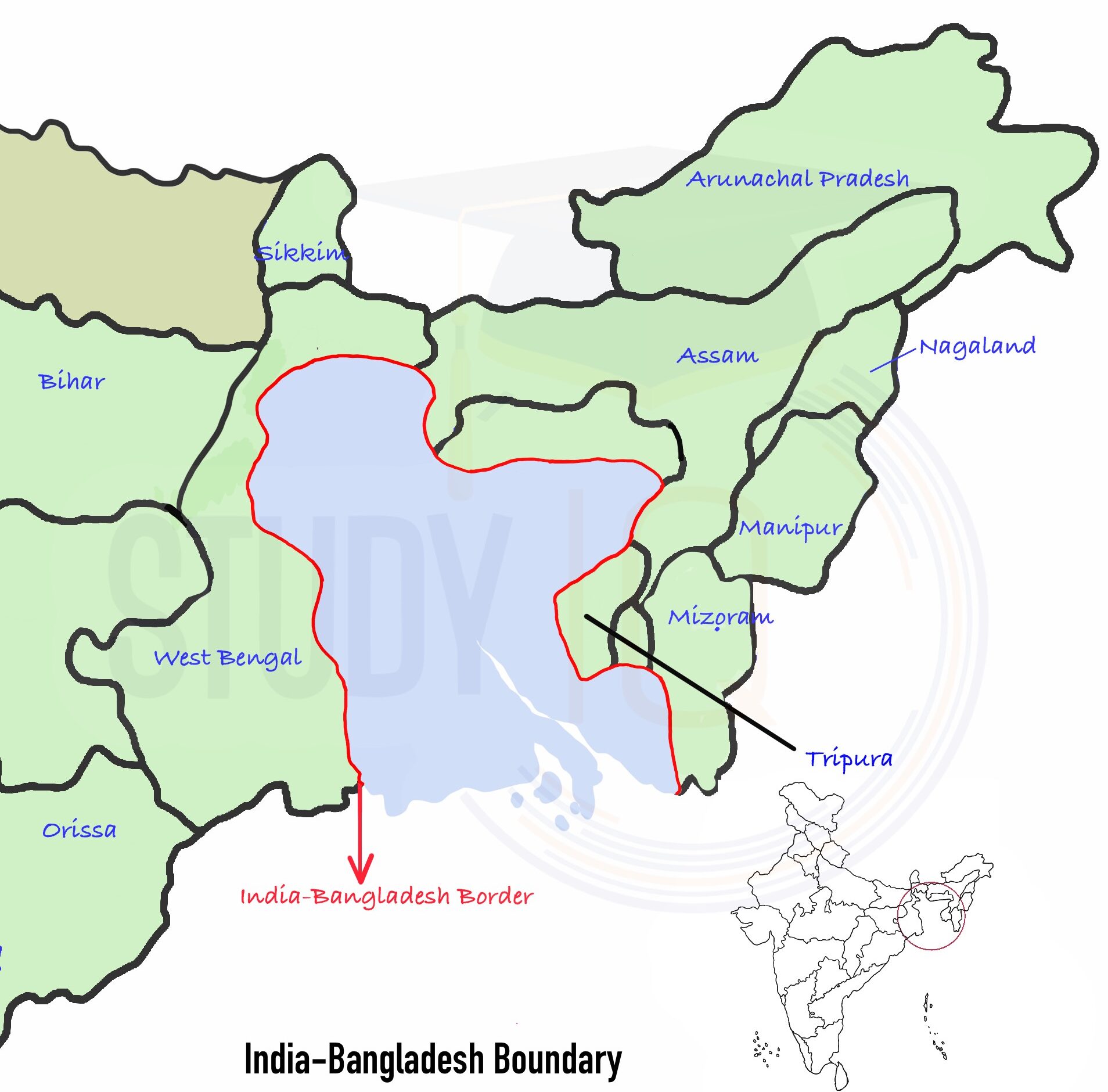
India and Bangladesh Border Map
The 4096 km-long border between India and Bangladesh is the longest land border that India has with any of its neighbours. Its borders are shared with Assam, West Bengal, Tripura, Meghalaya, and Mizoram states of India.
Read More: India-Nepal Border Dispute
India-Bangladesh Sea Boundary Dispute
- India and Bangladesh have a four-decade-long dispute over the total disputed area of 25,602 sq km in the Bay of Bengal.
- The location of the land border endpoint between the two countries and the determination of the maritime boundary’s course in the territorial waters were the main points of contention.
- Bangladesh pushed for an “equitable solution,” whereas India insisted on drawing the border using the “equidistance” method.
- Negotiations to resolve the maritime dispute between India and Bangladesh began in 1974, following the country’s independence in 1971.
- After 28 years of stalled talks, Bangladesh turned to the UN’s International Tribunal for the Law of the Sea (ITLOS) in 2009.
- In May 2011, the case was moved to The Hague’s Permanent Court of Arbitration (PCA). The main issue was how to demarcate the territorial sea. Bangladesh sought a fair solution for resource access, while India preferred an “equidistance” method, which sets boundaries based on a median line from each country’s shores.
In the end, the UN tribunal awarded Bangladesh 19,467 square kilometres of the contested area, which is one-fifth of the total 25,602 square kilometres in the Bay of Bengal. Both countries accepted this decision.
Read More: India-China Border Dispute
India-Bangladesh Land Boundary dispute
After the formation of Bangladesh in 1971, it was recognised that the newly formed nation had some ambiguity over a common border with India.
Land Boundary Agreement 1974
It was an agreement between India and Bangladesh concerning the demarcation of the land boundary and related matters between the two countries. It was intended to find a solution to the complex nature of the border demarcation.
In order to resolve this dispute, it was necessary to identify the precise area on the ground which would be transferred. For this purpose, a Protocol was signed between the two countries on 6th September 2011, which forms an integral part of the Land Boundary Agreement between India and Bangladesh, 1974. This had three purposes:
- To identify the issues relating to the demarcation of un-demarcated boundaries;
- To identify the territories in adverse possession, and
- To identify the enclaves that had to be exchanged.
Comilla-Tripura Land Dispute
- The Comilla-Tripura land border, which stretches for 6.5 kilometres, has not been demarcated, leaving the border dispute open-ended.
- Indian resistance to finding a solution to this problem is attributable to Hindu residents of the areas who fear moving to Bangladesh after demarcation.
- The establishment of borders at the zero point, the unresolved and unimplemented Teesta Treaty, and the lack of market access for Bangladeshi businesses and TV channels are among the issues that Bangladeshis have with India’s stance.
Therefore, India has a long-term interest in seeing a moderate, stable Bangladesh since good relations between India and Bangladesh can help to stabilise South Asia.
Challenges in India-Bangladesh Relations
India and Bangladesh generally have friendly ties, but some challenges exist:
Geopolitical Challenges
Border Disputes: Ongoing issues with border demarcation, especially in Assam and Tripura.
Illegal Immigration: Migrants from Bangladesh, due to unrest, have strained relations, causing socio-economic issues in the Indian border states.
Economic Challenges
Non-Tariff Barriers: Complicated customs procedures hinder trade between the two countries.
Water Sharing: Disagreements over sharing the waters of 54 cross-border rivers, especially the Brahmaputra and Ganges.
Connectivity Challenges
Unresolved Border Issues: A long land border (4,096 km) with some parts, like the Comilla-Tripura area, still not demarcated.
Lack of Infrastructure: Insufficient connectivity limits economic growth.
Security Challenges
Terrorism: India has raised concerns about Bangladesh-based terrorist groups.
Insurgency: Groups like ULFA and others reportedly have camps in Bangladesh and may fund operations in India.
China Factor
Investment: China is increasing its investments in Bangladesh, particularly in infrastructure and telecommunications.
Energy Challenges
Water Sharing Issues: Disputes over river water distribution, particularly concerning the Teesta River and the Farakka barrage, remain unresolved. An agreement made in 2011 has not been implemented due to disagreements.
India-Bangladesh Border Disputes Settlement
The Protocol was prepared with the support and concurrence of the concerned state governments of Assam, Meghalaya, Tripura and West Bengal. The 100th Constitutional Amendment Act 2015 was passed for three purposes,
- Transfer of Enclaves: To transfer some other territories to Bangladesh, where India received 51 enclaves, and Bangladesh received 111 enclaves.
- Transfer and Demarcation: There was also a deal of transferring adverse possessions and the demarcation of a 6.1 km undermarketed border stretch.
- Resolution of Disputes: For final settlement and resolution of territorial disputes and implementation of the Land Boundary Agreement 1974 and the 2011 Protocol between the two countries.
- For this purpose, the amendment modified the provisions relating to the territories of Assam, Meghalaya, Tripura and West Bengal.
Major Imports and Exports Between India and Bangladesh
As of 2026, Bangladesh’s major imports from and exports to India include:
| Bangladesh’s Major Exports to India (2026) |
|
| Bangladesh’s Major Imports from India (2026) |
|
The trade relationship between Bangladesh and India is crucial, significantly impacting both economies.

 US Losing Ground in the Middle East? Isr...
 Section 301 of the Trade Act of 1974: Pu...
 Three Crucial Issues Between US and Iran...













 WhatsApp





