Table of Contents
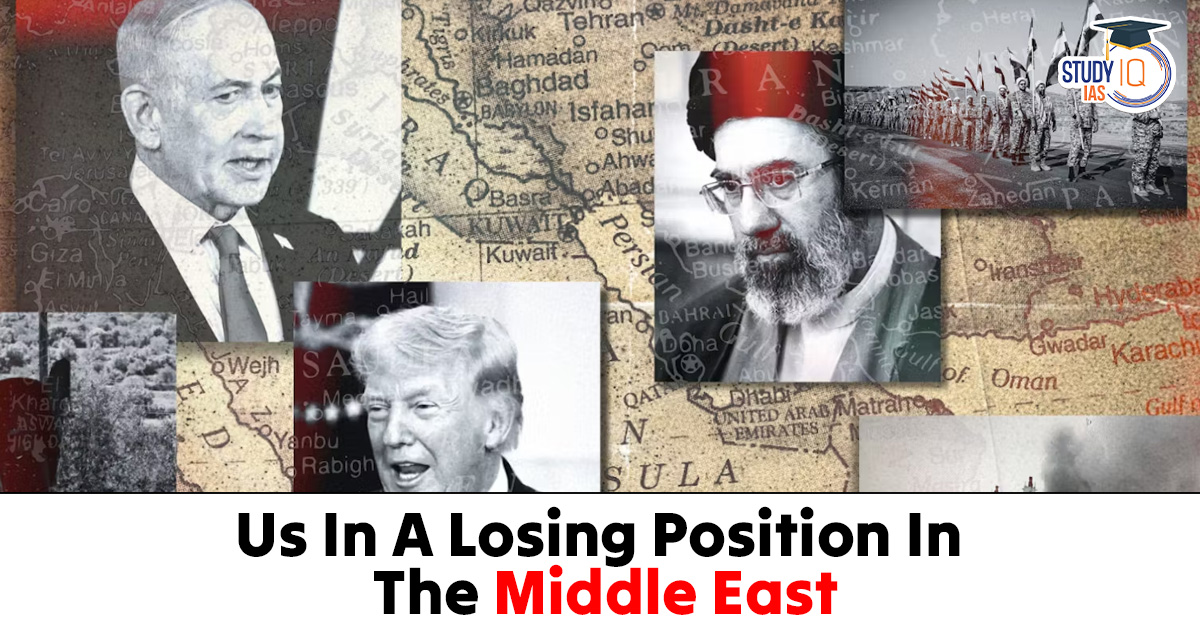
Context: The ongoing Gulf conflict has placed the United States in a strategically difficult position, while Israel continues to pursue an aggressive regional strategy aimed at weakening adversaries and expanding influence.
How the USA is Losing in the War
- Strategic Overstretch: The U.S. entered a war of choice under Israeli influence, ignoring internal caution, leading to long-term entanglement without a clear exit strategy (no off-ramp).
- Failure of Core Objectives: Unable to destroy Iran’s missile/drone capabilities or force regime change, reducing credibility of military coercion.
- Hormuz Leverage Loss: Iran retains effective control over the Strait of Hormuz (≈20% global oil flow), limiting U.S. ability to secure global trade routes.
- Ineffective Economic Pressure: Sanctions and blockade strategy failed to compel Iran to surrender (Iran prioritises sovereignty over economic relief).
- Global Isolation Trends: US. faces diverging positions from Europe, China, and Global South, weakening unified pressure on Iran.
- Domestic Political Costs: War likely to trigger internal political backlash (Congress resistance, electoral costs, economic burden).
USA is acting as per Israel
- Policy Alignment with Israeli Interests: US. decisions (withdrawal from Iran deal, military escalation) driven by alignment with Israeli strategic priorities (anti-Iran stance).
- Influence in Domestic Politics: Strong pro-Israel lobbying and electoral funding networks shape bipartisan U.S. foreign policy orientation.
- Constraint on Diplomatic Exit: Israel opposes a ceasefire and pushes for continued conflict/regime change, limiting U.S. ability to negotiate.
- Proxy Escalation Pressure: Israel may expand conflict (Lebanon, Iran) to pull the U.S. deeper into war, preventing disengagement.
- Suppression of Dissent: Critical voices within the U.S. political system remain marginalised or excluded from mainstream discourse.
How Israel is Winning the War
- Territorial and Strategic Gains: Expansion of control in Gaza, southern Lebanon (up to the Litani River), parts of Syria and the West Bank, increasing strategic depth.
- Weakening of Adversaries: Significant degradation of Hezbollah capabilities (rocket stockpiles reduced) and destruction of hostile infrastructure.
- Population Displacement Strategy: Use of destruction and displacement to reduce long-term security threats (denying insurgent bases).
- Low Relative Cost: Despite prolonged conflict, Israel incurs limited direct damage compared to its adversaries.
- External Financial Support: Heavy reliance on the US. Financial and military aid (tens of billions of dollars) sustains war efforts.
- Political Stability of Leadership: Continued domestic support for leadership (Benjamin Netanyahu’s long tenure) reflects perceived strategic success.
The conflict reflects a divergence in outcomes: the U.S. faces strategic fatigue, limited gains and rising costs, while Israel achieves tactical and territorial advantages under U.S. backing. However, long-term stability remains uncertain as prolonged conflict risks regional escalation and global economic disruption.

 Skyroot Vikram-1 Mission Aagaman: India'...
 Oor Pare Prehistoric Site: Location, Roc...
 Assam Election 2026: Exit Poll, Result D...













 WhatsApp