Table of Contents
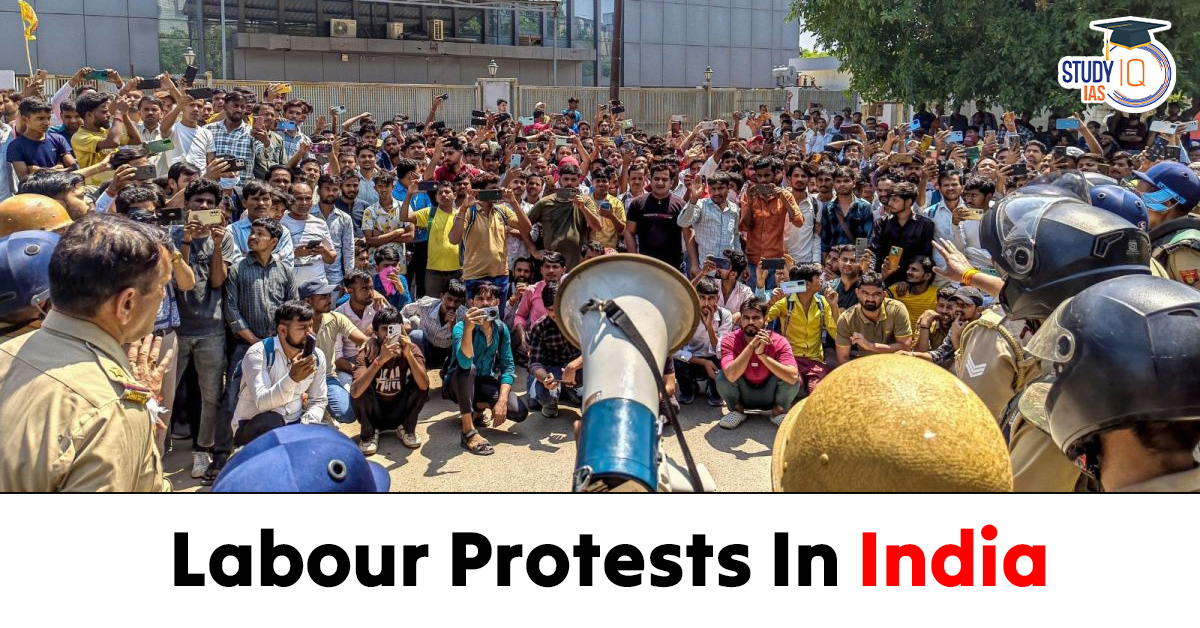
Context: Factory workers in industrial hubs like Noida and Manesar have launched violent protests over stagnant wages and poor working conditions.
| Factsheet |
| ·Inflation Gap: The all-India inflation rate for industrial workers (CPI-IW) rose by 24.8% between 2021 and 2026, while wage hikes in states like Haryana only averaged 15% in the same period.
·Minimum Wage Disparity: Before recent revisions, the monthly wage for unskilled workers in Haryana was ₹11,274.60, significantly lower than the Central Sphere rate of ₹20,358, causing widespread resentment. ·Revision Delays: Uttar Pradesh had not revised its base minimum wage since 2012, and Haryana delayed its revision for 10 years despite the five-year legal requirement. ·Living Costs: Migrant workers reported paying as much as ₹4,000 for LPG cylinders on the black market due to war-induced supply chain disruptions. |
Factors Leading to Rising Labour Protests
- Wage Stagnation vs. Inflation: Fixed base minimum wages have failed to adjust for the rapid spike in daily expenses, particularly food, rent, and fuel.
- Legislative Confusion: The notification of the four Labour Codes in November 2025 created expectations of higher pay and better social security that have not yet materialized on the ground.
- Flexible Working Hours: New codes allow a workday of up to 12 hours to facilitate a four-day work week, but workers fear this is being abused to increase workload without extra pay.
- Impact of External Conflicts: The Strait of Hormuz closure and West Asia war have increased input costs for factories, leading to delayed payments and job uncertainties.
Also Read: Noida Workers Protest 2026
Initiatives Taken
- Interim Wage Hikes: The Uttar Pradesh government announced an interim hike, raising Noida’s unskilled wage to ₹13,690 to quell immediate violence.
- Haryana Notification: Following protests in Manesar, Haryana notified a 35% hike, bringing the minimum wage to ₹15,220.71.
- Central Notification (September 2024): The Union government revised minimum wages for central sphere establishments to over ₹20,000 per month to set a benchmark.
- Draft Rules Issuance: The Centre issued draft rules for the new Labour Codes in December 2025 to clarify spread-over hours and rest intervals.
Challenges
Internal
- Notification Lag: While the Codes were notified in 2025, the final rules are pending in most states, leading to an unexpected damage to lawmaking.
- Regional Disparities: Differences in state-level wage notifications create a race to the bottom where industries might migrate to states with lower labour costs.
- Erosion of Trade Unions: The new codes leave the recognition of trade unions to state discretion, weakening the collective bargaining power of workers.
- Lack of Awareness: Misinformation on social media regarding uniform ₹20,000 wages has created unrealistic expectations and friction.
External
- Energy Crisis: High prices of LPG and cooking fuel due to global supply shocks disproportionately hit the disposable income of migrant workers.
- Global Trade Barriers: US tariffs and shipping disruptions have squeezed factory margins, making employers reluctant to pass on wage hikes.
- Strait of Hormuz Closure: This specific geopolitical event has crippled the flow of raw materials, causing industrial units to reel under intense input cost pressure.
Way Ahead
- Standardize Base Revisions: Ensure that the five-year revision of the base minimum wage is mandatory and automatic across all states to prevent decade-long stagnations.
- Clarify Labour Code Rules: The Centre and States must urgently notify final rules for the 2025 Labour Codes to eliminate confusion regarding 12-hour shifts and overtime.
- Institutionalize Bargaining: Strengthen the process for recognizing trade unions to ensure that grievances are settled at the negotiating table rather than on the streets.
- CPI-IW Alignment: Update the variable component of wages more frequently to reflect the real-time inflation felt by industrial workers.

 Skyroot Vikram-1 Mission Aagaman: India'...
 Oor Pare Prehistoric Site: Location, Roc...
 Assam Election 2026: Exit Poll, Result D...














 WhatsApp