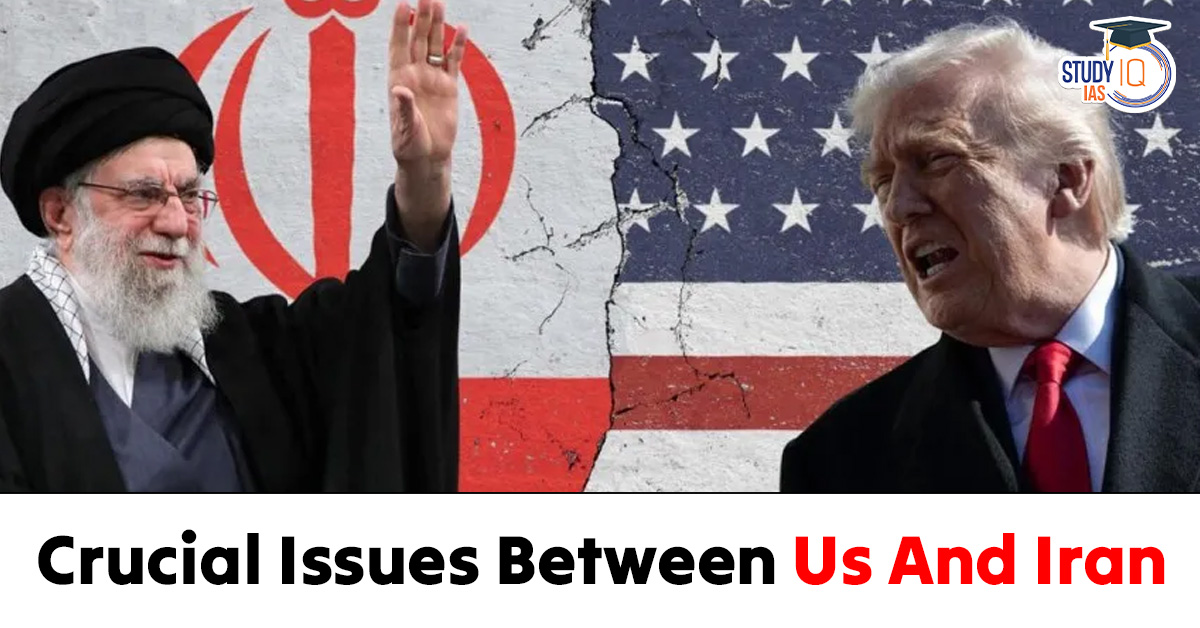
Context: Despite the failure of recent U.S.–Iran talks, a workable deal still exists around three core issues—nuclear (HEU), maritime (Hormuz), and regional conflicts, with both sides needing credible commitments.
Three Crucial Issues Between US and Iran
1. Iran’s Highly Enriched Uranium (HEU) – Possible Solutions
| Option |
Feasibility |
Key Issues / Explanation |
| Regime Change / Conquest |
Very Low |
Requires full-scale war and occupation (high cost, global instability, politically unacceptable) |
| Military Raid to Seize HEU (~400 kg; ≈10–12 bombs potential) |
Low |
HEU likely dispersed across multiple hardened sites; large-scale operation needed with high risk of failure |
| Coercive Pressure + Limited Deals |
Medium |
Sanctions/military pressure may force concessions but unlikely to fully eliminate nuclear risk |
| Iran Voluntary Transfer (with safeguards) |
High |
Most practical if combined with incentives (sanctions removal, economic reconstruction support) |
While coercive options face high military and political costs, a sustainable solution requires Iran’s voluntary cooperation, which in turn depends on credible verification mechanisms to ensure long-term compliance.
Modes within Voluntary Transfer
| Mechanism |
Explanation |
| IAEA Safeguards Model |
International monitoring ensures enrichment limits (≤3.67%); builds global legitimacy but faces U.S. trust deficit due to past compliance concerns |
| Bilateral US–Iran Mechanism |
Joint inspections and oversight; increases U.S. confidence but may face sovereignty concerns from Iran |
2. Strait of Hormuz Issue
| Aspect |
Details |
| Core Issue |
Iran is militarising the Strait of Hormuz (≈20% global oil flow) to gain leverage and raise funds for post-war reconstruction |
| US Proposal |
Joint mechanism to ensure safe passage (including possible revenue-sharing arrangement) |
| Key Constraint |
Toll on shipping violates freedom of navigation under UNCLOS and may trigger similar claims globally |
| Resolution Path |
Lift sanctions + release frozen assets to compensate Iran economically instead of toll collection |
| Outcome Logic |
With reduced economic pressure, Iran has less incentive to weaponise the strait |
3. Israel–Lebanon Conflict (Hezbollah Factor)
| Aspect |
Details |
| Core Issue |
Conflict between Israel and Hezbollah, an Iran-backed armed group |
| Israeli Position |
Seeks disarmament of Hezbollah to eliminate missile and drone threats |
| Lebanese Constraint |
Hezbollah’s deep political integration limits state’s ability to enforce disarmament |
| Resolution Path |
U.S. and Iran pressure respective allies to bring them to the negotiation table |
| Possible Outcome |
Ceasefire + phased disarmament within broader regional settlement |
The three issues are interconnected (nuclear capability, maritime leverage, and regional proxies) and cannot be solved in isolation. Military options are largely impractical, while coordinated diplomacy (sanctions relief, verification mechanisms, and regional negotiations) offers the most viable path toward a durable settlement.
Sharing is caring!


 Skyroot Vikram-1 Mission Aagaman: India'...
 Oor Pare Prehistoric Site: Location, Roc...
 Assam Election 2026: Exit Poll, Result D...














 WhatsApp