
Table of Contents
Context: India’s judicial system is facing a deep crisis, where delay has become the norm, turning justice into a prolonged struggle for ordinary citizens.
Sluggishness of India’s Legal System
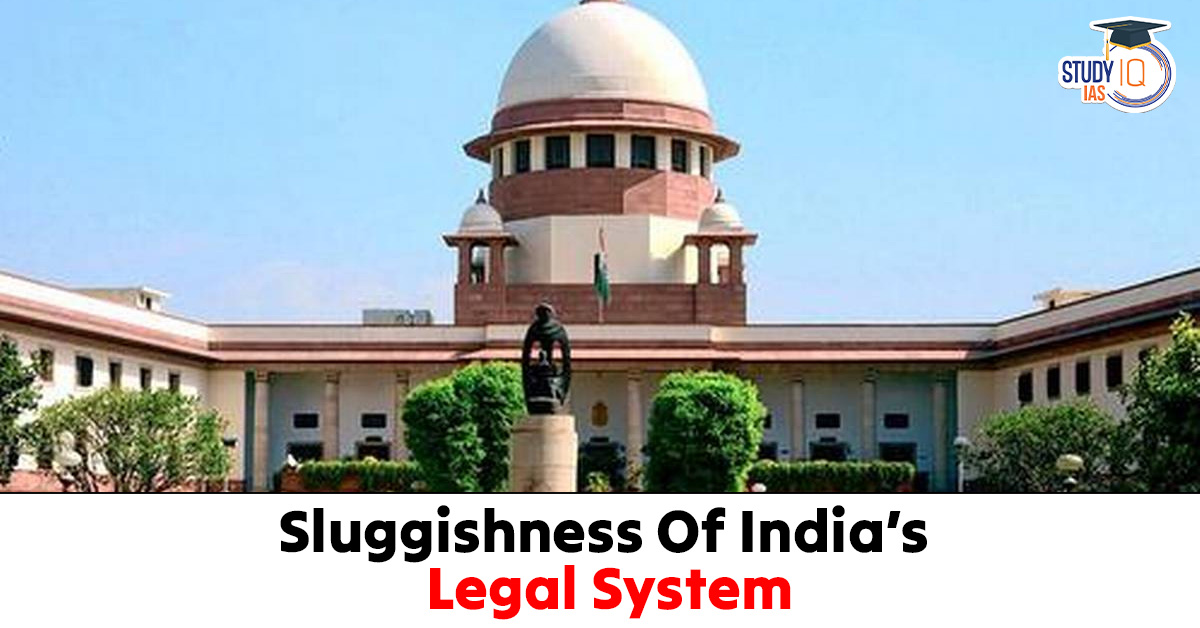
The sluggishness of India’s legal system has emerged as a critical concern, affecting access to timely justice and public confidence in the rule of law. With millions of pending cases across various courts, including the Supreme Court of India, High Courts of India, and the subordinate judiciary, delays have become a persistent challenge.
Factors such as judicial vacancies, complex procedures, frequent adjournments, and inadequate infrastructure contribute to the slow pace of case disposal. This not only burdens litigants with prolonged uncertainty but also impacts economic activity and governance, highlighting the urgent need for comprehensive judicial reforms.
Causes of Judicial Delay
- Massive Case Backlog: The scale of pendency, with over five crore cases, reflects a system struggling to keep pace with demand.
- Eg: Of the total pendency, ~4.5 crore cases are in subordinate courts, showing that the lower judiciary bears the brunt (NJDG data). Some civil disputes, especially land cases, last 20–30 years.
- Emotional & Financial Strain: Litigation becomes a long-drawn burden with no certainty of closure.
- Eg: A study by Vidhi Centre for Legal Policy highlights that litigants often spend multiples of their annual income on prolonged litigation. Example: Property disputes in states like Uttar Pradesh frequently pass across generations.
- Procedural Punishment: Frequent adjournments and delays make the process itself punitive.
- Eg: The Supreme Court in Hussainara Khatoon v. State of Bihar exposed how repeated adjournments kept undertrials jailed for years without trial, effectively punishing them before conviction.
- Justice Losing Value: Delayed outcomes fail to restore lost opportunities or dignity.
- Eg: In Salem Advocate Bar Association v. Union of India, the Court acknowledged that delayed justice defeats its purpose, especially in commercial disputes where lost business opportunities cannot be recovered.
Structural Faultlines in the System
- Outdated Procedures: Colonial-era rigidity and excessive paperwork slow efficiency.
- Eg: The Malimath Committee (2003) observed that procedural laws still reflect colonial-era adversarial structures, contributing to inefficiency and backlog.
- Undertrial Crisis: Stringent laws like UAPA result in prolonged detention without timely trials.
- Eg: According to the National Crime Records Bureau (Prison Statistics 2022), over 75% of prisoners are undertrials. Cases under laws like UAPA often see years-long detention without conviction (Eg: Bhima Koregaon accused)
- Inequality in Access: High costs make justice inaccessible for many.
- Eg: The National Legal Services Authority reports that a large share of the population remains unaware of free legal aid; meanwhile, senior advocates’ fees can run into lakhs per hearing.
- Centralised Burden: Distance from higher courts adds financial and logistical stress.
- Eg: Litigants from remote states must travel to the Supreme Court of India in Delhi, incurring high travel and accommodation costs. This burden was acknowledged in demands for regional benches.
- Lack of Diversity: Limited representation affects inclusive and empathetic decision-making.
- Eg: As of 2024, women constitute less than 15% of High Court judges, and representation from marginalised communities remains limited (data from Ministry of Law & Justice).
Challenges Associated
- Declining Public Trust: Delays erode faith in the judiciary and the rule of law.
- Eg: The World Justice Project Rule of Law Index ranks India relatively lower in civil justice timeliness, reflecting declining public confidence.
- Encouragement of Violations: Slow justice emboldens offenders and discourages compliance.
- Eg: Delays in criminal trials often allow accused persons to remain free for long periods, weakening deterrence. Economic offences and corruption cases frequently drag on for decades.
- Rights Violations: Prolonged trials undermine personal liberty and human rights.
- Eg: In Maneka Gandhi v. Union of India, the Supreme Court expanded Article 21, but prolonged trials continue to violate the “right to speedy trial,” reaffirmed in multiple judgments.
- Threat to Democracy: Weak judicial functioning impacts checks and balances.
- Eg: Judicial delays weaken oversight on executive actions. For instance, election-related petitions often remain unresolved until after the electoral cycle ends, diluting accountability.
Way Forward
- Time-Bound Justice: Set clear timelines for trials and bail decisions.
- Eg: The Supreme Court in Hussain v. Union of India stressed the need for fixed timelines in criminal trials to uphold speedy justice.
- Tech-Driven Efficiency: Use AI and data systems for better case management.
- Eg: The e-Courts Project (Phase III) under the Ministry of Law and Justice aims to integrate AI, virtual hearings, and digital records to reduce backlog.
- Inclusive Judiciary: Improve diversity to reflect societal realities.
- Eg: The push for diversity has been highlighted by the Supreme Court Collegium, though progress remains gradual.
- Decentralised Access: Expand regional benches and virtual hearings.
- Eg: Virtual hearings during COVID-19 allowed courts to function remotely, demonstrating how technology can reduce geographical barriers.
- Transparency & Accountability: Promote openness in proceedings and appointments.
- Eg: Live-streaming of constitutional bench proceedings began in 2022, improving openness in institutions like the Supreme Court.
- Shift in Legal Culture: Move toward resolution-oriented approaches.
- Eg: Reports like the Law Commission of India have recommended ADR mechanisms such as mediation and arbitration to reduce court burden.
Conclusion
The phrase “justice delayed is justice denied,” reiterated in Hussainara Khatoon v. State of Bihar, captures how delay erodes dignity and fairness. Alongside reforms like digitisation, ADR, and institutional restructuring, India can transition toward a citizen-centric justice system, restoring faith in the rule of law.

 Supreme Court on Plaint Amendment After ...
 Supreme Court on Children's Right to Int...
 Supreme Court Dowry Enforcement Order 20...







 WhatsApp





