
Table of Contents
India, with its vast geographical diversity, boasts a long and strategically significant coastline stretching along the Arabian Sea, the Bay of Bengal, and the Indian Ocean. The coastline plays a crucial role in shaping India’s economy, culture, biodiversity, and maritime security.
Coastlines of India
India’s coastline, extending for 7516.6 kilometers, is not just a geographical feature but a vibrant tapestry of ecosystems, cultures, and economic activities. Shaped by geological processes and historical legacies, India’s coastal plains can be broadly classified into the Eastern and Western Coastal Plains, each with its own distinct characteristics and significance.
Total Length of India’s Coastline
India has a total coastline of approximately 7,516.6 km, which includes:
- Mainland coastline: ~5,422.6 km
- Island territories: ~2,094 km
This extensive coastline makes India one of the major maritime nations in the world.
Longest and Shortest Coastlines
- Longest coastline (state): Gujarat
- Shortest coastline (state): Goa
Among districts, Ganjam in Odisha has the longest coastline in the state.
Coastal States and Union Territories
India’s coastline is shared by 9 states and 4 Union Territories:
| Coastal States | Union Territories |
|
|
Division of the Coastline of India
The Indian coastline is broadly divided into two parts:
Eastern Coastal Plains
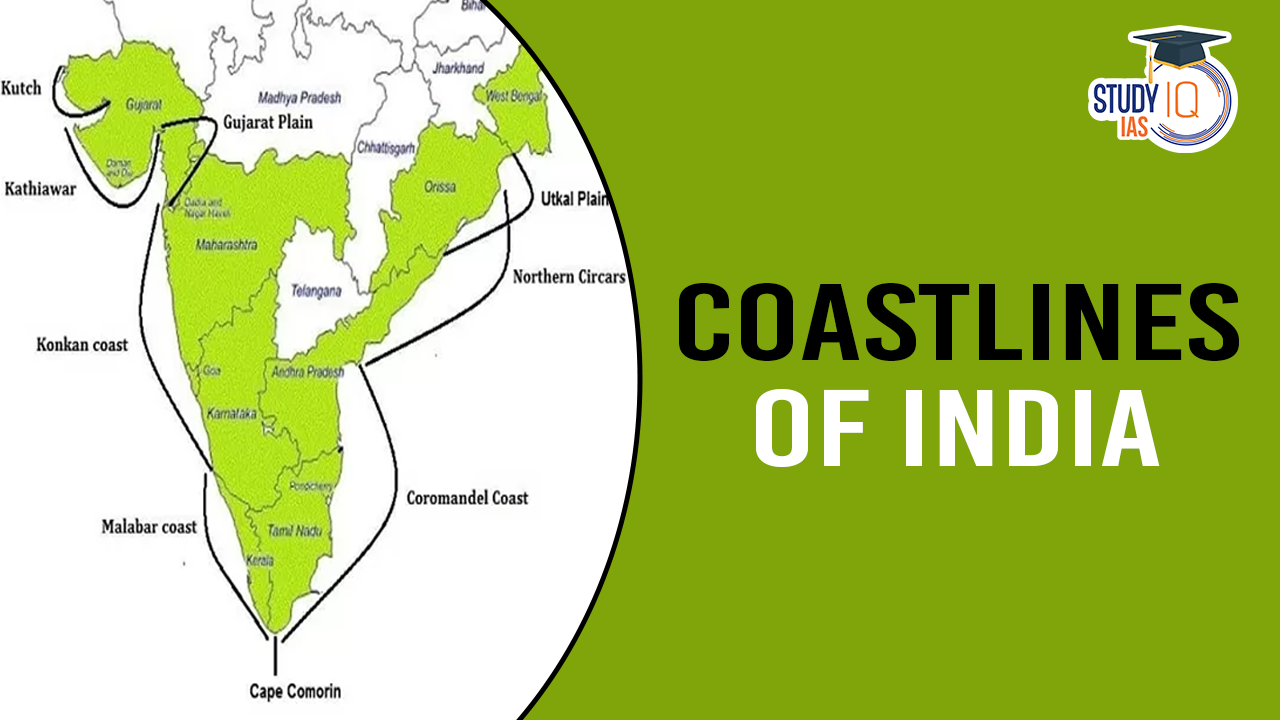
Eastern Coastal Plains Stretching from West Bengal to Tamil Nadu along the Bay of Bengal, it includes:
- Northern Circars Coast (Andhra Pradesh)
- Coromandel Coast (Tamil Nadu)
Features:
- Wider coastal plains
- Delta formations by major rivers like the Ganga, Mahanadi, Godavari, and Krishna
- Prone to cyclones
Stretching from West Bengal in the north to Tamil Nadu in the south, the Eastern Coastal Plains encompass the states of Andhra Pradesh, Odisha, and parts of Tamil Nadu. Fed by major rivers like the Mahanadi, Krishna, Godavari, and Cauvery, these plains boast fertile deltas that support thriving agricultural practices. The Krishna delta, known as the ‘Granary of South India,’ is a testament to the region’s agricultural prosperity. The Eastern Coastal Plains are further divided into three distinct divisions:
- Utkal Coast: This region, spanning from Chilika Lake to Kolleru Lake, is characterised by its wide expanse and abundant rainfall. Rice, coconut, and banana are among the crops cultivated here, contributing to the region’s agricultural diversity.
- Andhra Coast: Stretching from Kolleru Lake to Pulicat Lake, the Andhra Coast serves as a basin for the Krishna and Godavari rivers. The fertile plains support extensive agriculture and are crucial for the region’s economy.
- Coromandel Coast: Extending from Pulicat Lake to Kanyakumari in Tamil Nadu, the Coromandel Coast experiences dry summers and rainy winters due to the northeast monsoons. The region’s agricultural productivity and coastal ecosystems make it a vital part of India’s coastline.
Western Coastal Plains
Western Coastal Plains, stretching from Gujarat to Kerala along the Arabian Sea, it includes:
- Konkan Coast (Maharashtra & Goa)
- Kanara Coast (Karnataka)
- Malabar Coast (Kerala)
Features:
- Narrow coastal plains
- Rocky shores
- Natural harbours like Mumbai
From Kerala in the south to Gujarat in the north, the Western Coastal Plains traverse the states of Karnataka, Goa, Maharashtra, and Gujarat. Spanning 1500 kilometres, these plains are narrower than their eastern counterparts but are rich in natural resources and biodiversity. The Western Coastal Plains are divided into four distinctive sections:
- Kachchh and Kathiawar Coast: Formed by the silt deposits of the Indus River, Kachchh and Kathiawar were once gulf regions. Today, they are characterised by unique landscapes such as the Great Rann and the Little Rann, along with rich agricultural lands.
- Konkan Coast: Running from Daman to Goa, the Konkan Coast is renowned for its rice and cashew cultivation. The region’s scenic beauty, coupled with its marine biodiversity, attracts tourists from around the world.
- Karnataka Coast: Between Marmagaon and Mangalore lies the Karnataka Coast, known for its iron reserves and distinct marine topography. Waterfalls cascading down steep hillsides add to the region’s natural charm.
- Kerala Coast: Stretching from Mangalore to Kanyakumari, the Kerala Coast is characterised by its broad plains and backwater ecosystems. The Vembanad Lake, along with other lagoons and estuaries, contribute to the region’s ecological richness.
Major Coastal Features
Beaches
India is famous for scenic beaches like:
- Marina Beach
- Juhu Beach
Deltas
Fertile deltas formed by rivers support agriculture:
- Sundarbans – the largest mangrove forest
Lagoons & Backwaters
- Chilika Lake – the largest coastal lagoon in India
- Kerala backwaters – a major tourist attraction
Coral Reefs
Found in:
- Lakshadweep
- Andaman and Nicobar Islands
Economic Importance
The coastline contributes significantly to India’s economy:
- Ports & Trade: Major ports like Mumbai and Chennai handle international trade
- Fishing Industry: Supports millions of livelihoods
- Tourism: Beaches and coastal ecosystems attract tourists
- Energy Resources: Offshore oil and natural gas reserves
Strategic and Environmental Importance
- Strengthens maritime security
- Supports biodiversity and ecosystems
- Acts as a buffer against climatic events
However, challenges like coastal erosion, pollution, and rising sea levels threaten sustainability.
Conclusion
The coastline of India is not just a geographical feature but a lifeline for economic growth, cultural exchange, and environmental balance. From the bustling ports of Gujarat to the serene backwaters of Kerala, India’s coasts reflect diversity and strategic importance. Sustainable management of coastal resources is essential to ensure long-term development and ecological preservation.

 Global Warming and Sea-Land Breeze: Caus...
 Strait of Malacca: Strategic Importance,...
 India Forecasts Below-Normal Southwest M...













 WhatsApp





