
Table of Contents
Context
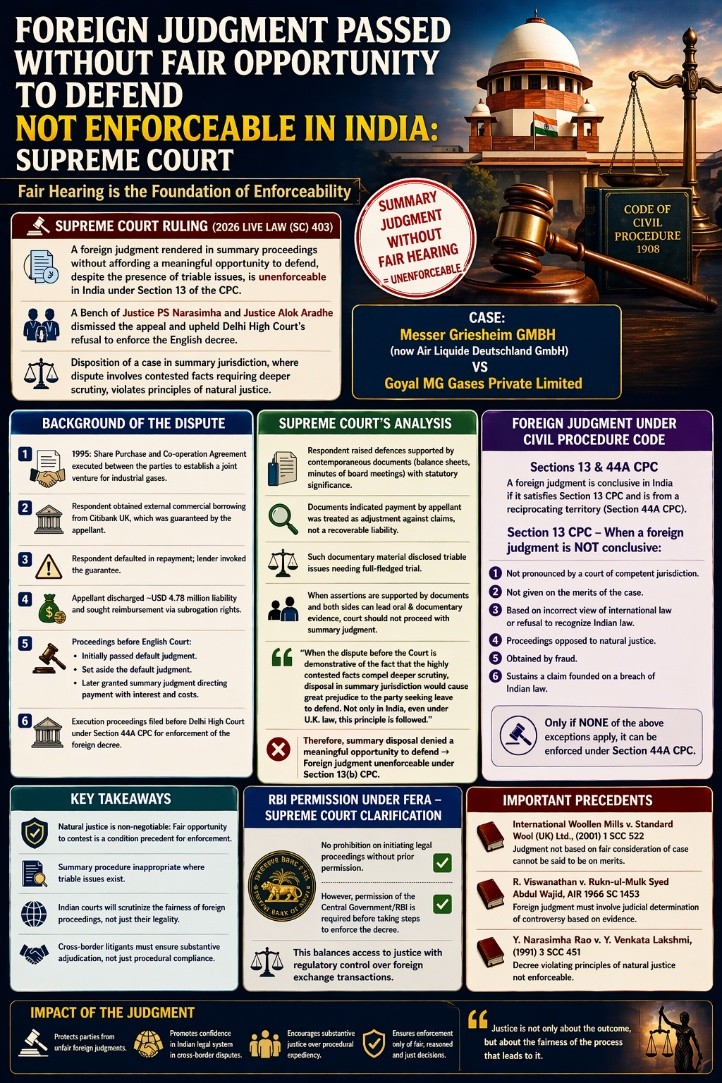
The execution of foreign judgements in India is essential at the convergence of private international law, business certainty, and constitutional justice standards. The recent decision by the Supreme Court of India in Messer Griesheim GmbH v. Goyal MG Gases Private Limited (2026 LiveLaw (SC) 403) reaffirms a crucial protection: a foreign judgement issued without providing an adequate opportunity for defence is unenforceable in India. This decision underscores the supremacy of natural justice under Section 13 of the Code of Civil Procedure, 1908 (CPC).
The decision constitutes a significant addition to the legal framework governing foreign decrees, particularly in summary proceedings, and underscores India’s prudent yet principled stance on the cross-border enforcement of court decisions.
Regulatory Structure for Foreign Judgements in India
The implementation of foreign judgements in India is principally regulated by Sections 13 and 44A of the Code of Civil Procedure, 1908. Section 13 establishes the criteria for the conclusive nature of a foreign judgement and delineates the exceptions that negate such conclusiveness.
A foreign judgement is definitive about any topic immediately adjudicated, except under the following conditions:
- In instances where a court of competent jurisdiction has not rendered a decision;
- where a ruling has not been made based on the merits of the case;
- when the proceedings evidently stem from a misinterpretation of international law or a failure to acknowledge Indian law;
- Where the processes contravene natural justice;
- When the judgement has been procured by fraudulent means;
- When it upholds a claim based on a violation of Indian law.
Section 44A enhances the enforcement of decisions issued by courts in reciprocating jurisdictions by recognising them as if they were decrees of Indian courts. This provision is, nevertheless, constrained by the limitations established in Section 13.
Case Factual Background
The conflict in Messer Griesheim GmbH v. Goyal MG Gases Pvt. Ltd. stemmed from a Share Purchase and Co-operation Agreement made in 1995 between the foreign appellant and the Indian respondent. The agreement anticipated the formation of a joint venture corporation involved in the production and commerce of industrial gases.
The respondent subsequently secured an external commercial borrowing credit from Citibank UK, guaranteed by the appellant. Following the respondent’s default, the lender activated the guarantee, and the appellant settled the remaining obligation of about USD 4.78 million.
The appellant, exercising its subrogation rights, commenced legal action in an English Court to recover the sum from the respondent. A default judgement was initially rendered and subsequently annulled. The English Court subsequently issued a summary judgement mandating the payment of the requested amounts, inclusive of interest and expenses.
The appellant aimed to enforce the foreign decree in India by commencing execution proceedings in the Delhi High Court pursuant to Section 44A of the CPC.
Analysis and Findings of the Supreme Court
The Supreme Court, consisting of Justices P.S. Narasimha and Alok Aradhe, affirmed the Delhi High Court’s decision to deny implementation of the foreign judgement. The Court’s rationale focused on the premise that a judgement issued without a meaningful opportunity for defence contravenes natural justice and is unenforceable under Section 13(b) of the CPC.
The Court noted that the respondent presented significant defences substantiated by contemporaneous records, such as balance accounts and board meeting minutes. The records possessed statutory evidential significance and indicated that the payment made by the appellant was regarded as an adjustment rather than a recoverable debt.
Under these conditions, the presence of “triable issues” required a comprehensive trial. The Court determined that resolving the issue via summary processes, despite the existence of disputed facts, constituted premature adjudication.
The Bench underscored that in cases involving intricate factual issues substantiated by documentary evidence, courts should abstain from issuing summary judgement. The Court observed that this approach is acknowledged in both Indian law and the procedural structure of courts in the United Kingdom.
Natural Justice and the Necessity of Equitable Opportunity
The decision of the Court is fundamentally based on the idea of natural justice, namely the principle of audi alteram partem- the right to be heard. The Court determined that the expedited resolution of the matter substantially deprived the respondent of a significant opportunity to articulate its defence.
This refusal was not only procedural but also substantive, since it obstructed the respondent from substantiating its position with oral and documentary evidence. As a result, the foreign judgement was deemed incompatible with established legal principles and so unenforceable.
The Court’s rationale is consistent with prior judgements, including International Woollen Mills v. Standard Wool (UK) Ltd., which established that a judgement lacking a fair assessment of the matter cannot be deemed a decision rendered on its merits.
Concept of “Judgement on Merits”
A fundamental element of Section 13 is the stipulation that a foreign judgement must be rendered “on merits” to be binding. Indian courts have generally construed this condition to signify that the judgement must be founded on an evaluation of the facts and arguments submitted by the parties.
The Supreme Court determined that the summary judgement issued by the English Court failed to meet this criterion. The existence of triable issues suggested that the situation necessitated a thorough investigation, which was not conducted.
This approach aligns with the decision in R. Viswanathan v. Rukn-ul-Mulk Syed Abdul Wajid, wherein the Court underscored that a judgement necessitates a judicial resolution of the dispute grounded in evidence.
Summary Judgement and Its Constraints
Summary judgement is a procedural tool intended to accelerate litigation by resolving instances lacking a genuine dispute over material facts. Nonetheless, its utilisation is constrained by stringent constraints.
The Supreme Court’s decision emphasises that summary judgement is not applicable in cases with disputed facts and intricate evidence. Such actions would compromise the integrity of the proceedings and contravene the tenets of natural justice.
The Court’s methodology demonstrates a sophisticated comprehension of procedural rules, harmonising efficiency with equity. It recognises the value of summary procedures while warning against their inappropriate application in instances necessitating thorough adjudication.
Regulatory Aspect: FERA and RBI Authorisation
The Supreme Court dismissed the appeal due to unenforceability under Section 13, while also elucidating the legal status concerning regulatory permits under the Foreign Exchange Regulation Act, 1973 (FERA).
The Court determined that although commencing legal actions without prior authorisation is permissible, such authorisation is necessary before executing a decree. This mandate guarantees adherence to regulatory standards governing foreign exchange operations.
The Court established a balance between access to justice and regulatory monitoring by differentiating between the initiation and enforcement of actions.
Implementation of Section 13 of the Civil Procedure Code in the Present Case
In Messer Griesheim GmbH v. Goyal MG Gases Pvt. Ltd., the Supreme Court meticulously implemented Section 13(b) of the Code of Civil Procedure. Section 13(b) deems a foreign judgement inconclusive if it has not been rendered “on the merits of the case.” The Court conducted a thorough examination to see if the English Court’s summary judgement met this criterion.
The appellant contended that the English Court’s decision, despite being summary, constituted a judgement on the merits. The Supreme Court dismissed this argument by thoroughly scrutinising the character of the proceedings. The respondent presented substantial and legitimate defences substantiated by contemporaneous documentary evidence, such as balance accounts and minutes from board meetings. The records, possessing statutory evidentiary significance, indicated that the financial transaction in question might not have constituted a simple liability but rather an adjustment of claims.
The existence of such material, in the Court’s opinion, evidently revealed “triable issues” necessitating thorough adjudication. The expedited resolution of the issue, without allowing a comprehensive trial, essentially deprived the respondent of a significant chance to present its defence. As a result, the judgement cannot be considered to have been issued on its merits and so does not satisfy the criteria established under Section 13(b) CPC.
This reasoning demonstrates a sophisticated comprehension of “merits,” extending beyond the mere delivery of a judgement to assess the fairness, accuracy, and adherence to principles of justice within the adjudicatory process itself.
Fundamentals of Natural Justice and Fair Hearing
A fundamental aspect of the Supreme Court’s decision is its reaffirmation of natural justice principles, including the idea of audi alteram partem- the right to be heard. The Court underscored that the enforcement of foreign judgements in India is dependent on compliance with these essential criteria.
The summary approach utilised by the English Court, while allowed under its procedural law, was deemed incompatible with Indian standards of justice in cases involving intricate factual disagreements. The Supreme Court explained that mere adherence to foreign legal procedures is inadequate; the process must also meet the minimum standards of justice acknowledged in Indian jurisprudence.
The Court’s assertion that summary judgement is unsuitable under UK law when contested facts exist further bolsters its rationale. It emphasised that the refusal of leave to defend under such conditions leads to “premature adjudication” and inflicts significant prejudice.
This methodology is consistent with prior decisions, like International Woollen Mills v. Standard Wool (UK) Ltd. (2001), in which the Supreme Court determined that a judgement rendered without adequate evaluation of evidence cannot be deemed a decision on the merits. In Y. Narasimha Rao v. Y. Venkata Lakshmi (1991), the Court denied implementation of a foreign matrimonial order, citing a violation of natural justice principles.
Conclusion
The verdict in Messer Griesheim GmbH v. Goyal MG Gases Pvt. Ltd. signifies a notable advancement in the legal framework regarding the implementation of foreign judgements in India. The Supreme Court has emphasised the importance of natural justice in multinational litigation by finding that a summary judgement issued amidst triable questions is unenforceable.
The ruling elucidates that the notion of “merits” under Section 13 CPC is not a mere formality but a fundamental prerequisite that includes equity, the right to defend, and comprehensive adjudication. It offers essential insights into the relationship among procedural law, regulatory mandates, and international comity.
The decision establishes a rigorous benchmark for equity and responsibility in an increasingly globalised legal environment characterised by frequent cross-border disputes. It guarantees that foreign judgements executed in India are both legally valid and morally and procedurally equitable.
The judgement ultimately enhances the legitimacy of the Indian legal system as one dedicated to upholding justice in both domestic and international arenas.

 Supreme Court on Plaint Amendment After ...
 Supreme Court on Children's Right to Int...
 Supreme Court Dowry Enforcement Order 20...








 WhatsApp