Table of Contents
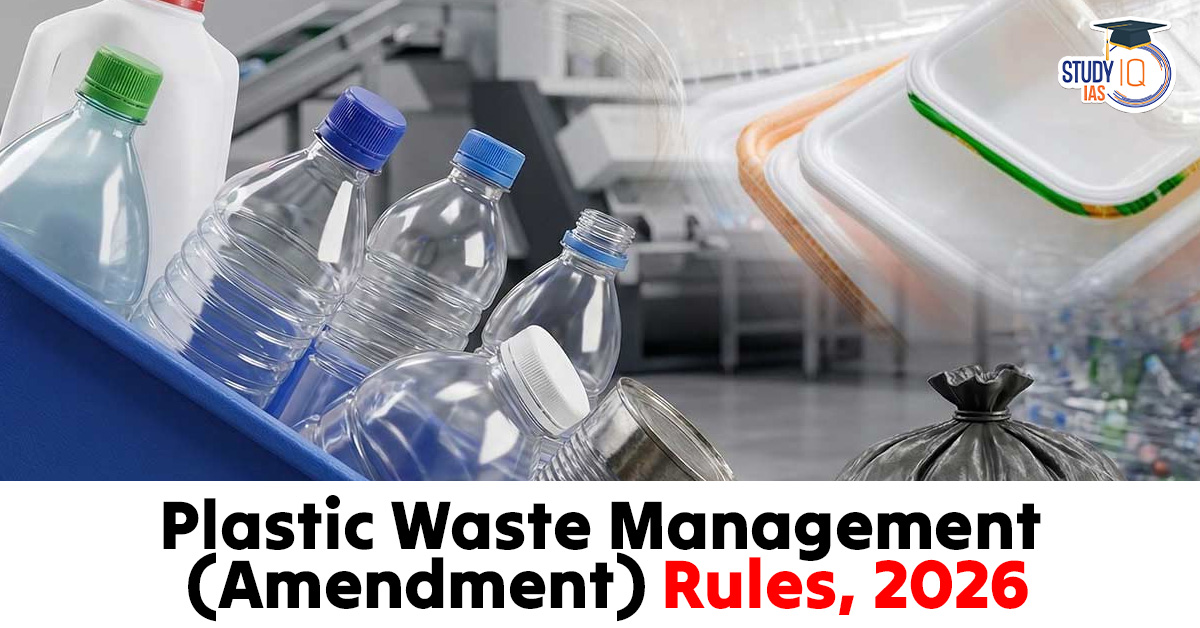
Context: The Ministry of Environment, Forest and Climate Change has reinforced the Plastic Waste Management Rules to transition from a “take-make-dispose” model to a Circular Economy. Recent amendments to India’s Plastic Waste Management Rules signal a strategic shift toward market-based flexibility and recycled content mandates.
Key Features of the Plastic Waste Management (Amendment) Rules, 2026
- Mandatory Recycled Content: For the first time, the rules mandate a specific percentage of recycled plastic in new packaging. For 2025-26, targets are set at 30% for Category I (Rigid), 10% for Category II (Flexible), and 5% for Category III (Multi-layered).
- Compliance Flexibility (Carry-Forward): Companies that fail to meet their 2025-26 recycling targets are permitted to carry forward the shortfall for up to three subsequent years, provided they fulfil at least one-third of the deficit annually.
- Tradable EPR Certificates: The rules formalise a market-based mechanism where companies exceeding their targets can sell Extended Producer Responsibility (EPR) certificates to those facing a shortfall, facilitating a flexible national compliance grid.
- Phased Targets for Reuse: Beyond recycling, the rules introduce mandatory reuse obligations for rigid plastic packaging, such as a 70% reuse target for large water carboys and 10% for smaller containers (0.9–4.9 litres) by 2025-26.
- Centralized Digital Tracking: All Producers, Importers, and Brand Owners (PIBOs) must register and file annual returns on a centralized online portal managed by the Central Pollution Control Board (CPCB) to ensure transparency in waste processing claims.
- Environmental Compensation (EC): A “Polluter Pays” regime is established where financial penalties are levied for non-compliance. These funds are earmarked for collection, shared out for recycling infrastructure, and end-of-life disposal projects.
- Exemptions for Safety Standards: The rules provide a critical exclusion where recycled content targets do not apply if they conflict with food safety regulations (FSSAI) or other specific healthcare quality standards.
- Defined Plastic Categorization: To streamline processing, plastic is strictly divided into four categories: Category I (Rigid), Category II (Flexible/Single Layer), Category III (Multi-layered), and Category IV (Compostable plastics), each with distinct trajectory benchmarks.
Key Challenges
- The Recycling Paradox: The very qualities that make plastic ubiquitous, its low cost, flexibility, and adaptability, make it economically difficult to incentivise its collection and reuse compared to materials like metal.
- Compliance Dilution: The 2026 amendments allow companies to carry forward recycling shortfalls for up to three years. This “elasticity” effectively pushes 2025-26 targets into 2028-29, potentially weakening the urgency for immediate action.
- Stagnant Collection Rates: While the EPR goal was 100% collection by 2024-25, government data suggests actual rates hover between 50%-60%. The lack of new, higher collection targets for 2025 and beyond suggests a plateau in enforcement.
- Verification Gaps: There is currently no robust public evidence or official reckoning to confirm that companies are meeting their 100% collection obligations, leading to a reliance on potentially inflated self-declarations.
- Market-Logic Risks: The introduction of “trading certificates” shifts the problem from an environmental mandate to a market commodity, allowing firms to “buy” their way out of compliance without necessarily reducing their own physical plastic footprint.
Way Forward
- Strict Accountability for Shortfalls: While flexibility is provided through the “one-third annual deficit” rule, regulators must ensure that “carrying forward” does not become a permanent loophole for avoiding environmental responsibility.
- Data Transparency & Auditing: The government must move beyond self-reported data. Independent, third-party audits of the CPCB (Central Pollution Control Board) portal are essential to verify that 100% collection is actually happening on the ground.
- Strengthening Category III Processing: Specific focus and higher incentives are needed for Multi-layered Plastics (Category III), which are the hardest to collect and recycle but often comprise the bulk of consumer litter.
- Standardizing Recycled Content: As mandates for recycled content (like the 30% rule for rigid plastics) kick in, the government must standardise the quality of “recycled resin” to ensure it meets safety and durability benchmarks, especially for non-food applications.
- Incentivizing the Informal Sector: Since a vast majority of plastic collection in India is done by the informal waste-picking community, the EPR framework must formally integrate these workers to ensure the “trading certificates” reflect actual grassroots labour.

 Skyroot Vikram-1 Mission Aagaman: India'...
 Oor Pare Prehistoric Site: Location, Roc...
 Assam Election 2026: Exit Poll, Result D...














 WhatsApp