Table of Contents
Context
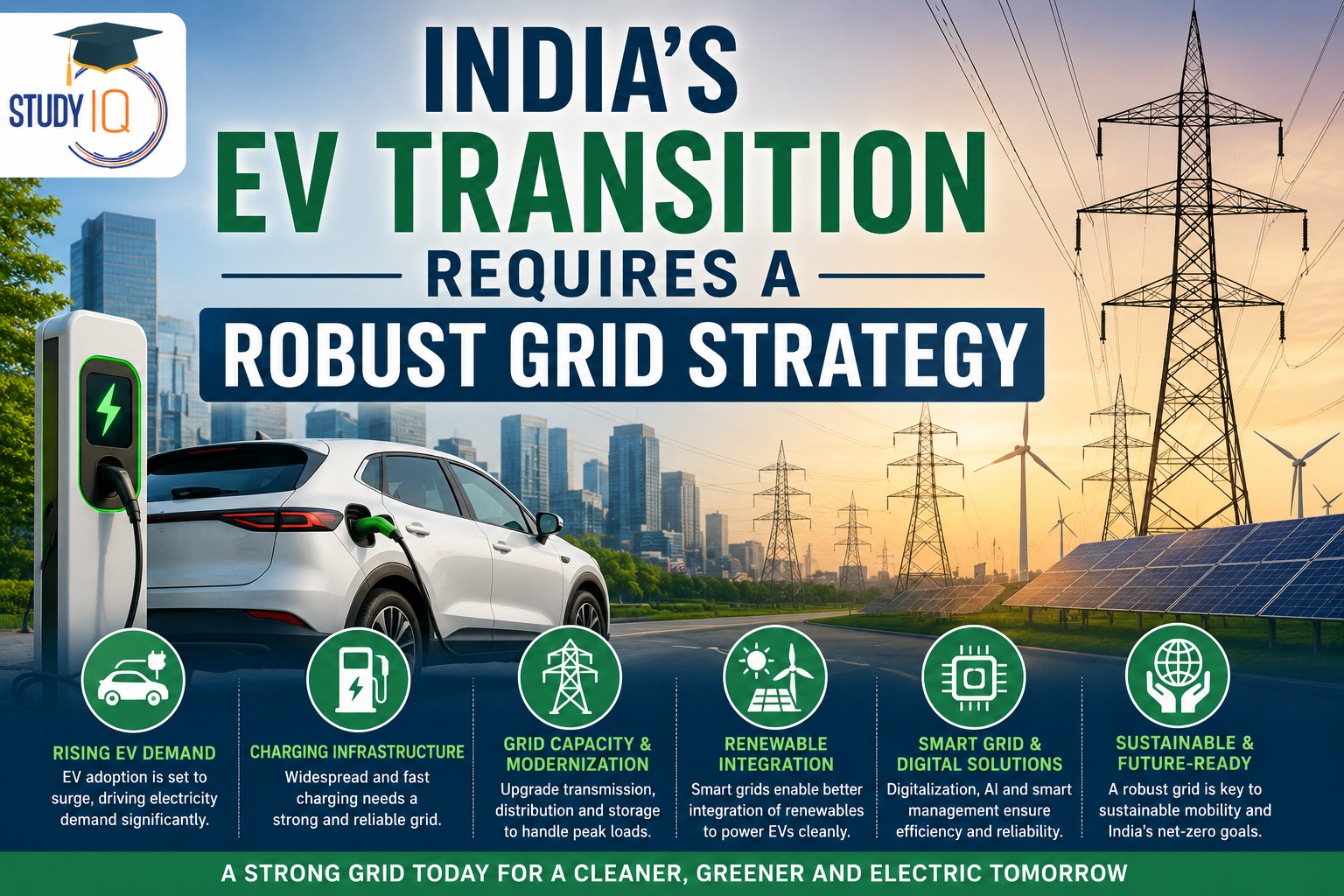
Amid rising volatility in global crude oil prices due to the ongoing West Asian conflict, energy experts have highlighted that India’s electric vehicle (EV) transition cannot succeed without parallel strengthening of the country’s power infrastructure and grid management systems.
|
What is an EV Grid Strategy? |
| ● An EV grid strategy refers to a coordinated framework that integrates transport electrification with electricity generation, transmission, and distribution systems.
● Rather than viewing EVs merely as battery-operated vehicles, the approach treats them as a large and interconnected electricity demand network capable of significantly influencing grid behaviour. |
Read Also: UPSC Daily Current Affairs 2026
Key Data and Statistics on India’s EV and Power Ecosystem
- Rising Electricity Demand from EVs: Electrifying India’s nearly 420 million registered vehicles could require an additional 900–1,100 TWh of electricity annually.
- Achieving even 50% fleet electrification by 2047 may increase yearly electricity demand by nearly 500 TWh, equivalent to about one-third of India’s present power generation.
- Freight Sector’s High Energy Burden: Heavy Goods Vehicles (HGVs) account for only about 2% of India’s vehicle fleet but could consume nearly 450–565 TWh annually if fully electrified because of their high energy requirements.
- Existing Power Capacity: By mid-2026, India’s installed power capacity reached 520.51 GW.
- The country successfully handled a peak demand of 242.49 GW, while non-fossil fuel sources contributed over half of total installed capacity.
India’s Expanding EV Ambition: Key Focus Areas
- Strengthening Freight Corridors: India aims to shift long-distance freight transport away from imported diesel toward domestically generated electricity.
- E.g., electrifying transport networks such as the Golden Quadrilateral requires planning for high-capacity transmission infrastructure before large-scale deployment of electric trucks.
- Moving Beyond the Two-Wheeler-Centric Approach: Policy attention is increasingly shifting toward electrifying commercial transport rather than focusing primarily on personal mobility.
- Eg: Even 309 million electric two-wheelers would account for less than 7% of projected EV electricity demand, highlighting the dominant energy footprint of commercial fleets.
- Managing Peak Electricity Demand: Unregulated charging behaviour can place sudden stress on urban electricity systems.
- Eg: Simultaneous evening charging by millions of EV users around 7 PM may overload local distribution networks, leading to brownouts and higher tariffs.
- Expanding Clean Baseload Power: The additional electricity required for EV charging must increasingly come from clean and reliable energy sources.
- Eg: Combining solar, wind, and emerging technologies such as Micro Modular Nuclear Reactors near highway charging hubs can provide uninterrupted low-carbon power.
- Developing a Circular Battery Economy: India also seeks to establish domestic recycling and reuse systems for EV batteries to reduce import dependence and environmental risks.
Major Initiatives Undertaken
- PM-E-DRIVE Scheme: The scheme serves as the primary incentive mechanism for EV adoption, especially targeting high-impact segments such as electric buses and commercial vehicles.
- National Electricity Plan (NEP) Expansion: India plans to expand its transmission network to 6.48 lakh circuit kilometres by 2032, with an estimated investment of ₹9.15 lakh crore to facilitate renewable integration.
- BIS Interoperable Charging Standards: The Bureau of Indian Standards introduced an India-specific dual-plugin charging standard for electric buses, successfully tested at the Ahmedabad Ranip Depot.
- Smart Meter Rollout under RDSS: Around 4.05 crore smart meters have been installed under the Revamped Distribution Sector Scheme (RDSS), enabling digital monitoring and smarter electricity management.
Key Challenges in Grid Integration
- Financial Stress on Discoms: Many state distribution companies lack adequate financial resources to modernize transformers and substations.
- Eg: Commercial fleet operators often face delays in obtaining high-tension electricity connections because local utilities struggle with infrastructure upgrades.
- Risk of Coal-Based Electrification: If EV charging relies heavily on thermal power, emissions may merely shift from vehicle exhausts to power plants.
- Eg: Greater dependence on coal-fired electricity could replace oil imports with rising coal imports from countries such as Australia and Indonesia.
- Lack of Smart Charging Infrastructure: Many existing chargers do not support real-time communication with the grid.
- Eg: Deploying outdated charging systems today could create costly retrofitting requirements once nationwide smart tariff systems are introduced.
- Sudden Demand Surges: Uncoordinated charging patterns can sharply increase electricity loads during peak periods.
- Eg: Simultaneous charging during extreme summer conditions may destabilize urban grids and damage local infrastructure.
- Uneven Regional Preparedness: EV adoption and renewable integration remain concentrated in a few leading states.
- Eg: States such as Karnataka have achieved relatively high EV adoption, while many populous inland states still lag in grid preparedness.
Way Forward
- Mandatory Smart Charging Standards: Introduce nationwide regulations requiring all EV chargers to support automated and bidirectional communication with the grid.
- Integrated Power and Transport Planning: The Ministry of Power and the Ministry of Road Transport should jointly map future megawatt-scale charging infrastructure along freight corridors.
- Dynamic Time-of-Use Tariffs: Adopt variable electricity pricing systems that encourage consumers to charge EVs during periods of surplus renewable generation, particularly daytime solar hours.
- Linking RDSS Funding with EV Readiness: State discom funding under RDSS should be tied to measurable EV infrastructure and grid modernisation targets.
- Storage-Backed Highway Charging Hubs: Develop Battery Energy Storage Systems (BESS) and pumped-storage hydro facilities near major highway charging stations to ensure a reliable round-the-clock electricity supply.
|
Read More Notes |
|
| Environment Notes | Art and Culture Notes |
| Science and Tech | History Notes |
| Geography Notes | Indian Polity Notes |
| General Knowledge | International Relation |
|
Explore StudyIQ Courses |
|
 Financial Stability in India: RBI’s 5 ...
 Inter-Parliamentary Union (IPU): 153rd A...
 GST 2.0 and Decriminalisation of Tax Off...














 WhatsApp