Table of Contents
Context
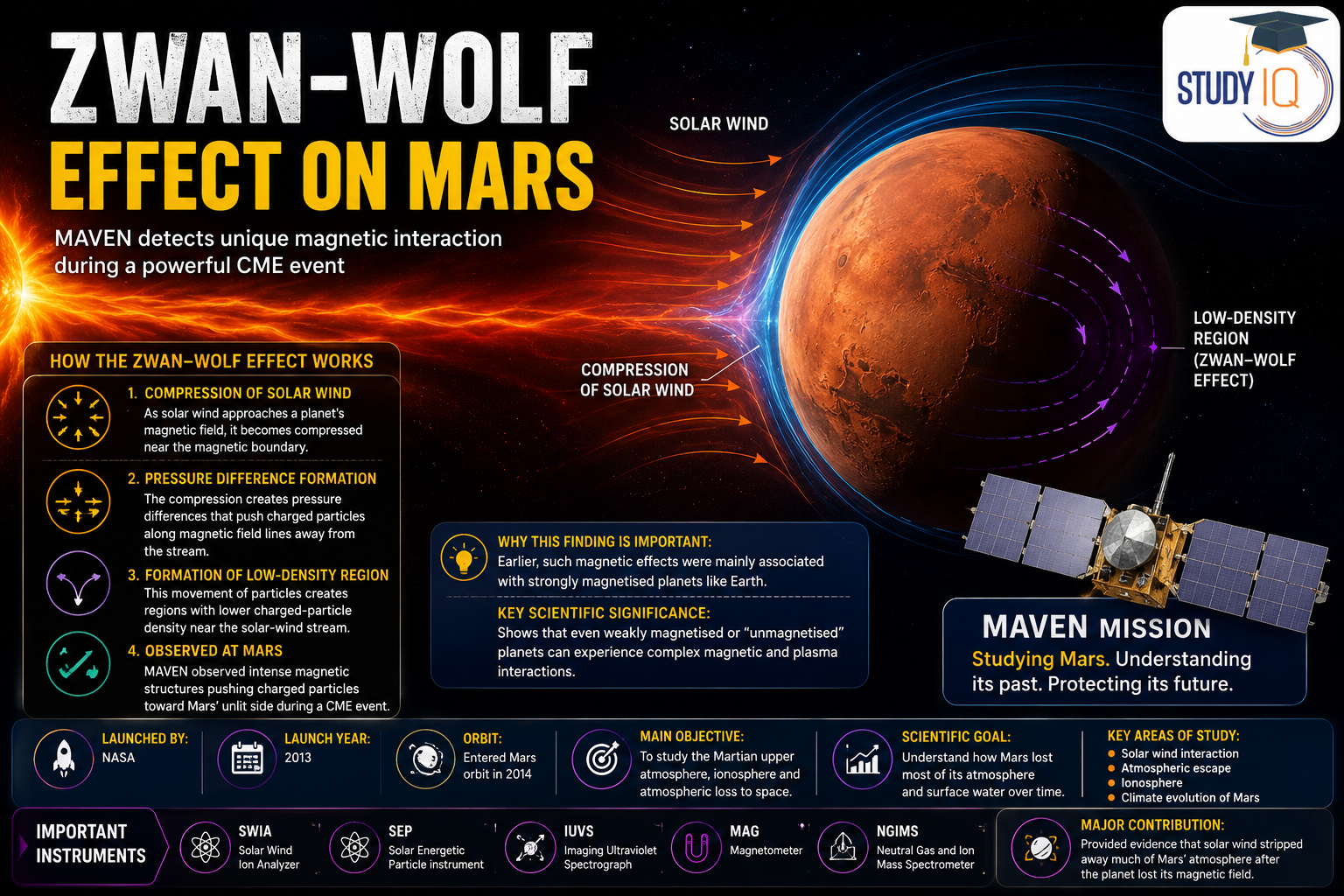
Scientists using Mars Atmosphere and Volatile Evolution (MAVEN) detected the Zwan–Wolf effect on Mars during a powerful Coronal Mass Ejection (CME) event.
Read Also: UPSC Daily Current Affairs 2026
About the Zwan–Wolf Effect
- Meaning: Planetary magnetic fields compress incoming solar wind, creating regions with lower charged-particle density. Ita Process include:
- Compression of Solar Wind: As solar wind approaches a planet’s magnetic field, it becomes compressed near the magnetic boundary.
- Pressure Difference Formation: The compression creates pressure differences that push charged particles along magnetic field lines away from the stream.
- Formation of Low-Density Region: This movement of particles creates regions with lower charged-particle density near the solar-wind stream.
- Observed at Mars: MAVEN observed intense magnetic structures pushing charged particles toward Mars’ unlit side during a CME event.
- Why the Finding Is Important: Earlier, such magnetic effects were mainly associated with strongly magnetised planets like Earth.
- Key Scientific Significance: Shows that even weakly magnetised or “unmagnetised” planets can experience complex magnetic and plasma interactions.
About MAVEN Mission
- Launched By: National Aeronautics and Space Administration (NASA).
- Launch Year: Launched in 2013 aboard an Atlas V rocket.
- Orbit: Entered Mars orbit in 2014.
- Main Objective: To study the Martian upper atmosphere, ionosphere and atmospheric loss to space.
- Scientific Goal: Understand how Mars lost most of its atmosphere and surface water over time.
- Key Areas of Study: Solar wind interaction, atmospheric escape, ionosphere and climate evolution of Mars.
- Important Instruments:
- Solar Wind Ion Analyzer (SWIA)
- Solar Energetic Particle (SEP) instrument
- Imaging Ultraviolet Spectrograph (IUVS)
- Magnetometer (MAG)
- Neutral Gas and Ion Mass Spectrometer (NGIMS)
- Major Contribution: Provided evidence that solar wind stripped away much of Mars’ atmosphere after the planet lost its magnetic field.
|
Read More Notes |
|
| Environment Notes | Art and Culture Notes |
| Science and Tech | History Notes |
| Geography Notes | Indian Polity Notes |
| General Knowledge | International Relation |
|
Explore StudyIQ Courses |
|
 Inter-Parliamentary Union (IPU): 153rd A...
 GST 2.0 and Decriminalisation of Tax Off...
 Tuvalu and Rising Sea Levels: Climate Ch...














 WhatsApp