Table of Contents
Context
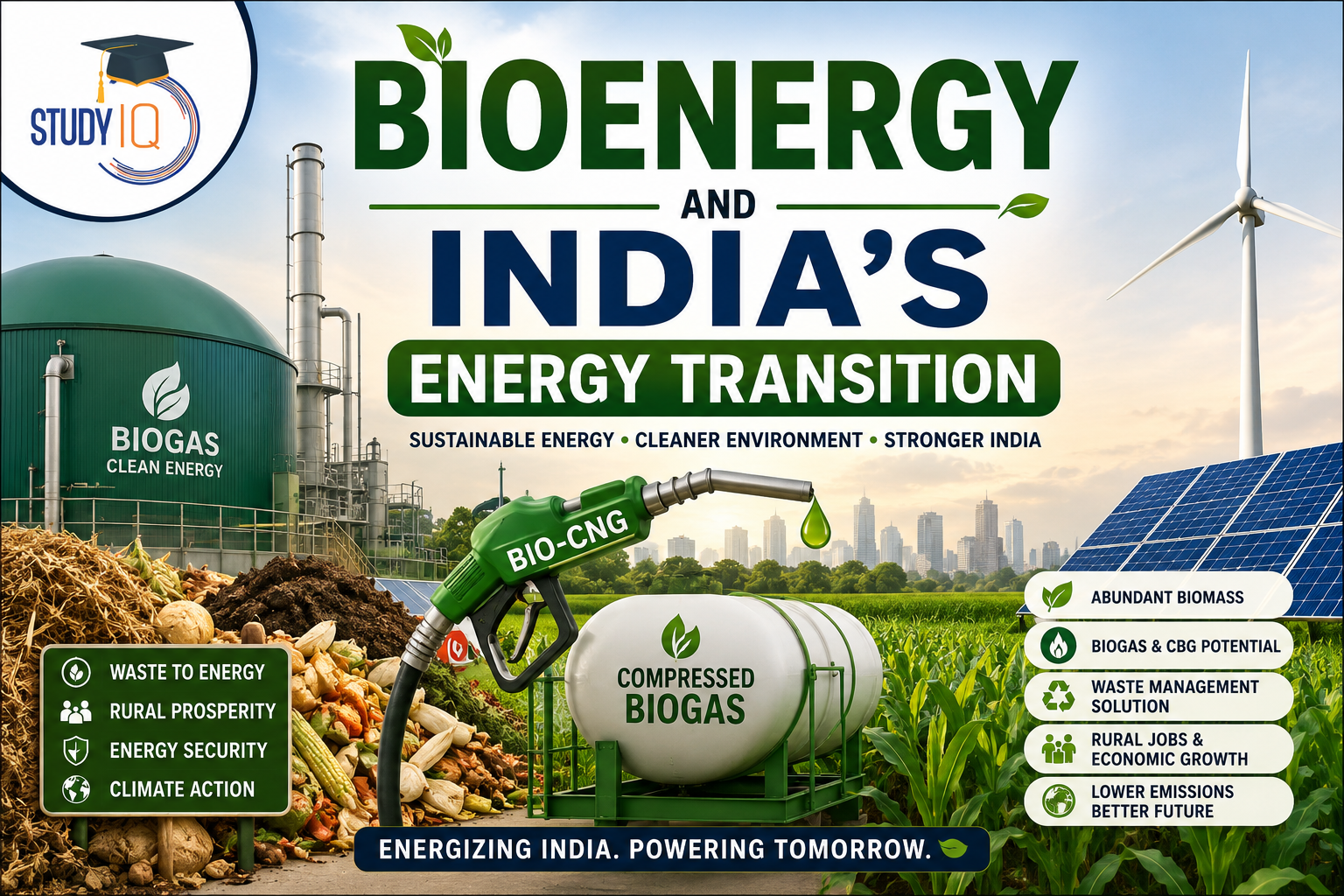
Rising energy-security concerns and waste-management challenges are increasing India’s focus on commercially viable bioenergy solutions.
Read Also: UPSC Daily Current Affairs 2026
Opportunity for Biogas & Bioenergy
- Large Biomass Resource Base: India generates nearly 750 million tonnes of biomass annually, including around 230 million tonnes surplus agricultural biomass.
- Reducing Import Dependence: Efficient biomass utilisation could replace a significant share of fossil-fuel imports. (India imports ~85% crude oil and is among top LNG importers globally)
- CBG Potential: India’s compressed biogas (CBG) potential is estimated at 40–62 MMTPA, but current installed capacity remains below 1% of potential.
- Waste-to-Energy Opportunity: India’s municipal solid waste generation may rise to 165 million tonnes by 2031 and 436 million tonnes by 2050, creating huge feedstock potential.
- Climate & Air Pollution Benefits: Bioenergy can reduce stubble burning, landfill methane emissions and urban air pollution. (Crop-residue burning contributes significantly to winter pollution in North India)
- Rural Economy & Employment: Bioenergy ecosystems support farmers, MSMEs and rural jobs through feedstock aggregation and decentralised energy systems. (CBG projects in Odisha alone estimated to generate ~21,000 jobs by 2030)
Various Technologies for Bioenergy
- Gasification
- Suitable Feedstock: Best suited for dry biomass such as crop residue, husk, woody biomass and solid organic waste.
- Process: Biomass undergoes drying, pyrolysis and partial oxidation at 800–1000°C to produce syngas.
- Output & Uses: Produces syngas used for heat, electricity, methanol, ethanol, renewable methane and hydrogen production. (Important for future clean-fuel ecosystems)
- Additional Benefit: Produces biochar for soil enhancement and carbon sequestration.
- Anaerobic Digestion
- Suitable Feedstock: Best suited for sewage, food waste, animal manure and industrial organic waste.
- Process: Microorganisms decompose organic matter in oxygen-free conditions to produce biogas.
- Output: Produces methane-rich biogas and nutrient-rich digestate. (Useful for cooking fuel, electricity and bio-CNG production)
- Key Applications: Relevant for dairy clusters, urban waste systems, sewage plants and agro-industrial hubs.
Challenges
- Feedstock Variability: Biomass differs in moisture, density and ash content, reducing efficiency and operational reliability.
- Poor Waste Segregation: Only around 50% of collected municipal waste undergoes proper treatment in India.
- High Logistics Costs: Transporting bulky biomass over long distances reduces economic viability. (Biomass collection remains fragmented and seasonal)
- Low Technology Penetration: India’s bioenergy deployment remains far below potential despite abundant feedstock availability.
- Policy & Financing Gaps: Investors face uncertainty regarding feedstock supply, pricing mechanisms and long-term policy stability.
- Operational Challenges: Anaerobic digestion requires continuous feedstock supply and stable biological conditions for efficient operation.
Government Schemes & Initiatives for Biogas
- SATAT Scheme (2018): Launched by the Ministry of Petroleum & Natural Gas to promote production of Compressed Biogas (CBG) from biomass and waste. (Target: 5,000 CBG plants; implemented through OMCs like IOCL, BPCL and HPCL)
- GOBARDhan Scheme: Launched under Swachh Bharat Mission to convert cattle dung and organic waste into biogas, CBG and bio-fertilisers. (Focus on circular economy and rural sanitation)
- National Bioenergy Programme: Implemented by the Ministry of New and Renewable Energy (MNRE) for promoting waste-to-energy, biomass briquettes, pellets and biogas plants. (Approved outlay: ₹1,715 crore for Phase-I)
- Waste-to-Energy Programme: Supports projects converting urban, industrial and agricultural waste into biogas, bio-CNG and electricity. (Promotes scientific waste management)
Way Forward
- Integrated Waste Management: Match suitable technologies with appropriate feedstock — gasification for dry waste and digestion for wet waste.
- Expand Decentralised Energy Systems: Promote localised bioenergy plants for villages, MSMEs and agro-industrial clusters. (Reduces logistics cost and improves rural energy access)
- Strengthen Policy Support: Expand SATAT, GOBARDhan and CBG blending obligations with long-term regulatory certainty.
- Improve Waste Segregation & Collection: Strengthen municipal segregation and feedstock aggregation systems for reliable supply chains.
- Promote Carbon Markets & Incentives: Expand carbon-credit mechanisms and financial incentives for bioenergy projects. (CBG already included under carbon-credit trading framework)
- Invest in R&D & Innovation: Support advanced gasification, biomethane upgrading and hydrogen-from-biomass technologies for future clean-energy systems.
|
Read More Notes |
|
| Environment Notes | Art and Culture Notes |
| Science and Tech | History Notes |
| Geography Notes | Indian Polity Notes |
| General Knowledge | International Relation |
|
Explore StudyIQ Courses |
|
 Inter-Parliamentary Union (IPU): 153rd A...
 GST 2.0 and Decriminalisation of Tax Off...
 Tuvalu and Rising Sea Levels: Climate Ch...











 WhatsApp