Table of Contents
Context
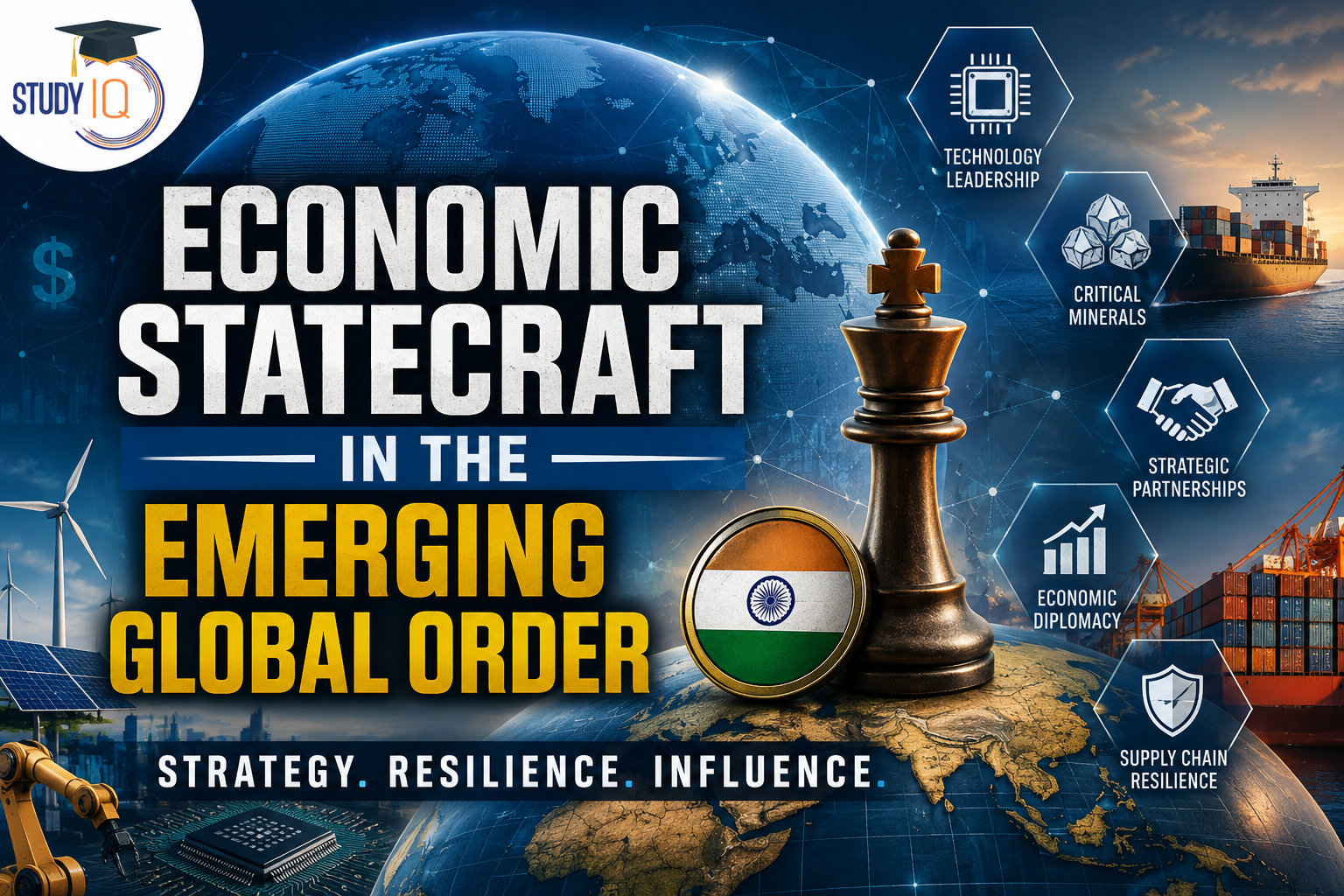
Globalisation is increasingly being shaped by strategic competition, where supply chains, technology ecosystems, critical minerals and trade networks are becoming instruments of geopolitical power.
Read Also: Judiciary Current Affairs
Emergence of a Geoeconomic World Order
- Fusion of Economics and Security: Economic tools such as tariffs, export controls, sanctions and technology restrictions are now central instruments of statecraft.
- g.: U.S.-China trade war, semiconductor restrictions, rare-earth export controls
- Shift from Efficiency to Resilience: Countries are prioritising secure and diversified supply chains over purely low-cost globalisation. (g: friend-shoring, near-shoring, supply-chain resilience initiatives)
- Decline of Traditional Multilateralism: WTO-led universal trade frameworks are weakening as countries increasingly rely on bilateral and mini-lateral economic arrangements.
- g.: IPEF, Indo-Pacific partnerships, regional economic coalitions
- Strategic Importance of Technology & Minerals: Semiconductors, AI, batteries and critical minerals are emerging as decisive sources of geopolitical influence. (g.: CHIPS Act, lithium diplomacy)
- Rise of Economic Nationalism: Major powers are increasingly using industrial policy, subsidies and domestic manufacturing promotion to secure strategic autonomy.
- g. U.S. Inflation Reduction Act, EU strategic autonomy policies)
Why India is Gaining Strategic Importance
- Alternative Manufacturing Hub: Global firms seeking diversification beyond China view India as a large and relatively stable production base. (E.g.: Apple supply-chain expansion, electronics manufacturing growth)
- Demographic & Market Advantage: India combines a large workforce with one of the world’s fastest-growing consumer markets.
- Digital Governance Model: India’s Digital Public Infrastructure (DPI) model is emerging as a globally recognised governance framework. (E.g. UPI, Aadhaar, DigiLocker)
- Technology & Innovation Ecosystem: India is becoming a key hub for AI, Global Capability Center (GCC), semiconductor design and engineering services.
- g. India hosts 2,117 GCCs and over 250 AI/ML Centres of Excellence)
- Democratic Strategic Partner: India is increasingly viewed as a trusted democratic alternative in an uncertain geopolitical environment.
India’s Geoeconomic Strategy
- Multi-Alignment Diplomacy: India is diversifying economic partnerships without exclusive bloc alignment. (Engagement with U.S., EU, Gulf, ASEAN, Russia and Global South simultaneously)
- Supply-Chain Resilience Policies: Focus on domestic manufacturing and reducing vulnerabilities in critical sectors. (Examples: PLI schemes, semiconductor mission, logistics reforms)
- Technology Partnerships: India is deepening strategic cooperation in semiconductors, AI, telecom and clean technologies. (g.: India-U.S. semiconductor initiative, Quad critical technologies)
- Critical Mineral Outreach: Building overseas resource partnerships to secure lithium, cobalt and rare-earth supply chains. (g.: Agreements with Australia and Argentina)
- Economic Diplomacy as Foreign Policy Tool: Trade agreements and connectivity projects are increasingly integrated into strategic policy. (g.: IMEC corridor, FTAs with UAE and Australia)
Structural Challenges Before India
- Import Dependence: India remains dependent on external sources for semiconductors, critical minerals and advanced technologies.
- Infrastructure & Logistics Bottlenecks: High logistics costs and uneven industrial infrastructure affect competitiveness. (Logistics costs around 13–14% of GDP)
- Weak R&D Ecosystem: Low investment in research and innovation constrains technological leadership. (R&D expenditure around 0.7% of GDP)
- Limited High-End Manufacturing: India’s integration into advanced global value chains remains below East Asian economies.
- Balancing Geopolitical Pressures: Simultaneous engagement with competing powers creates diplomatic and economic constraints.
Way Forward
- Build Competitive Manufacturing Ecosystems: Improve logistics, industrial clusters, ease of doing business and energy reliability.
- Strengthen Innovation Capacity: Expand investment in R&D, semiconductors, AI and emerging technologies.
- Deepen Strategic Trade Partnerships: Pursue diversified FTAs and resilient supply-chain coalitions.
- Develop Skilled Human Capital: Align higher education and skilling with advanced manufacturing and technology sectors.
- Preserve Strategic Autonomy: Maintain diversified economic engagement while avoiding overdependence on any single power bloc.
|
Read More Notes |
|
| Environment Notes | Art and Culture Notes |
| Science and Tech | History Notes |
| Geography Notes | Indian Polity Notes |
| General Knowledge | International Relation |
|
Explore StudyIQ Courses |
|
 US Treasury Yields at 25-Year High: Impa...
 National Coastal Mission 2.0 (NCM 2.0): ...
 New CAFE Norms 2027–32: Key Features, ...











 WhatsApp