Table of Contents
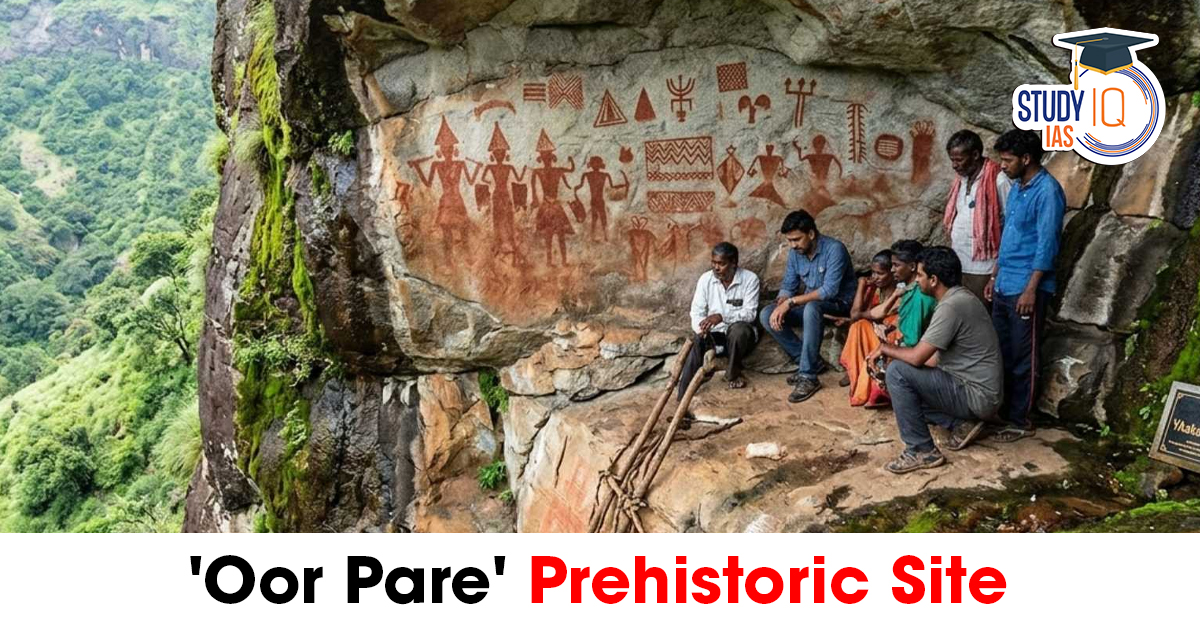
Context: Researchers from the Yaakai Heritage Trust have rediscovered a significant prehistoric rock art site named ‘Oor Pare’ in the Nilgiris.
About Oor Pare Prehistoric Site
The Oor Pare Prehistoric Site is an important archaeological location that sheds light on early human habitation in the high-altitude regions of Ladakh. Known for its prehistoric rock engravings and cultural remains, the site provides valuable insights into the lifestyle, beliefs, and environment of ancient communities.
- Location: Situated northwest of the famous Vellarikombai village in Kotagiri, Nilgiris district, Tamil Nadu. It lies at an elevation of approximately 1,100 metres above sea level.
- Indigenous Significance: The site is considered sacred by the Irula and Kurumba tribal communities.
- Paintings at Oor Pare:
- Executed in red ochre, a natural earth pigment used extensively in prehistoric art.
- Figures: 30 types—anthropomorphic (conical headgear), elongated “ladder-like” forms, and dotted rectangular ritual symbols.
| Petroglyphs vs. Pictographs |
| While “Oor Pare” features pictographs (paintings on rock), petroglyphs are images created by carving or incising the rock surface (prominent in the Konkan region). |
Key Features of Oor Pare Site
- Rock Art (Petroglyphs): The site contains carvings depicting animals, hunting scenes, and symbolic patterns
- Evidence of Early Human Activity: Indicates the presence of prehistoric communities in harsh Himalayan conditions
- Cultural Significance: Reflects early artistic expression and social practices
Historical Importance
The Oor Pare site is significant because it:
- Helps trace human migration patterns in the Himalayan region
- Offers clues about the climatic and environmental conditions of prehistoric times
- Contributes to the broader study of ancient civilisations in India
Archaeological Value
Researchers study the site to understand:
- Evolution of human settlements in high-altitude zones
- Interaction between humans and wildlife
- Development of early symbolic communication through rock art
Conservation Concerns
- Natural erosion and weathering
- Lack of awareness and protection
- Need for preservation and documentation
Conclusion
The Oor Pare Prehistoric Site stands as a testament to early human resilience and creativity in extreme environments. Protecting such sites is crucial for preserving India’s rich prehistoric heritage and advancing archaeological research.

 16 Mahajanapadas: List, Capitals, Locati...
 Ghaznavid Empire in Punjab: History, Rul...
 Samvatsari Parva 2026: Know the Signific...














 WhatsApp