Table of Contents
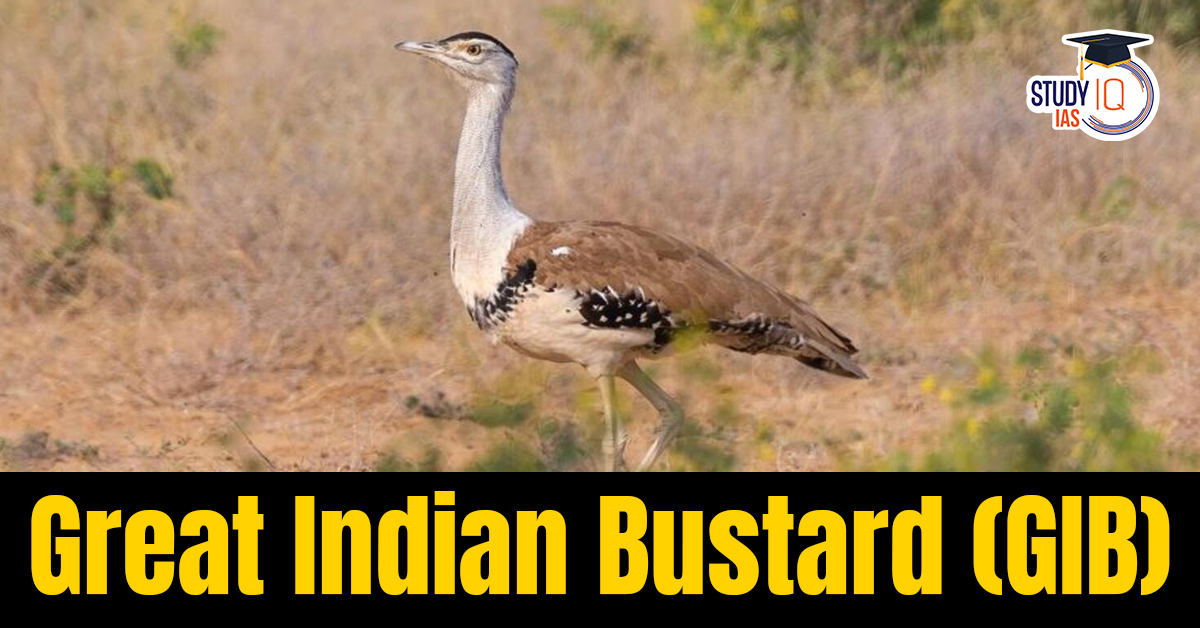
Context: To overcome the biological hurdle of Gujarat’s surviving wild Great Indian Bustards (GIB) being exclusively female, conservationists successfully deployed the ‘Jumpstart Method’ to produce the first chick in the state in over a decade.
|
About Jumpstart Method |
|
About Great Indian Bustard (GIB)
- Great Indian Bustard (GIB) is endemic to the Indian subcontinent.
- Habitat: open grasslands, arid plains and scrub forests.
- Range: Its population is confined mostly to Rajasthan and Gujarat. A small population found in Maharashtra, Karnataka and Andhra Pradesh.
- Distribution: Primarily found in the arid grasslands of Rajasthan (Desert National Park), which holds the last viable breeding population; also found in small pockets of Gujarat, Madhya Pradesh, Karnataka, and Andhra Pradesh, as well as parts of Pakistan.
Features of GIB
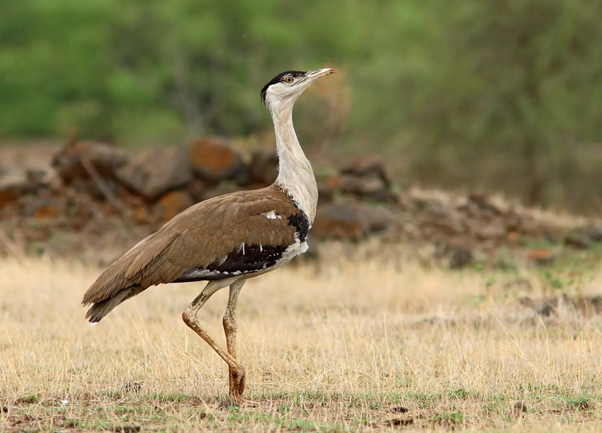
- Males have a distinctive black crown, a long neck, and a buff-coloured body with white underparts.
- Females are generally smaller and lack the prominent black crown.
- One of the heaviest flying birds, weighing between 10 to 15 kg.
- It is primarily omnivorous. It feeds on insects like grasshoppers, beetles and sometimes even small rodents and reptiles. It also feeds on grass seeds.
- Among the heaviest flying birds in the world, often compared to an ostrich in appearance, it is an omnivorous ground-dweller (locally known as Godawan) that serves as an indicator species for the health of the grassland ecosystem.
Conservation Status of GIB
- IUCN status: Critically Endangered
- Wildlife Protection Act, 1972: Schedule I
- CITES: Appendix 1
- Covered under the species recovery program.
- Only less than 150 GIBs are left in the wild and are almost exclusively restricted to India.
Threats
- Power lines (disturb visibility)
- Habitat destruction and fragmentation, & Overgrazing.
Steps taken to Conserve Great Indian Bustard (GIB)
- Species Recovery Programme: It is kept in the species recovery programme under the Integrated Development of Wildlife Habitats of the Ministry of Environment, Forests and Climate Change (MoEFCC).
Firefly Bird Diverters
- Firefly bird diverters are flaps installed on power lines.
- They work as reflectors for bird species like the GIB. Birds can spot them from a distance of about 50 meters and change their path of flight to avoid collision with power lines.
Artificial Hatching
- The conservation breeding programme started in 2019 by collecting eggs from the wild and artificially hatching them.
- The first chick, named ‘Uno,’ hatched on 21 June 2019. Eight more chicks were hatched that year and raised and monitored. A total of 29 GIBs have been housed in the two breeding centres in Rajasthan.
Conservation Efforts
- Project Great Indian Bustard by the Rajasthan Government.
- Included under the “Recovery Programme for Critically Endangered Species” by the Ministry of Environment.
- Supreme Court Intervention: Mandatory installation of bird diverters on power lines to prevent electrocution—the biggest threat to their survival.
- State Bird of Rajasthan.
| Note |
| Sam Grasslands: Situated in the Jaisalmer district, within the Desert National Park (DNP). It houses a sophisticated Captive Breeding Centre, where eggs are collected from the wild, incubated, and hatched under scientific supervision.
Naliya Grasslands: Located in the Kutch district of Gujarat, specifically within the Lala-Parjan sanctuary area. |
| UPSC PYQ |
Q. With reference to India’s Desert National Park, which of the following statements is correct? (2020)
Select the correct answer using the code given below: (a) 1 and 2 only (b) 2 and 3 only (c) 1 and 3 only (d) 1, 2 and 3 Answer: C |

 Skyroot Vikram-1 Mission Aagaman: India'...
 Oor Pare Prehistoric Site: Location, Roc...
 Assam Election 2026: Exit Poll, Result D...














 WhatsApp