
Table of Contents
The Prime Minister of India is the head of the government and the most powerful executive authority in the country. Since its independence in 1947, India has had multiple Prime Ministers who have shaped the nation’s political, economic, and social landscape. As of 2026, Narendra Modi is serving as the current Prime Minister of India (since 2014).
The article provides a comprehensive list of Prime Ministers of India since 1947, including tenure dates, political party affiliations, and key achievements during their time in office. Learn who the current Prime Minister of India is in 2026.
Current Prime Minister of India (2026)
- Name: Narendra Modi
- Party: Bharatiya Janata Party (BJP)
- Tenure: 2014 – Present
- Position: 14th Prime Minister of India
As of June 2026, the current Prime Minister of India is Shri Narendra Modi. He was sworn in for his third consecutive term on June 9, 2024, following the general elections held earlier that year.
Narendra Modi is only the second Indian Prime Minister to achieve three consecutive terms, following Jawaharlal Nehru. His leadership has been marked by significant economic reforms, infrastructure development, and a focus on digital initiatives. In his third term, Modi continues to emphasise India’s role on the global stage, including plans to attend the upcoming BRICS summit in Brazil.
| Important Facts About Prime Ministers of India |
|
List of Prime Ministers of India (1947-2026)
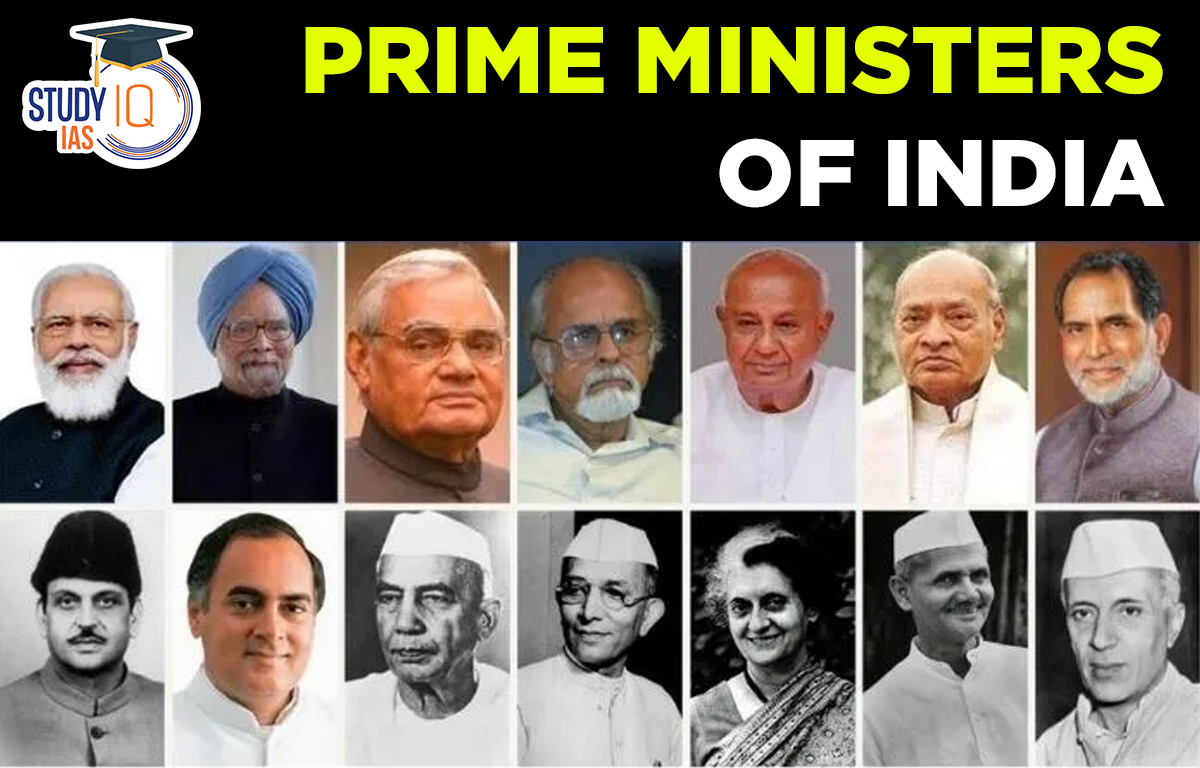
Here is the updated List of Prime Ministers of India from 1947 to 2026.
| S.No. | Names | Birth-Death | Tenure | Party |
Interesting Facts |
| 1 | Jawahar Lal Nehru | (1889–1964) | 15 August 1947 – 27 May 1964; 16 years, 286 days. | INC | Prime Minister of independent India for the first and longest period. First, the in-office death of a prime minister. |
| 2 | Gulzarilal Nanda | (1898–1998) | 27 May 1964 to 9 June 1964; 13 days. | After Nehru’s untimely death, the nation’s first acting prime minister assumed control. | |
| 3 | Lal Bahadur Shastri | (1904–1966) | 9 June 1964 to 11 January 1966; 1 year, 216 days. | INC | During the Indo-Pak war in 1965, he was the originator of the phrase “Jai Jawan Jai Kisan.” |
| 4 | Gulzarilal Nanda | (1898-1998) | 11 January 1966, 24 January 1966; 13 days. | The only man to have twice served as acting prime minister of India. | |
| 5 | Indira Gandhi | (1917–1984) | 24 January 1966 to 24 March 1977; 11 years, 59 days. | INC | The Indian prime minister’s spouse, who took the oath of office |
| 6 | Morarji Desai | (1896–1995) | 24 March 1977 – 28 July 1979; 2 years, 126 days. | Janata Party | First PM in 1977 following the emergency. At 81 years old, India’s oldest prime minister took the oath of office before resigning. His birthday was celebrated once every four years because he was born on February 29. |
| 7 | Charan Singh | (1902–1987) | 28 July 1979 to 14 January 1980; 170 days. | Janata Party (Secular) | Only the PM who has never addressed the legislature |
| 8 | Indira Gandhi | (1917–1984) | 14 Jan.1980 to 31 Oct. 1984; 4 years, 291 days. | INC | Following the disaster in 1977, the first PM returned to power in 1980. Like her father, she also passed away while in office. |
| 9 | Rajiv Gandhi | (1944–1991) | 31 Oct 1984 to 2 Dec 1989; 5 years, 32 days. | INC | At the age of 40, he became India’s youngest prime minister. |
| 10 | V. P. Singh | (1931–2008) | 2 Dec 1989 to 10 Nov 1990; 343 days. | Janata Dal | First prime minister to leave following a no-confidence vote |
| 11 | Chandra Shekhar | (1927–2007) | 10 Nov 1990 to 21 June 1991; 223 days. | Samajwadi Janata Party | He has never held a position of minister in any ministry. |
| 12 | P. V. Narasimha Rao | (1921–2004) | 21 June 1991 to 16 May 1996; 4 years, 330 days. | INC | He was from Andhra Pradesh and served as the nation’s first South Indian prime minister. |
| 13 | Atal Bihari Vajpayee | (1924-2018) | 16 May 1996 to 1 June 1996; 16 days. | BJP | The shortest tenure of any Indian PM is 16 days as PM. |
| 14 | H. D. Deve Gowda | (born 1933) | 1 June 1996 to 21 April 1997; 324 days. | Janta Dal | He succeeded as South India’s second prime minister. He is a Karnataka native. But he didn’t work there for more than a year. |
| 15 | Inder Kumar Gujral | (1919–2012) | 21 April 1997 to 19 March 1998; 332 days. | Janata Dal | After Indra Gandhi and Deve Gowda, the third Prime Minister to come from the Upper House. |
| 16 | Atal Bihari Vajpayee | (born 1924-2018) | 19 March 1998 to 22 May 2004; 6 years, 64 days. | BJP | First non-Congress Prime Minister of independent India to serve out his full tenure |
| 17 | Manmohan Singh | (born 1932) | 22 May 2004 to 26 May 2014; 10 years, 4 days. | INC | First PM of India from the minority community. |
| 18 | Narendra Modi | (born 1950) | 26 May 2014- (Incumbent) | BJP | 3rd time Prime Minister other than Jawaharlal Nehru |
Timeline of Prime Ministers of India
- 1947–1964: Jawaharlal Nehru
- 1964–1966: Lal Bahadur Shastri
- 1966–1977: Indira Gandhi
- 1977–1979: Morarji Desai
- 1979–1980: Charan Singh
- 1980–1984: Indira Gandhi
- 1984–1989: Rajiv Gandhi
- 1989–1990: V. P. Singh
- 1990–1991: Chandra Shekhar
- 1991–1996: P. V. Narasimha Rao
- 1996–1998: Coalition Era Begins
- 1998–2004: Atal Bihari Vajpayee
- 2004–2014: Manmohan Singh
- 2014–Present: Narendra Modi
Longest Serving PM of India
The longest-serving Prime Minister of India is Jawaharlal Nehru. He was India’s first Prime Minister and held the office from Independence until he died in 1964.
- Tenure: August 15, 1947 – May 27, 1964
- Duration: Nearly 17 years (exactly 16 years, 286 days)
PM Modi Becomes India’s Second Longest-Serving Prime Minister
- As of July 25, 2025, PM Narendra Modi has spent 4,078 continuous days in office, breaking the earlier record of 4,077 days by Indira Gandhi.
- Modi is only behind Jawaharlal Nehru, who had served for 16 years and 286 days from 1947 to 1964.
- PM since: May 26, 2014 (currently serving third term since June 2024)
Achievements:
- First Prime Minister born after the independence of India
- Longest non-Congress-serving Prime Minister
- Only non-Congress party leader to win three successive Lok Sabha elections, all in majority (2014, 2019, 2024)
| Rank | Prime Minister | Continuous Tenure |
|---|---|---|
| 1 | Jawaharlal Nehru | ~16 years, 286 days |
| 2 | Narendra Modi | 4,078 days (as of July 25, 2025) |
| 3 | Indira Gandhi | 4,077 days |
| 4 | Manmohan Singh | 10 years, 4 days |
Important Information about Prime Minister of India
| Aspect | Details |
| First Prime Minister of India | The First Prime Minister of India was Pandit Jawaharlal Nehru. On 15 August 1947, Lord Mountbatten picked him. He was a Freedom Fighter in India’s independence. He also belonged to the Indian National Congress Party. He was a Member of Parliament from Phulpur. He served in office from 15 August 1947 to 15 April 1952 during his first term. |
| First Woman Prime Minister of India | The first woman Prime Minister of India was Indira Gandhi. She served from 1966 to 1977 and then again from 1980 until she was assassinated in 1984. She was the daughter of Jawaharlal Nehru, who was the first Prime Minister of India. Indira Gandhi had a big impact on India’s politics during her time in office. |
| Oldest Prime Minister of India | Morarji Desai was India’s oldest Prime Minister, serving at 81 from 1977 to 1979. He was born on 29 February 1896 and held various significant positions in government throughout his career, including Chief Minister of Bombay State, Home Minister, Finance Minister, and Deputy Prime Minister before assuming the role of Prime Minister. Desai’s tenure is notable for his peace activism and efforts to improve relations with neighbouring countries like Pakistan and China. |
List of Prime Ministers’ Tenure
| Name | Political Party | Length of term |
| Jawaharlal Nehru | INC | 16 years, 286 days |
| Indira Gandhi | INC/INC(I)/INC(R) | 11 years, 59 days |
| Narendra Modi | BJP | Incumbent |
| Manmohan Singh | INC | 10 years, 4 days |
| Atal Bihari Vajpayee | BJP | 6 years, 64 days |
| Rajiv Gandhi | INC(I) | 5 years, 32 days |
| P. V. Narasimha Rao | INC(I) | 4 years, 330 days |
| Morarji Desai | JP | 2 years, 126 days |
| Lal Bahadur Shastri | INC | 1 year, 216 days |
| Vishwanath Pratap Singh | JD | 343 days |
| Inder Kumar Gujral | JD | 332 days |
| H. D. Deve Gowda | JD | 324 days |
| Chandra Shekhar | SJP(R) | 223 days |
| Charan Singh | JP(S) | 170 days |
| Gulzarilal Nanda | INC | 13 days |
Also Check: List of Finance Ministers of India
Key Highlights and Analysis
Coalition Era in India
- Began in 1989
- Saw multiple short-term governments
Economic Reforms Era
- Initiated during P. V. Narasimha Rao’s tenure (1991)
Modern Political Era
- Dominated by stable governments post-2014
Prime Minister of India Facts
| Important Facts | |
| Longest-serving Prime Minister of India | Jawaharlal Nehru (1947 – 1964) |
| India’s second-longest-serving Prime Minister | Narendra Modi |
| Two times as acting Prime Minister | Gulzari Lal Nanda |
| The Bharat Ratna was awarded to the first Female Prime Minister | Indira Gandhi |
| First Prime Minister of India who was not a member of the Congress | Morarji Desai |
| The highest civilian honour in Pakistan was given to the Indian Prime Minister | Morarji Desai |
| India’s youngest Prime Minister | Rajiv Gandhi |
| First South Indian Prime Minister | P.V. Narasimha Rao |
| First Prime Minister of India who was a member of the Rajya Sabha | Indira Gandhi |

 Right to Vote vs. Right to Contest: Key ...
 Whip System in India: Meaning, Types and...
 Delimitation Process: Meaning, Southern ...


 WhatsApp





