
Table of Contents
Context: The Congress directed all its Lok Sabha MPs through a strict three-line whip to ensure full attendance and back the party’s position during a special three-day parliamentary session focused on amending the women’s reservation law and undertaking delimitation based on the 2011 Census.
About Whip
A whip is a formal direction issued by a political party instructing its members to be present for a vote or to vote in a specified manner. In India, all political parties can issue such directives to their legislators.
Each party designates a senior member from its parliamentary group as the Chief Whip, who is responsible for issuing these instructions. The Chief Whip is supported by other whips.
Origin of Whip System
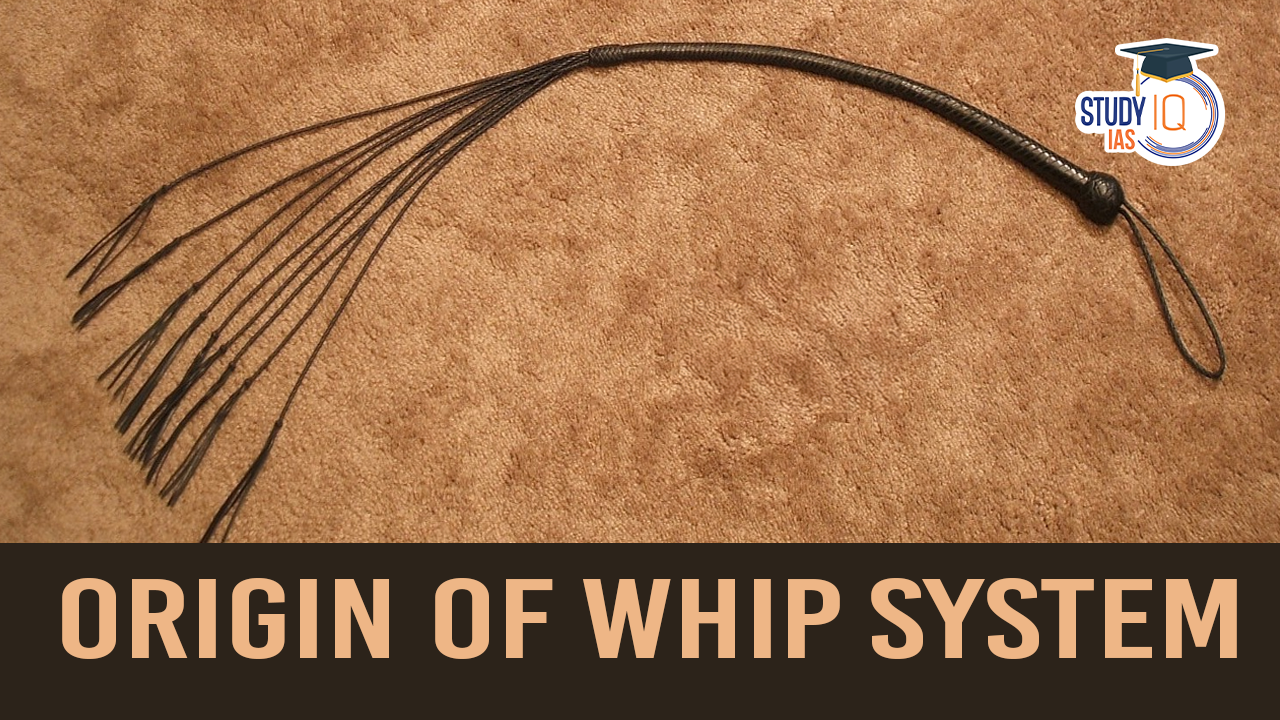
- The term “whip” originates from the hunting fields of England, where a “whipper-in” would bring straying hounds back into the pack.
- The term was later adopted in politics by Edmund Burke, who referred to it in the context of gathering followers to support the King’s ministers.
About Whip System in India
- The whip system has been a part of India’s parliamentary history since the country’s independence.
- This post is neither mentioned in the rules of houses nor in the constitution. It owes its origin to parliamentary conventions.
- They are appointed by respective political parties.
- The Minister of Parliamentary Affairs is the Chief Whip of Government.
Function
- The whip ensures attendance and party-line voting during critical votes in Parliament, especially when a division (counting votes) is held on matters crucial to the party’s agenda.
- Violating a whip, particularly a strict three-line whip, can lead to disqualification under the Anti-Defection Law.
Check here: Functions of Whip
Types of Whips
- One-Line Whip: Informs MPs about a vote but allows abstention.
- Two-Line Whip: Directs MPs to be present but does not instruct on how to vote.
- Three-Line Whip: Requires MPs to be present and vote strictly according to the party line. This is the most commonly used whip and has the strictest enforcement.
| Global Practices |
| United Kingdom (UK): In UK, breaking the three-line whip leads to a person’s expulsion from the party; however, the member may continue serving as an independent member of Parliament until the party accepts him/her back |
Constitutional Status
The position of a whip is not explicitly provided for in the Constitution of India, parliamentary rules, or any statute. It operates on established parliamentary conventions.
Functions of a Whip
- Ensures members vote in line with party decisions.
- Communicates the party’s stance and gauges members’ opinions.
- Maintains discipline within the party in the legislature.
- Secures the attendance of members during proceedings.
- Detects and reports dissatisfaction among legislators to party leadership.
- Prepares and circulates lists of speakers for debates and legislative business.
- Acts as a key link in maintaining party cohesion within Parliament.
Key Supreme Court Judgements
- Kihoto Hollohan v. Zachillhu (1992): The Supreme Court upheld the validity of the Tenth Schedule (anti-defection law) and affirmed that parties can direct members through whips, though such power is not unlimited and must align with constitutional principles.
- Rajendra Singh Rana v. Swami Prasad Maurya (2007): The Court ruled that a whip cannot be issued for a private member’s bill, as such proposals are introduced by individual legislators, not parties.
- Jagjit Singh v. State of Haryana (2006): The Court clarified that the issuance of a whip and actions taken for its violation are subject to judicial review, and must adhere to principles of fairness and natural justice.

 Anti-Defection Law: Origin, Provisions o...
 Central Information Commission (CIC): Ap...
 Panchayati Raj Institutions (PRI): Evolu...














 WhatsApp





