
Table of Contents
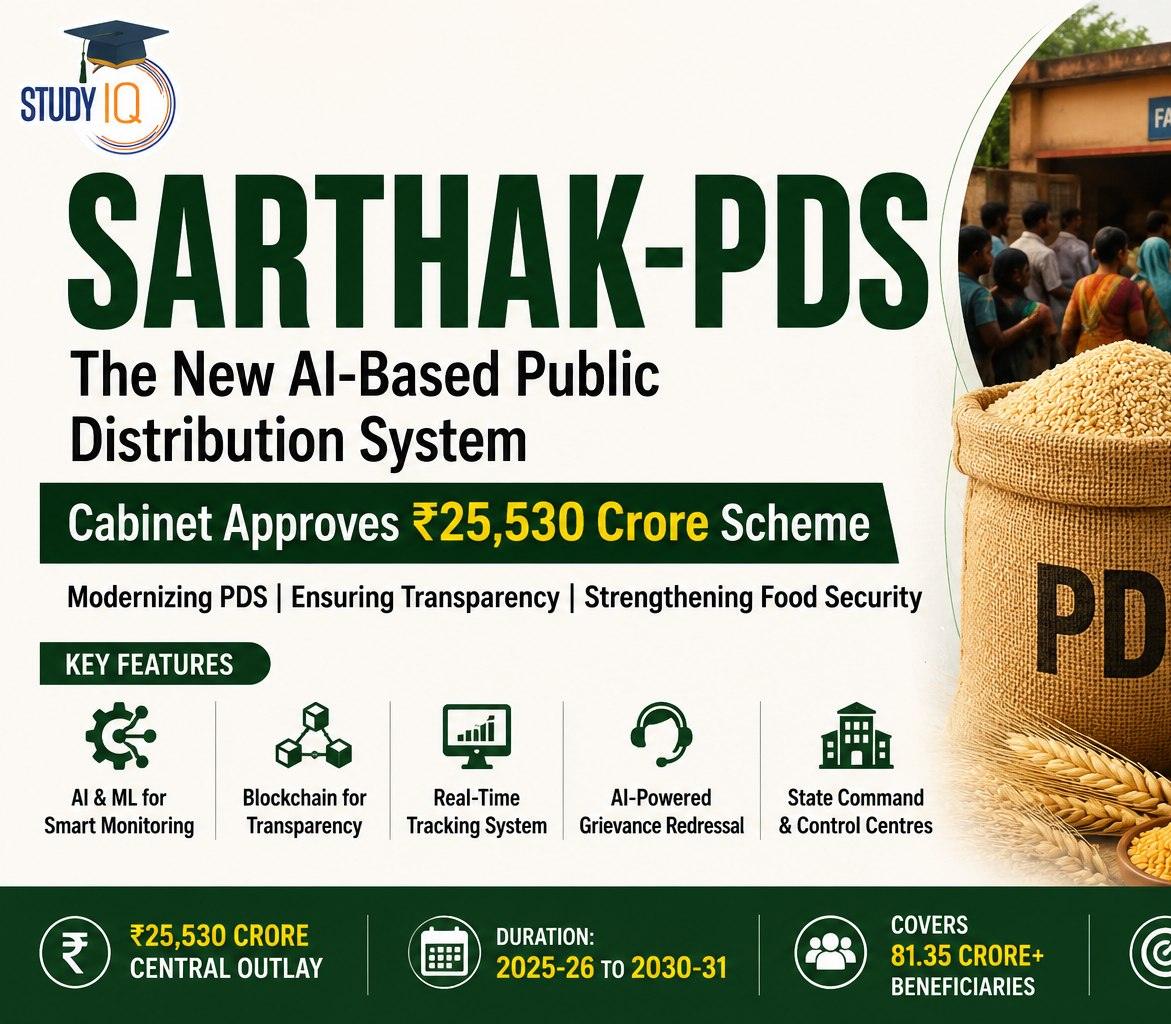
The Union Government has approved the ambitious SARTHAK-PDS scheme with a massive budget allocation of ₹25,530 crore to modernize India’s Public Distribution System (PDS). The scheme aims to improve foodgrain distribution, reduce leakages, enhance transparency, and strengthen food security delivery through advanced technologies such as Artificial Intelligence (AI), Blockchain, Machine Learning (ML), and real-time monitoring systems.
Approved by the Cabinet Committee on Economic Affairs (CCEA) chaired by Prime Minister Narendra Modi, the scheme will operate till March 31, 2031, and is expected to transform India’s ration distribution network under the National Food Security Act (NFSA).
Read Also: UPSC Daily Current Affairs 2026
What is SARTHAK-PDS?
SARTHAK-PDS stands for:
Scheme for Assistance in Ration Transport and Handling with Automation in Public Distribution System
The scheme integrates financial assistance for foodgrain transportation along with technology-driven reforms to create a more efficient and transparent Public Distribution System.
The government has merged two existing schemes under SARTHAK-PDS:
- Assistance to State Agencies for intra-State movement of foodgrains and FPS dealer margins under NFSA
- SMART-PDS (Scheme for Modernization and Reforms through Technology in Public Distribution System)
The unified scheme aims to streamline ration distribution and improve service delivery across India.
Objectives of SARTHAK-PDS Scheme
The primary objective of SARTHAK-PDS is to modernize the Public Distribution System and ensure seamless delivery of subsidized foodgrains to beneficiaries.
Key Objectives
- Strengthen food security delivery
- Improve last-mile ration distribution
- Reduce corruption and leakages in PDS
- Support Fair Price Shop (FPS) dealers
- Enhance transparency in foodgrain movement
- Improve digital governance
- Enable real-time monitoring of ration supply
- Ensure efficient implementation of NFSA
The government aims to create a technology-enabled and beneficiary-centric ration distribution ecosystem.
₹25,530 Crore Budget Approved for SARTHAK-PDS
The Central Government has approved a total outlay of ₹25,530 crore for the implementation of SARTHAK-PDS over the next five years.
The financial assistance will cover:
- Intra-state transportation of foodgrains
- Handling charges
- Support for Fair Price Shop dealers
- Technology infrastructure upgrades
- Digital monitoring systems
The revised financial norms are expected to improve operational efficiency and ensure smooth delivery of foodgrains to beneficiaries.
Key Features of SARTHAK-PDS Scheme
The biggest highlight of SARTHAK-PDS is its focus on digital transformation and smart governance.
AI-Based Monitoring System
Artificial Intelligence will be used for:
- Real-time monitoring
- Predictive analytics
- Fraud detection
- Beneficiary grievance redressal
AI systems will help authorities identify irregularities and improve efficiency in ration distribution.
Blockchain Technology in PDS
Blockchain integration will improve transparency and reduce the chances of foodgrain diversion or tampering during transportation.
Benefits include:
- Secure supply chain tracking
- Tamper-proof records
- Improved accountability
- Better inventory management
Unified National PDS Database
A centralized digital database will be created to improve beneficiary verification and remove duplicate records.
This will help in:
- Better coordination between states
- Faster authentication
- Improved portability of ration benefits
Real-Time Tracking of Foodgrains
The scheme will introduce end-to-end digital tracking systems for foodgrain movement across states and Fair Price Shops.
This is expected to:
- Reduce delays
- Prevent leakages
- Improve accountability
- Enhance transparency
State Command and Control Centres
Dedicated command centres will be established for monitoring PDS operations at the state level.
These centres will supervise:
- Foodgrain transportation
- FPS operations
- Beneficiary complaints
- Stock management
Focus on Last-Mile Foodgrain Delivery
One of the major priorities of SARTHAK-PDS is strengthening last-mile delivery systems.
The scheme aims to ensure:
- Timely ration delivery
- Faster foodgrain transportation
- Better coordination between Centre and States
- Improved support for Fair Price Shops
- Reduced supply chain disruptions
Importance of SARTHAK-PDS Under NFSA
The SARTHAK-PDS scheme supports India’s commitments under the National Food Security Act (NFSA), 2013.
Currently, NFSA covers approximately 81.35 crore beneficiaries across the country.
The scheme will strengthen:
- Food security
- Nutritional support
- Affordable foodgrain access
- Transparency in welfare delivery
The government has described food security as both a social responsibility and a legal obligation.
Benefits of SARTHAK-PDS Scheme
Benefits for Beneficiaries
- Faster ration distribution
- Improved transparency
- Reduced corruption
- Better grievance redressal systems
- Seamless access to subsidized foodgrains
Benefits for Fair Price Shops (FPS)
- Improved dealer margins
- Better infrastructure support
- Technology-enabled operations
- Efficient stock management
Benefits for Government
- Better monitoring of PDS
- Reduced foodgrain leakages
- Improved data-driven governance
- Enhanced accountability
Challenges in Implementation
Despite its ambitious vision, the scheme may face several challenges:
- Digital infrastructure gaps in rural areas
- Internet connectivity issues
- Data privacy concerns
- Training requirements for FPS dealers
- Coordination challenges between Centre and States
Effective implementation and regular monitoring will be crucial for the success of the scheme.
Conclusion
The SARTHAK-PDS scheme marks a major reform in India’s Public Distribution System. By integrating AI, blockchain, ML, and real-time monitoring systems, the government aims to create a transparent, efficient, and technology-driven ration distribution network.
With a ₹25,530 crore investment and focus on last-mile delivery, the scheme is expected to strengthen India’s food security architecture and improve the lives of millions of beneficiaries covered under NFSA.
SARTHAK-PDS could become one of the most significant digital governance reforms in India’s welfare delivery system over the next decade.
FAQs on SARTHAK-PDS Scheme
What is SARTHAK-PDS?
SARTHAK-PDS is a new government scheme aimed at modernizing India’s Public Distribution System using AI, blockchain, and digital monitoring systems.
What is the full form of SARTHAK-PDS?
Scheme for Assistance in Ration Transport and Handling with Automation in Public Distribution System.
What is the budget of SARTHAK-PDS?
The scheme has been approved with a Central outlay of ₹25,530 crore for five years.
Which technologies will be used in SARTHAK-PDS?
AI, Machine Learning, Blockchain, NLP, predictive analytics, and real-time monitoring systems.
How many beneficiaries are covered under NFSA?
Around 81.35 crore beneficiaries are covered under the National Food Security Act.
|
Read More Notes |
|
| Environment Notes | Art and Culture Notes |
| Science and Tech | History Notes |
| Geography Notes | Indian Polity Notes |
| General Knowledge | International Relation |
|
Explore StudyIQ Courses |
|
 Alpine Musk Deer: Habitat, Distribution,...
 International Day of Rural Women 2026: D...
 Short-Lived Climate Pollutants (SLCPs): ...














 WhatsApp





