Table of Contents
Context
The legal framework governing wills and testamentary succession holds considerable importance in the Indian legal system as it pertains to individuals’ autonomy about the distribution of their property after death. Testamentary freedom enables an individual to dictate the disposition of their assets in accordance with their preferences rather than conventional inheritance laws. Simultaneously, due to the propensity of wills to disrupt the normal order of succession, they often incite significant legal disputes among relatives. Courts must consequently reconcile two conflicting priorities: safeguarding testamentary autonomy and averting fraud, coercion, or undue influence.
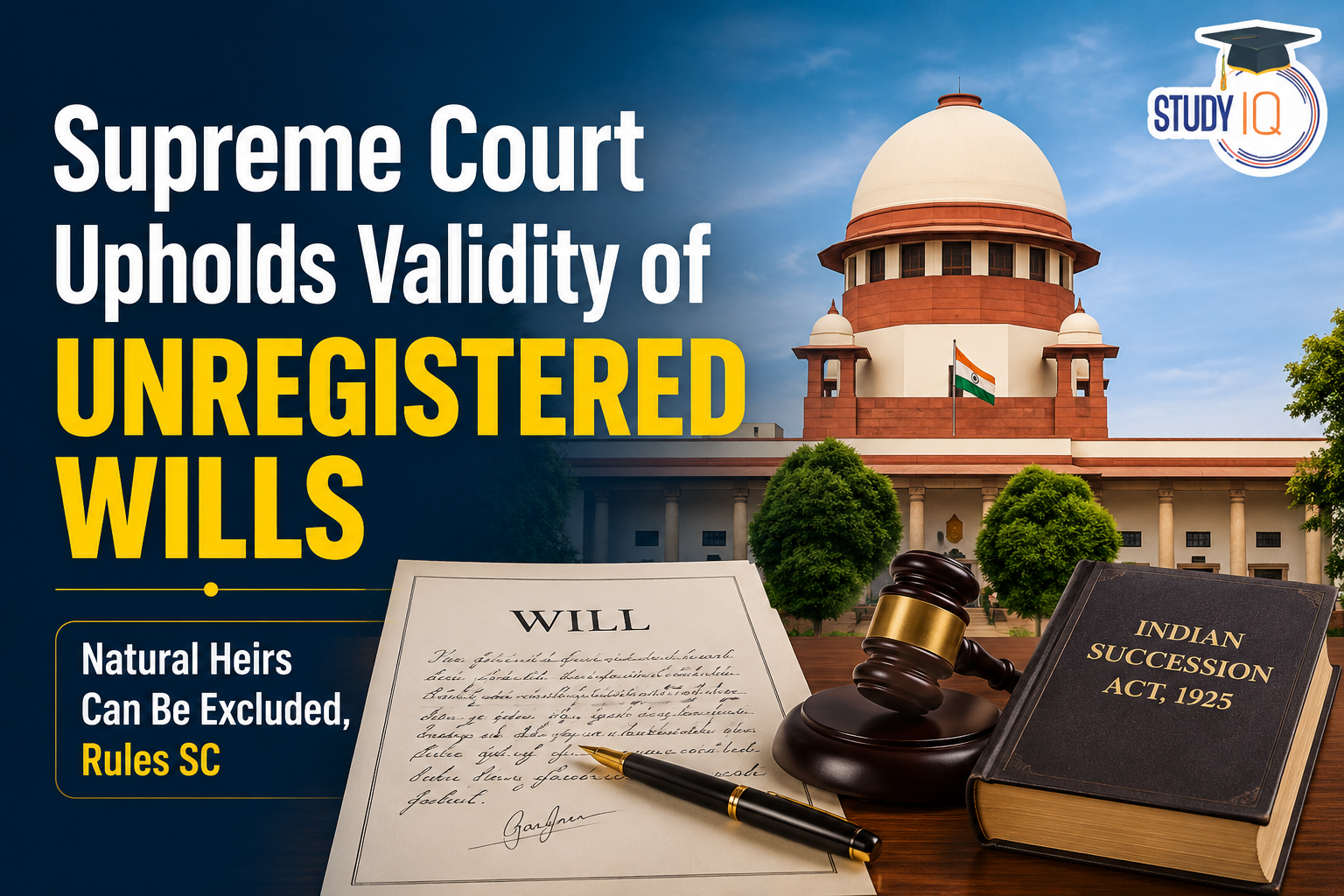
The recent Supreme Court decision in Parvathi Nairthi v. Laxmi Nairthy is of substantial importance in this regard. The Court reiterated two significant principles regulating testamentary succession in India. The sheer absence of will registration cannot render it suspicious, as Indian law does not require the compulsory registration of wills. The exclusion of natural heirs, such as a spouse or children, does not inherently nullify a will, as the primary purpose of testamentary disposition is to disrupt the standard line of succession.

Overview of Testamentary Succession in India
The Indian Succession Act of 1925 primarily regulates testamentary succession in India. A will is a legal declaration by a testator concerning the distribution of property upon death. In contrast to intestate succession, where property is allocated based on statutory inheritance rules, testamentary succession permits an individual to allocate assets according to personal preferences.

The justification for allowing wills is rooted in the acknowledgement of individual freedom and property rights. An individual who has obtained property through legitimate methods possesses the right to determine its distribution upon death. Testamentary independence thus signifies an expansion of proprietary liberty. However, since the testator becomes deceased when disputes occur, courts must meticulously examine the conditions under which the document was executed. Indian succession law has developed comprehensive measures to guarantee authenticity and voluntariness.
Section 63 of the Indian Succession Act delineates the method for executing an unprivileged will. The testator must sign or place a mark on the document, and the will must be witnessed by a minimum of two individuals. Section 68 of the Indian Evidence Act, 1872 mandates the examination of a minimum of one attesting witness to establish execution in a court of law. These measures jointly aim to prevent fabrication and guarantee that the testamentary instrument accurately represents the intentions of the deceased.’
Read Also: Judiciary Current Affairs
Facts and Context of the Present Dispute
The case before the Supreme Court involved agricultural and ancestral holdings located in Karnataka. The deceased testator, B. Sheena Nairi, was a Chartered Accountant residing in Bombay. Prior to his demise on November 30, 1983, he executed a will dated May 15, 1983, in favour of his sister, Laxmi Nairthy. The will explicitly indicated that the testator had already allocated “enough and more” for his wife and children living in Bombay. Therefore, he resolved to bequeath the remaining suit properties to his sister.
The will was witnessed by two individuals: the testator’s brother, B. Jagannatha Nairi, and Mohammad Saheb. Subsequent to the testator’s demise, the wife requested the transfer of property titles in her favour from the revenue authorities. Upon the sister’s revelation of the will, extensive litigation commenced.
The spouse and offspring contested the will on multiple bases. They asserted that the document was counterfeit and falsified. They contended that the will was dubious due to its exclusion of the rightful heirs and its unregistered status. Furthermore, they depended on an affidavit purportedly submitted by one of the attesting witnesses, which opposed the execution of the will. The trial court, the first appellate court, and the Karnataka High Court simultaneously affirmed the legality of the will. The appellants, feeling wronged, approached the Supreme Court.
Supreme Court’s Examination of the Exclusion of Natural Heirs
A primary question before the Court was whether the exclusion of the wife and children represented a suspicious circumstance adequate to invalidate the will.
The Supreme Court categorically dismissed this assertion. The bench, consisting of Justice Ujjal Bhuyan and Justice Vijay Bishnoi, noted that the primary function of a will is to modify the standard order of succession. The exclusion of natural heirs does not inherently provoke suspicion.
The Court noted:
“It is trite to state that when the validity of a Will is to be determined, the overall terms of a Will, the intention of the testator and the surrounding circumstances have also to be seen. Mere exclusion of the natural heirs from the property of the testator, by itself, cannot be construed as a suspicious circumstance so as to invalidate a Will outrightly.”
The Court referenced the prior decision in Rabindra Nath Mukherjee v. Panchanan Banerjee, which established that the exclusion of natural heirs alone does not render a will suspicious. The Court emphasised that the will provided a logical justification for the exclusion. The testator explicitly indicated that he had provided enough for his wife and children financially during his lifetime. This clarification refuted claims of capriciousness or inequity. The decision so underscores the notion that courts must honour testamentary intent unless strong evidence demonstrates fraud, coercion, or incapacity.
Registration of Wills in India: Legal Status and Judicial Perspective
The appellants contended that the will should be regarded as questionable due to its unregistered status. The Supreme Court, in rejecting this submission, stressed that the registration of wills is not mandatory under Indian law. According to Section 18 of the Registration Act, 1908, the registration of wills is discretionary. In contrast to sale deeds, gift deeds, or mortgages, testamentary instruments are not subject to mandatory registration.
The Court cited the landmark case in Ishwardeo Narain Singh v. Kamta Devi, which unequivocally established that the majority of wills in India remain unregistered and that no negative inference may be deduced solely due to the absence of registration.
The Supreme Court reaffirmed:
“There is nothing in law which requires the registration of a will, and wills are in a majority of cases not registered at all.”
This legislative approach is based on the private character of testamentary intentions. Individuals may prefer not to publicly reveal the contents of their wills while alive. Mandating registration would compromise privacy and individual autonomy. Nonetheless, registration may have evidentiary value. A registered will could reduce the likelihood of future conflicts, as registration offers formal recognition of its execution by a governmental body. The lack of registration does not nullify the document nor establish a presumption of forgery.
The Court’s elucidation is important as plaintiffs often seek to contest unregistered wills solely on that premise. The decision so inhibits the exploitation of technical issues devoid of substantive validity.
Questionable Conditions and Burden of Proof
Indian courts have always underscored that doubts regarding a will must pertain to its execution or genuineness, rather than to emotional discontent among beneficiaries.
The preeminent authority on this matter is H. Venkatachala Iyengar v. B.N. Thimmajamma, in which the Supreme Court established criteria for proving wills and for establishing suspicious circumstances. The Court determined that in the presence of dubious circumstances, the proponent must adequately clarify them before the will may be deemed genuine.
Instances of dubious circumstances may encompass the testator’s mental incompetence, the active participation of beneficiaries in the execution, anomalous dispositions lacking justification, or discrepancies in signatures and attestation. Nevertheless, suspicion cannot be established solely on the basis of the exclusion of legal heirs or the absence of registration. Courts must differentiate between legitimate evidentiary issues and speculative arguments driven by discontent.
The Court determined that the testimony of an attesting witness properly validated the will. The witness affirmed that the testator signed the instrument willingly and while possessing a sound and disposed mind. In contrast, the appellants did not provide compelling proof of forgery or falsification. Unsubstantiated charges were deemed inadequate to overturn the presumption resulting from proper execution.
Mutation Records and Financial Management
The Court also addressed the question of mutation entries made in favour of the widow following the testator’s death. The appellants contended that these entries supported their claim of ownership. The Supreme Court dismissed this argument and reaffirmed the established precedent that mutation entries do not grant ownership. Income records are largely maintained for fiscal purposes, including the assessment and collection of land revenue.
The Court elucidated that mutation neither establishes nor terminates ownership rights. Substantive title must be established using legal instruments, including sale deeds, inheritance laws, or testamentary documents. The distinction between fiscal administration and legal ownership is especially significant in rural property disputes, where mutation entries are sometimes misinterpreted as definitive evidence of title.
Conclusion
The Supreme Court’s decision in Parvathi Nairthi v. Laxmi Nairthy is a substantial reaffirmation of the established norms regulating testamentary succession in India. The Court emphasised that the absence of will registration does not inherently raise doubts regarding its validity, as Indian law does not require registration. The exclusion of natural heirs does not inherently invalidate a will, as testamentary flexibility allows for divergence from standard succession laws.
The decision emphasises that courts should concentrate on actual suspicious circumstances influencing execution, voluntariness, or authenticity, rather than emotional grievances presented by dissatisfied heirs. The Court reinforced the legal framework regulating wills and succession disputes by prioritising legislative conformity, evidential rigour, and respect for testamentary intent.
The court’s decision exemplifies the judiciary’s dedication to reconciling individual autonomy with procedural protections. It underscores the principle that property owners have the freedom to allocate their assets in accordance with their personal desires, as long as those desires are articulated through a legally recognised testamentary document. By doing so, the Court upheld the sanctity of testamentary succession and the constitutional principles of liberty, dignity, and personal choice that underpin contemporary Indian jurisprudence.
 Supreme Court Dowry Enforcement Order 20...
 Supreme Court Modifies 3-Year Practice R...
 Doctrine of Per Incuriam Explained: Supr...






 WhatsApp