Table of Contents
Context: Due to LPG shortages during the West Asia conflict, many Indian households shifted to electric cooking options such as induction and infrared cooktops.
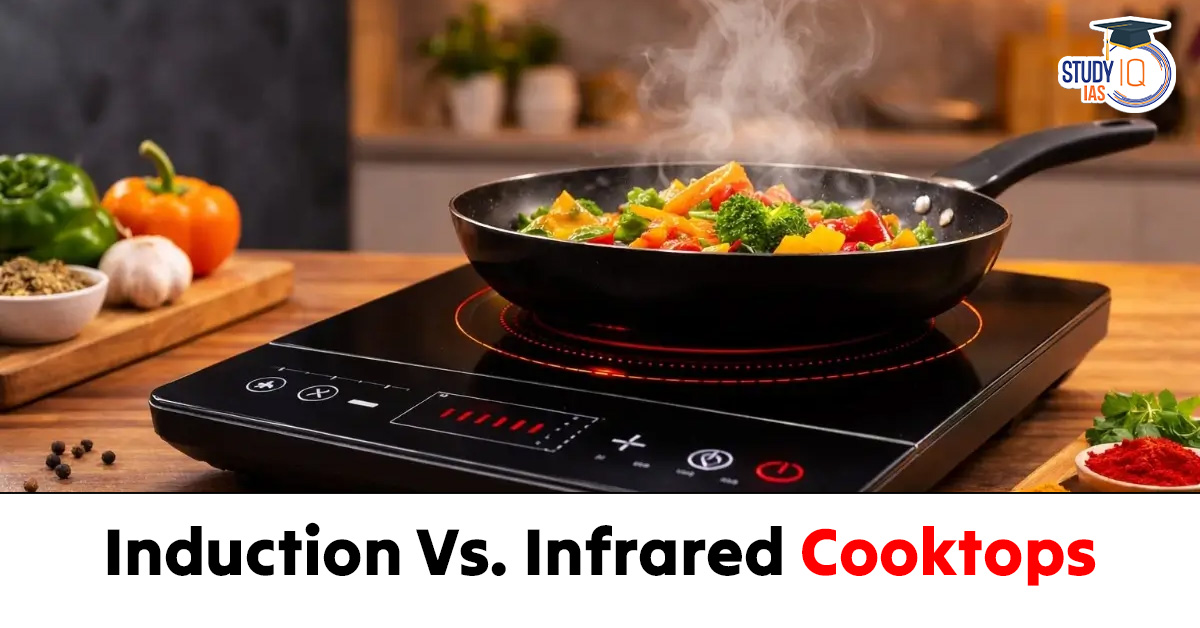
Induction vs. Infrared Cooktops
Choosing the right cooktop can make a big difference in your cooking experience, especially as modern kitchens shift toward energy-efficient and smart appliances. Among the most popular options today are induction and infrared cooktops, both offering sleek designs and advanced technology compared to traditional gas stoves.
While induction cooktops use electromagnetic fields to directly heat cookware, infrared cooktops rely on radiant heat to warm the surface and then the vessel. Each comes with its own advantages in terms of speed, safety, energy efficiency, and compatibility. Understanding the key differences between induction and infrared cooktops can help you decide which one best suits your cooking style and household needs.
Working Principle
- Induction Cooktop: Works on electromagnetic induction, where an electric coil generates a changing magnetic field that induces currents in a ferromagnetic vessel, and the vessel’s resistance converts this energy directly into heat.
- Infrared Cooktop: Works on radiant heating where electricity heats a coil or halogen element beneath a glass surface, producing infrared radiation that is absorbed by the cookware, generating heat for cooking.
Also Check: Electric Cooking Solution in India
Difference Between Induction and Infrared Cooktops
| Feature | Induction Cooktop | Infrared Cooktop |
| Heating Principle | Electromagnetic induction heats vessel directly | Radiant heat from heated coil warms vessel |
| Energy Efficiency | Very high (≈85–95%) | Moderate (≈70–80%) |
| Cookware Requirement | Requires ferromagnetic cookware (cast iron, magnetic steel) | Works with almost any cookware (steel, aluminium, glass, ceramic) |
| Heat Transfer | Direct heating of vessel | Indirect heating through glass surface |
| Temperature Control | Precise electronic control (pulse-width modulation/frequency control) | Phase-angle control of coil heating |
| Energy Loss | Minimal heat loss | Higher heat loss to surroundings |
| Impact on Power Grid | More efficient, stable electrical load | Can distort current waveform and reduce power factor |
| Safety | Surface relatively cool (only vessel heats) | Surface becomes hot due to heated coil |

 QDENGA Dengue Vaccine: India’s First A...
 Skyroot Vikram-1 Mission Aagaman: India'...
 Oor Pare Prehistoric Site: Location, Roc...














 WhatsApp