
Table of Contents
Context
Article 226 of the Constitution of India serves as a formidable tool for the court in upholding justice, accountability, and the safeguarding of rights. The writ jurisdiction of High Courts, unlike conventional statute remedies, is founded on constitutional authority and is fundamental to judicial review. The scope of this article has significantly transformed, especially with the adoption of Article 226(2), which broadened the territorial jurisdiction of High Courts via the concept of “cause of action.” Nonetheless, although the idea of cause of action is well established in civil law, its implementation in criminal jurisprudence has generated intricate interpretation difficulties.

Chronological Development of Article 226
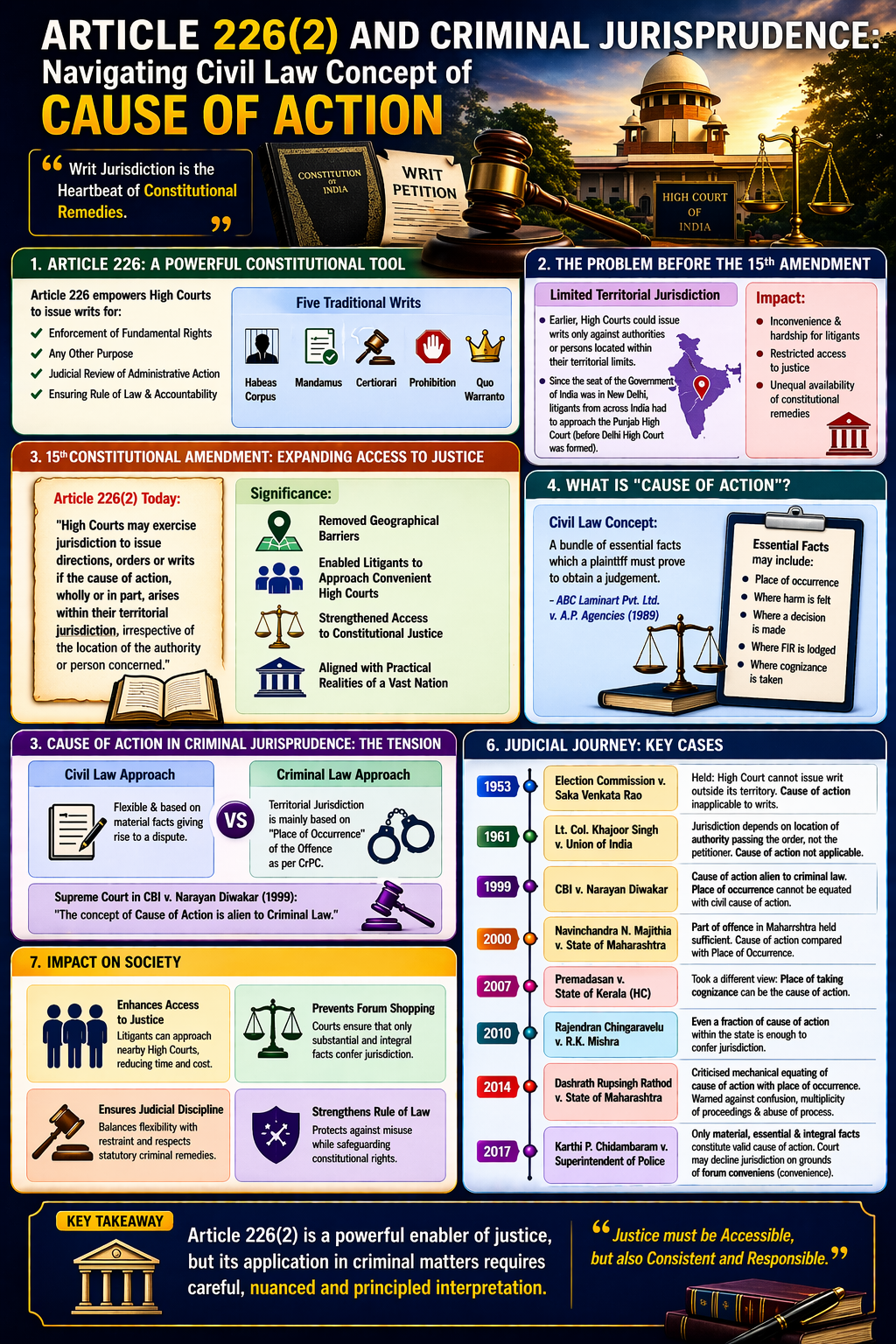
Initially, Article 226 granted High Courts the authority to issue writs solely within the “territories over which it exercises jurisdiction.” This territorial constraint resulted in considerable practical challenges, especially with issues affecting the Union Government. Due to the central government’s seat in New Delhi, litigants nationwide were forced to seek redress from the Punjab High Court (before the Delhi High Court was established) against the central government.
This issue was highlighted in early constitutional jurisprudence. In Election Commission v. Saka Venkata Rao, the Supreme Court held that a High Court could not exercise jurisdiction over authorities located outside its territorial limits. A writ petition submitted to the Madras High Court against the Election Commission (based in Delhi) was deemed not maintainable. The Court specifically dismissed the relevance of the “cause of action” notion to writ procedures, noting that this concept is limited to civil litigation.
A similar position was reiterated in Lt. Col. Khajoor Singh v. Union of India, where the Supreme Court held that jurisdiction under Article 226 depended on the location of the authority passing the impugned order, not on the residence of the petitioner or the place where the consequences of the order were felt.
These decisions revealed the deficiencies of the original framework and underscored the necessity for modification.
The Fifteenth Constitutional Amendment and the Emergence of Article 226(2)
To resolve these practical challenges, the Constitution (15th Amendment) Act implemented Clause (1A), which subsequently evolved into Article 226(2). This amendment represented a substantial change by permitting High Courts to assert jurisdiction if the “cause of action,” in whole or in part, originated within the limits of their jurisdictions, regardless of the authority’s location.
This innovation facilitated equitable access to justice by allowing litigants to engage with High Courts nearer to their residence or the locus of the issue. It also linked writ jurisdiction with the realities of a geographically extensive and administratively intricate nation such as India.
Understanding the Notion of “Cause of Action”
The expression “cause of action” originates from civil law and denotes a collection of fundamental facts that a plaintiff must establish to obtain a legal remedy. The Supreme Court in ABC Laminart Pvt. Ltd. v. A.P. Agencies defined cause of action as every fact which, if traversed, must be proved to support a right to judgment.
The concept establishes territorial jurisdiction in civil procedures, ensuring cases are submitted to the right forums. Nevertheless, its integration into constitutional and criminal law has been fraught with challenges.
Cause of Action and Criminal Jurisprudence: A Conceptual Conflict
Criminal law conventionally functions on the premise of territorial jurisdiction determined by the “location of the offence.” The Code of Criminal Procedure (CrPC) establishes comprehensive regulations for the venue for trial of offences, emphasising considerations such as the location of the act, the locus of the outcome, and the jurisdiction of the investigative body.
Conversely, the civil law notion of cause of action is more expansive and adaptable. This essential distinction generates friction when Article 226(2) is applied in criminal cases.
The Supreme Court examined this matter in CBI v. Narayan Diwakar, where it explicitly determined that the notion of cause of action is “alien” to criminal law. The accused sought to invoke the jurisdiction of the Gauhati High Court by contending that a part of the cause of action originated in Arunachal Pradesh. The Court dismissed this argument, underscoring that criminal jurisdiction cannot be established through civil law principles.
Initial Judicial Hesitance and Rigid Territorial Framework
In the early years subsequent to the amendment, courts exhibited prudence in the application of the cause of action concept to criminal cases. The prevailing perspective was that writ jurisdiction should refrain from intervening in criminal investigations or proceedings unless extraordinary circumstances were present.
This prudent strategy was based on apprehensions regarding the preservation of the criminal justice system’s integrity and the avoidance of interference with investigative procedures. Judicial authorities were cautious about permitting plaintiffs to bypass statutory remedies under the CrPC through the invocation of writ jurisdiction.
Gradual Expansion and Legal Experimentation
Notwithstanding initial hesitance, courts progressively commenced experimentation with the implementation of Article 226(2) in criminal cases. This was motivated by the necessity to tackle practical issues stemming from inter-state crimes and administrative measures with transnational consequences.
In some instances, courts have equated “cause of action” with the “place of occurrence” of the offence, while in others, they have taken into account elements such as the location of the FIR, the site of investigation, or the location of resultant harm.
This era of judicial experimentation established a more adaptable methodology, while it also engendered contradictions and doctrinal ambiguity.
The Issue of Jurisdictional Uncertainty
The absence of a definitive and uniform criterion for establishing jurisdiction under Article 226(2) in criminal cases has resulted in numerous practical challenges:
- Ambiguity for Litigants: Individuals may be uncertain regarding the suitable venue for pursuing redress.
- Conflicting Judgements: Various High Courts may have disparate perspectives on jurisdiction.
- Procedural Delays: Time and resources may be wasted on resolving jurisdictional conflicts instead of substantive matters.
These problems highlight the necessity for a more cohesive judicial system.
Wider Constitutional Implications of Article 226
Article 226 serves not just as a procedural mechanism but also as a fundamental assurance of justice. Its scope encompasses not just the enforcement of fundamental rights but also “any other purpose,” rendering it one of the most expansive constitutional remedies accessible.
The writ jurisdiction fulfils various functions:
- Safeguarding of Fundamental Rights
- Judicial Review of Administrative Actions
- Upholding the Rule of Law
- Ensuring Accessible Solutions
The implementation of Article 226(2) significantly fortified these functions by eliminating geographical constraints and improving access to justice.
Judicial Efforts to Reconcile Civil and Criminal Concepts
The judicial interpretation of Article 226(2) within criminal law illustrates a persistent effort to harmonise two inherently distinct legal traditions: the civil law’s systematic theory of “cause of action” and the jurisdictional rules rooted in territoriality of criminal law. Judicial bodies have generally recognised that the integration of a civil law principle into criminal law must be undertaken with discretion.
In Navinchandra N. Majithia v. State of Maharashtra, the Supreme Court adopted a pragmatic stance, holding that the Bombay High Court might exercise jurisdiction if part of the accused’s offence occurred within its geographical boundaries. This marked a significant transition, since the Court tacitly associated the concept of “cause of action” with the “place of occurrence” of the offence. The decision acknowledged that strict compliance with geographical limits could jeopardise access to justice, especially in matters with interstate components.
Similarly, in Rajendran Chingaravelu v. R.K. Mishra, the Court broadened the interpretation of Article 226(2) by determining that even a minor part of the cause of action occurring within a jurisdiction is adequate to grant jurisdiction to a High Court. The investigative operations, including search and seizure in Hyderabad, were deemed integral to the cause of action, thereby affirming the jurisdiction of the Andhra Pradesh High Court.
Nonetheless, these decisions also led to theological ambiguity. By combining “cause of action” with “place of occurrence,” courts jeopardised the complexity of a sophisticated legal term and obscured the line between civil and criminal law.
Judicial Prudence Regarding Misappropriation and Forum Shopping
The Supreme Court has consistently cautioned against the exploitation of Article 226(2) by the litigants attempting to invoke the jurisdiction of a “convenient“ High Court. This issue is notably illustrated in Kusum Ingots & Alloys Ltd. v. Union of India, where the Court underscored that not every trivial or incidental fact can establish a cause of action. Jurisdiction can only be conferred by facts that are significant, necessary, and integral to the dispute.
This notion was further substantiated in Karthi P. Chidambaram v. Superintendent of Police, whereby the Court refused to consider a writ petition contesting an FIR filed in Delhi. The petitioner contended that a part of the cause of action occurred in Tamil Nadu; nevertheless, the Court determined that these links were insufficient to warrant jurisdiction. It emphasised that the notion of “forum conveniens” permits courts to decline jurisdiction, even when it is technically present, if an alternative forum is more suitable.
These verdicts emphasise a crucial doctrinal protection: Article 226(2) does not permit forum shopping. The objective is to improve access to justice, rather than to facilitate strategic litigation strategies.
Evaluation of the “Place of Occurrence” Methodology
A pivotal moment in this jurisprudence occurred in Dashrath Rupsingh Rathod v. State of Maharashtra, wherein the Supreme Court scrutinised previous decisions that confused cause of action with the place of occurrence. The Court noted that this method resulted in confusion, multiple proceedings, and possible abuse of process.
The Court did not completely overturn previous precedents but warned against their uncritical application. It underscored that criminal jurisdiction should be ascertained according to the legislative requirements of the Code of Criminal Procedure (CrPC), rather than appropriating notions from civil law without modification.
The decision constitutes a doctrinal rectification, advocating for courts to embrace a more principled and contextually attuned methodology in the application of Article 226(2) to criminal cases.
Alternative Methodologies: Cognizance as a Determinant
In some instances, courts have examined alternate frameworks for establishing jurisdiction. In Premadasan v. State of Kerala, the Kerala High Court determined that the place where a magistrate takes cognisance may serve as the cause of action. This method redirects attention from the place of the offence to the point at which legal proceedings commence.
These interpretations underscore the adaptability of Article 226(2), although they also exacerbate the inconsistency in its implementation. The lack of a uniform standard highlights the necessity for more explicit judicial guidance.
Effects on Criminal Justice and Society
The changing interpretation of Article 226(2) has considerable ramifications for the criminal justice system and society as a whole. The broadened jurisdiction of High Courts improves access to justice by enabling litigants to seek recourse in courts within their geographical vicinity. This is especially significant in a large nation such as India, where geographical obstacles may hinder legal remedies.
The ambiguity in the application of the cause of action concept to criminal proceedings may result in:
- Multiplicity of Litigation: Numerous High Courts may be solicited for the identical issue, leading to contradictory rulings.
- Forum Shopping: Litigants may deliberately select jurisdictions deemed more advantageous.
- Judicial Inefficiency: Courts may allocate resources to ascertain jurisdiction instead of resolving substantive matters.
These problems underscore the precarious equilibrium that must be preserved between accessibility and judicial rigour.
Article 226: Enhanced Constitutional Importance
In addition to the matter of territorial jurisdiction, Article 226 holds a pivotal position within India’s constitutional framework. It authorises High Courts to issue writs for the enforcement of fundamental rights and for “any other purpose,” thereby expanding its reach beyond that of Article 32.
The five traditional writs– Habeas Corpus, Mandamus, Certiorari, Prohibition, and Quo Warranto– function as essential instruments for judicial review. In the realm of criminal law, writs like Habeas Corpus and Certiorari are essential for protecting individual liberty and guaranteeing procedural justice.
The extension of Article 226 via the 15th Constitutional Amendment demonstrates the Constitution’s dedication to accessibility and justice. Nonetheless, its implementation must adhere to the norms of federalism, judicial propriety, and procedural integrity.
Conclusion
The implementation of Article 226(2) in criminal jurisprudence signifies a multifaceted and developing domain of constitutional law. The introduction of the “cause of action” doctrine has broadened the territorial jurisdiction of High Courts; its adoption from civil law has produced considerable theoretical difficulties.
Judicial decisions have fluctuated between aligning the cause of action with the place of occurrence, investigating other methodologies such as cognizance, and warning against potential misuse. The lack of a consistent norm has resulted in ambiguity, requiring a more structured and principled framework.
Ultimately, the path forward necessitates acknowledging that criminal law demands a unique approach to jurisdiction. Article 226(2) should persist in enabling access to justice; its implementation must adhere to the norms of relevance, materiality, and judicial restraint. The judiciary, as the protector of constitutional equilibrium, must guarantee that this potent provision is employed to promote justice rather than complicate it.
The present doctrinal growth involves not only interpreting the law but also reconciling conflicting legal traditions while maintaining the integrity of both civil and criminal jurisprudence.

 Supreme Court Dowry Enforcement Order 20...
 Supreme Court Modifies 3-Year Practice R...
 Doctrine of Per Incuriam Explained: Supr...








 WhatsApp