
Table of Contents
Context
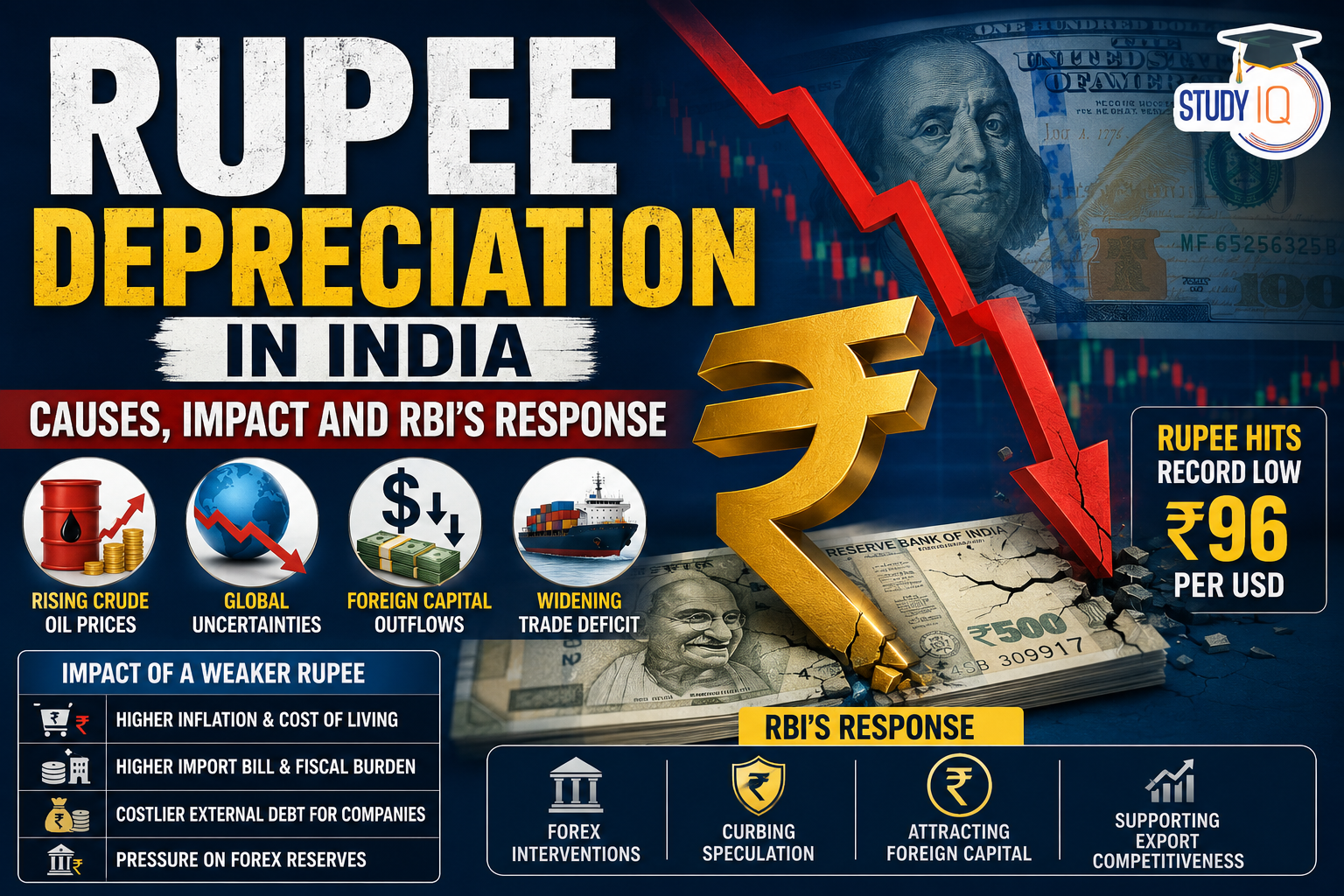
The Indian rupee has recently fallen past the 96-per-dollar mark, hitting a new record low. The rupee has declined by nearly 5.2% against the dollar since the Iran-US conflict began in late February.
Read Also: UPSC Daily Current Affairs 2026
Factors responsible for the weakening of the Rupee against Dollar
Domestic Factors
- Widening Current Account Deficit (CAD): The structural gap between India’s imports and exports has expanded significantly. Beyond the massive energy bill, high international prices for other essential commodities have bloated India’s overall import costs.
- Foreign Capital Outflows (FII & FPI Sell-offs): With better returns available in the US and high valuations in Indian equity markets, FPIs and FIIs have become major net sellers. As foreign investors withdraw billions of dollars from Indian stocks and government securities (G-Secs) and send the money back to the US, they sell Rupees to buy Dollars, which puts further pressure on the Rupee to weaken.
- Importers Are Buying Dollars in Advance: Indian companies dependent on imported goods and raw materials have increasingly started securing dollars in advance to protect themselves against further currency depreciation.
- Limited Export Competitiveness: While sectors like IT and pharma can benefit from a weaker rupee, the overall benefit is limited because many Indian exports rely on imported components, which have become more expensive.
- Inflation & Growth Headwinds: Even though the long-term growth outlook remains strong, but, the slower near-term GDP growth & very low inflation level have acted as negative economic indicators, dampening investor confidence in the Rupee’s short-term stability.
External & Global Factors
- India-USA Trade Tensions & Tariffs: The USA is one of India’s top trading partners. However, the imposition of a 50% tariff on Indian goods by the Trump administration has severely impacted the export competitiveness of Indian goods & has increased the market risk perception.
- Geopolitical Tensions: Wars, conflicts (e.g. Russia-Ukraine, US-Iran War), or global crises trigger risk-off sentiment, pushing investors toward the dollar. Geopolitical conflicts in the Middle East and supply-chain anxieties around the Strait of Hormuz have pushed Brent crude oil prices past the $100–$110 per barrel mark.
- High Crude Oil Prices & Import Dependence: India imports almost 80-85% of its crude oil, thus, it is highly vulnerable to global energy spikes.
- Strengthening of USA Dollar: Despite the US Fed Reserve beginning its rate-cut cycle, the US Dollar has maintained persistent strength, reflecting its status as global reserve currency & a safe haven asset during a period of geopolitical uncertainty.
Monetary Policy Factors
- US Federal Reserve’s Monetary Policy: The US Federal Reserve’s decision to increase interest rates makes USD-denominated assets more attractive to investors. This leads to capital outflows from emerging markets like India, further weakening the rupee.
- RBI’s Stance: The RBI has chosen a Neutral Policy Stance & kept the repo rate unchanged for most part of the year 2025 – prioritizing domestic liquidity management & growth over an aggressive defense of the Rupee.
Consequences of weakening of the Rupee
Impact on Consumers
- Inflationary Pressure (Imported Inflation): As the INR weakens, the Oil Marketing Cos. have to pay more Rupees for the same barrel of oil. This increased cost is eventually passed on to the consumers through higher prices for petrol, diesel, and natural gas. This high fuel cost then triggers a cascading effect.
- Rising Cost of Living: The price of other key imports, such as electronics, gold, industrial chemicals, and fertilisers, also rise – intensifying the inflationary pressure & eroding the purchasing power & savings of the average household.
Impact on Corporations (External Debt)
- Increase in Debt Servicing Cost: The Indian Corporates who have taken ECBs denominated in USD & have not fully hedged their exposure, face a major risk. A weaker rupee means that a company has to pay more INR for the USD-denominated debt.
- Divergent Fortunes: The corporate sector witnesses a divergence – while the export-oriented cos. see higher profits, the import-dependent cos. & highly indebted cos. face significant financial strain.
Macroeconomic Impact
- Worsening Trade Deficit & Pressure on Reserves: The RBI often intervenes (spot intervention) in the forex market to prevent excessive depreciation of the Rupee. The RBI sells USD to absorb the excessive Rupee liquidity. However, it leads to reduction in the national reserve buffer.
- Capital Flight: Withdrawal of funds by FPI & FIIs is one the causes for the weakening of the INR. If the Rupee continues to weaken, it could signal greater macroeconomic instability which may increase the rate of capital flight from India – creating a self-perpetuating cycle of depreciation.
- Higher Subsidy Burden: Government spending on fuel and fertilizer subsidies rises sharply when import costs increase, worsening the fiscal deficit.
How India is responding to the weakening of the Rupee
- Direct and Indirect Forex Interventions: The RBI’s first line of defense has been selling US dollars from India’s foreign exchange reserves, which have declined to around $697 billion from over $720 billion before the recent crisis . The RBI has asked state-owned oil refiners (the largest buyers of dollars) to curb their spot market purchases and instead use a dedicated foreign currency credit line, effectively reducing immediate demand on the rupee.
- Curbing Speculation and Volatility: To prevent excessive speculation from driving the rupee’s fall, the RBI has also tightened regulations. This includes imposing a mandatory daily limit of $100 million on Authorised Dealers’ Net Open Position (NOP) to limit excessive currency market positioning.
- Attracting Foreign Capital: To increase the supply of dollars, authorities are looking to attract more foreign investment. This includes potentially reviving special deposit schemes for Non-Resident Indians (NRIs). Policymakers are working to make Indian G-Secs more lucrative for global institutional investors.
- Permitting Fuel Price Increase: To improve its fiscal situation, India has allowed small increases in domestic fuel prices. By aligning fuel prices with the high global crude oil prices of $110–$120 per barrel, the government aims to reduce the losses faced by State-run Oil Marketing Companies (OMCs), which are struggling with costly crude oil imports and a weak Rupee.
Way Forward
Strengthen Domestic Macro-fundamentals
- Energy Security: Aggressive domestic oil & gas exploration (Vedanta’s $5 bn commitment), scaling ethanol blending (E20 target achieved), expanding renewable energy. India must prioritize domestic exploration blocks and completely optimize its Strategic Petroleum Reserves (SPR) to store oil when prices see temporary dips.
- Reduce Import Dependence: Boost domestic production of electronics, chemicals, and capital goods to cut imports.
- Contain fiscal and current account deficits through better tax mobilisation, rationalised subsidies, and export diversification so external financing needs remain credible.
Manage External Vulnerability
- Expand Rupee Vostro Accounts: India needs to accelerate its bilateral trade mechanism—paying for oil, gas, and commodities in Indian Rupees (INR) or localized currency swaps with major trade partners like Russia, the UAE, and alternative non-Western energy suppliers.
- Internationalizing the UPI-RuPay Stack: Forging deeper cross-border payment links shrinks the need for US Dollars in retail, tourism, and remittance corridors.
- Forex Reserves: Maintain adequate forex reserves and flexible exchange rates so the RBI can smooth volatility without defending unsustainable levels, reassuring markets about India’s shock‑absorbing capacity.
- Upgrade Export Competitiveness: Upgrade export competitiveness with reforms in logistics, trade facilitation, skilling, and industrial policy, focusing on high‑value manufacturing and services instead of low‑margin commodities.
|
Read More Notes |
|
| Environment Notes | Art and Culture Notes |
| Science and Tech | History Notes |
| Geography Notes | Indian Polity Notes |
| General Knowledge | International Relation |
|
Explore StudyIQ Courses |
|
 Why Do Stampedes Occur in India? Crowd P...
 Strategic Disinvestment in India: IDBI B...
 Women’s Livelihoods in India: Challeng...














 WhatsApp





