Table of Contents
Context: Chief Justice of India said India’s justice system problem is limited access due to costs, delays, complexity and barriers, not lack of laws, making access to justice the primary impediment for citizens.
About Access to Justice
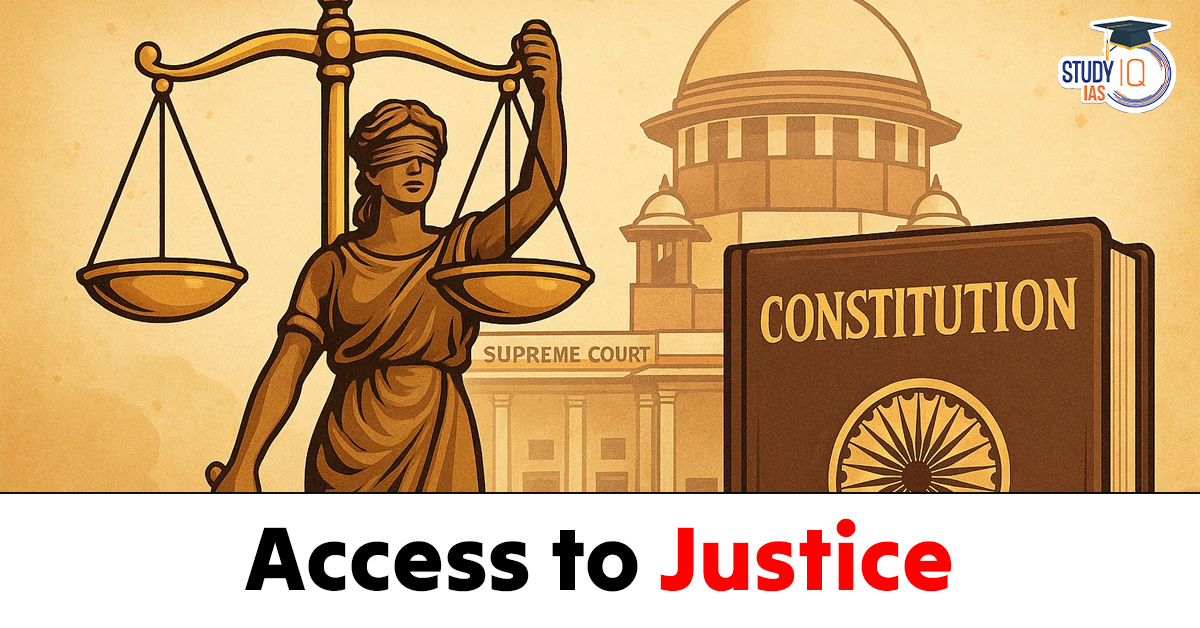
Access to Justice signifies a core democratic principle whereby every individual, irrespective of their social or economic background, has the opportunity to seek and secure remedies through formal or informal justice mechanisms for their grievances. In the absence of meaningful access to justice, individuals may find themselves unable to assert their rights, challenge injustices, or obtain redress for the harms they endure.
Legal and Constitutional Provisions
Constitutional provisions
- Article 14 (Equality Before Law): Guarantees all citizens equality before the law and equal protection of laws. The Supreme Court has expanded this to include the right to access justice, ensuring that every individual can approach the courts without any form of discrimination.
- Article 21 (Right to Life and Personal Liberty): Recognized as a cornerstone of access to justice, Article 21 protects the right to seek legal remedies for violations of personal liberty and fundamental rights.
- Article 39A (Free Legal Aid): A Directive Principle aimed at ensuring that no person is denied legal assistance due to economic or other incapacities. It mandates the state to promote justice based on equal opportunity, with special attention to vulnerable and marginalised groups.
- Articles 32 and 226 (Constitutional Remedies): These provisions empower individuals to directly approach the Supreme Court (Article 32) and High Courts (Article 226) for the enforcement of their rights, thereby facilitating meaningful access to justice.
Statutory and institutional framework
Legal Services Authorities Act, 1987: This Act established the National Legal Services Authority (NALSA) to provide free legal services to the weaker sections of society.
- Section 12 identifies beneficiaries, including women, children, SCs/STs, persons with disabilities, and those below the poverty line.
- Lok Adalats established under this Act offer low-cost, quick dispute resolution mechanisms.
- Tele-Law and E-Lok Adalats initiatives extend legal advice and dispute resolution to remote and underserved areas using technology.
Public interest litigation (PIL)
Expansion of Locus Standi: The concept of PIL allows any concerned citizen or organisation to approach the courts on behalf of those whose rights are violated, even if they are not directly affected.
- Eg: MC Mehta v. Union of India (1987)—one of the landmark PILs—was filed for addressing environmental pollution in Delhi, leading to key judicial interventions in environmental law.
Elements of the Right to Access to Justice
| Element | Meaning | Supporting Data/Examples |
|
Availability of Legal Remedies |
Citizens must be able to approach courts and legal institutions to seek redressal for grievances. |
● Vishaka v. State of Rajasthan (1997): Led to the formulation of guidelines to address sexual harassment at the workplace.
● Use of writs like Habeas Corpus allows individuals to challenge unlawful detentions. |
|
Affordability |
Legal processes should be financially accessible, especially for economically weaker sections. |
● Article 39A mandates free legal aid to prevent denial of justice based on economic constraints.
● In 2021–22, over 21 lakh individuals benefitted from free legal aid through NALSA. |
| Awareness and Information | Citizens must be aware of their rights and the means available for legal redress. | ● NALSA’s Know Your Rights campaigns empower citizens through legal awareness.
● The National Commission for Women conducts outreach programs to educate women on issues like domestic violence and workplace rights. |
|
Fair and Transparent Procedures |
Judicial processes must uphold principles of fairness, equity, and transparency. |
● Maneka Gandhi v. Union of India (1978): Reinforced that the right to a fair hearing is an essential part of Article 21.
● Live-streaming of court proceedings promotes judicial transparency and public trust. |
|
Physical and Legal Accessibility |
Courts and legal services should be physically reachable and provide appropriate representation. |
● Gram Nyayalayas bring the judiciary closer to rural populations; over 400 courts settled 25,000+ cases as of 2023.
● Legal aid clinics in law colleges extend legal assistance to underprivileged individuals. |
Barriers to Access to Justice
| Various Barriers | Nature | Illustration |
|
Social Barriers |
Caste-Based Discrimination | Dalits have been historically denied access to shared community resources like village wells. |
| Lack of Legal Awareness | Rural populations unaware of provisions under the Legal Services Authorities Act, 1987 offering free legal aid. | |
| Low Literacy Levels | Illiterate farmers often fail to comprehend rights under land acquisition laws. | |
| Gender Bias | Social stigma discourages rural women from reporting domestic abuse. | |
|
Economic Barriers |
High Legal Costs | Many undertrials depend on overburdened legal aid lawyers due to inability to afford private counsel. |
| Court-Related Expenses | Daily wage workers are unable to travel long distances to attend court hearings. | |
| Bribery in Law Enforcement | Citizens are often forced to pay police to file an FIR in theft cases. | |
| Extended Pre-Trial Detention | NCRB data shows over 75% of undertrials are from economically weaker sections. | |
|
Legal Barriers |
Procedural Complexities | Civil dispute proceedings delayed due to slow service of summons under procedural laws. |
| Police Inefficiency | Forensic delays occur as evidence is sent to labs in far-off states. | |
| Institutional Corruption | Bribes demanded for accessing certified copies of court orders. | |
| Lack of Competent Legal Aid | Inadequate legal representation in cases like Bandhua Mukti Morcha hampers justice for bonded labourers. |
Measures to Strengthen Access to Justice
Strengthen Legal Aid Infrastructure
- Enhance the reach and effectiveness of existing legal aid services, including the National Legal Services Authority (NALSA)
- Deploy trained paralegal volunteers at the grassroots level to connect underserved communities with formal legal mechanisms.
Digitize the Justice Ecosystem
- Accelerate the implementation of the e-Courts project to streamline case management and improve transparency.
- Ensure robust access to digital services such as e-filing, virtual hearings, and online grievance redressal, particularly in rural and remote areas.
Build Legal Capacity and Professional Training
- Conduct regular training and capacity-building programs for judges, legal aid lawyers, and court staff.
- Include mandatory modules on case management, digital literacy, and social justice in legal education and professional development.
Promote Legal Awareness and Civic Education
- Launch awareness campaigns to educate citizens, especially in rural and marginalised areas, about their legal rights and remedies.
- Use schools, panchayats, community centres, and social media platforms to promote understanding of legal aid services, Lok Adalats, and complaint redressal systems.
Address Procedural Delays and Judicial Backlogs
- Set clear timelines for case disposal and impose penalties for unjustified delays.
- Expand judicial infrastructure by increasing the number of judges, introducing efficient case tracking systems, and integrating AI for intelligent docket management.

 Chief Election Commissioner Removal 2026...
 Fundamental Duties of Indian Constitutio...
 Skyroot Vikram-1 Mission Aagaman: India'...














 WhatsApp