Table of Contents
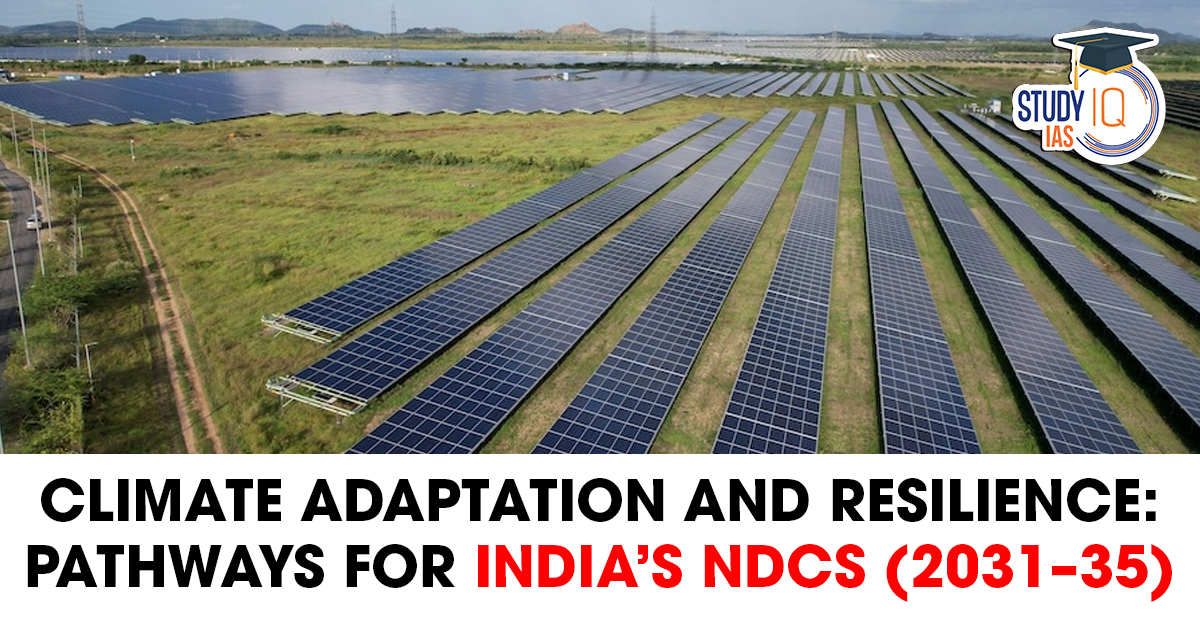
Context: India is mainstreaming adaptation into its development strategy through updated Nationally Determined Contributions (NDCs) and localised resilience models.
Current State of Climate Vulnerability in India
- India is the ninth most climate-vulnerable nation globally.
- Between 1995 and 2024, India recorded 430 extreme weather events, resulting in economic losses of $170 billion and affecting 1.3 billion people.
Institutional Models for Climate Resilience
- NICRA (National Innovations in Climate Resilient Agriculture): An ICAR initiative covering 448 villages across 151 hotspots, focusing on climate-smart agriculture and risk mapping.
- Tamil Nadu’s Climate Resilient Villages (CRV): Recognised by the Economic Survey 2025-26 as a “best practice.” It utilises a holistic approach in 11 districts, integrating water management, renewable energy, and alternative livelihoods.
Challenges in Adaptation Financing
- Budgetary Skew: While adaptation spending was estimated at 6% of GDP in FY22, the Union Budget 2026–27 remains heavily focused on emission mitigation.
- Taxonomy Gaps: The Draft Framework of Climate Finance Taxonomy (2025) is currently mitigation-centric, lacking a clear typology to prioritise and fund vulnerable sectors.
- Global Finance Gap: Developing nations face an annual financing gap of $284–$339 billion through 2035, according to the UNEP Adaptation Gap Report 2025.
Strategies for Strengthening Adaptive Capacity
- Climate Budgeting: The Ministry of Finance should mandate climate budgeting through State Finance Departments, integrating adaptation targets into annual budgetary planning.
- Quantifying Benefits: Highlighting the ten-fold return on investment in adaptation (as per WRI) can help attract private and international capital.
- National Adaptation Plan (NAP): Operationalising NDCs through updated State Action Plans on Climate Change (SAPCCs) that include regular vulnerability assessments at the block level.
- Whole-of-Systems Approach: Moving beyond infrastructure to include skill development, rehabilitation guidelines for climate-displaced populations, and dedicated workforces in climate change cells.
- Locally Led Adaptation (LLA): A core theme of COP30, stressing that resilience planning must transition from national mandates to Panchayati Raj Institutions and Urban Local Bodies.

 Ramsar Sites in India 2026 List: Names, ...
 Skyroot Vikram-1 Mission Aagaman: India'...
 Oor Pare Prehistoric Site: Location, Roc...













 WhatsApp