Table of Contents
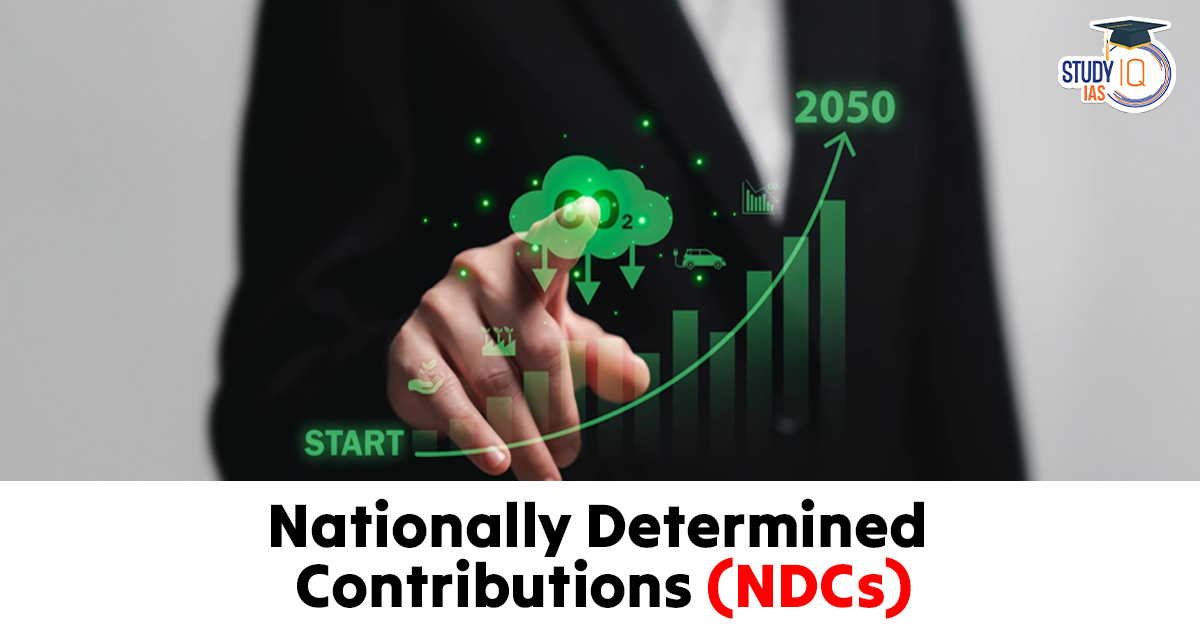
Context: The Indian government announced a bold update to its third set of Nationally Determined Contributions (NDCs) for the 2031–2035 period, significantly raising its climate ambition ahead of its formal communication to the UNFCCC.
Nationally Determined Contributions (NDCs): New 2035 Targets vs. 2030 Commitments
India’s Updated Nationally Determined Contributions (NDCs) are a response to the First Global Stocktake (GST), which concluded that the world is currently not on track to limit warming to 1.5°C.
| Goal Category | 2030 Target (Updated Aug 2022) | 2035 Target (Announced Mar 2026) |
| Non-Fossil Fuel-Based Power Capacity | 50% of installed electricity capacity from non-fossil sources | 60% of installed electricity capacity from non-fossil sources |
| Emissions Intensity of GDP | Reduce by 44% from 2005 levels | Reduce by 47% from 2005 levels |
| Carbon Sink (Forests & Tree Cover) | Create an additional sink of 2.5–3 billion tonnes of CO₂ equivalent | Enhance sink to 3.5–4 billion tonnes of CO₂ equivalent |
Current Status and Progress Check of NDCs
India is one of the few G20 nations consistently overachieving its climate pledges:
- Electricity Capacity: Currently, 52% of India’s installed capacity is non-fossil (Solar, Wind, Hydro, Nuclear, Biomass), achieving the 2030 goal four years early. However, non-fossil sources currently account for only 25% of actual power generation.
- Emissions Intensity: As of 2019, India had already achieved a 36% reduction. The move to a 47% target by 2035 balances energy security with decarbonization.
- Forest Cover: While forest cover rose from 21% (2005) to 6% (2021), it still trails the National Forest Policy goal of 33%.
|
Note |
| 1. Nationally Determined Contributions (NDCs): These are voluntary climate action plans submitted by countries under the Paris Agreement to outline their specific targets for reducing greenhouse gas emissions and adapting to climate impacts.
2. Global Stocktake (GST): This is a fundamental process established under the Paris Agreement to periodically assess the world’s collective progress toward limiting global warming to 1.5°C. 3. Carbon Sink: Natural or artificial reservoirs (like forests) that absorb more CO2 than they release. 4. Emissions Intensity: The total amount of greenhouse gases emitted per unit of GDP. |
The Positives of NDCs
- Early Achievement of 2030 Targets: India has demonstrated “strong resolve” by meeting its 50% non-fossil capacity target four years ahead of schedule (reaching 52.5% by early 2026). This creates a credible foundation for the more ambitious 60% target for 2035.
- Decoupling Growth from Emissions: Achieving a 36% reduction in emissions intensity by 2020 proves that India can maintain high GDP growth while slowing the rate of carbon output. The new 47% target signals a commitment to further “green” the industrial sector.
- Nuclear and Hydrogen Pivot: The SHANTI Act (2025) is a major positive, opening the nuclear sector to 49% FDI. This enables the deployment of Small Modular Reactors (SMRs) of 200–250 MW, providing decentralised, carbon-free baseload power that complements intermittent solar and wind.
- Global South Climate Evangelism: While developed nations like the US are retreating from climate commitments, India’s reaffirmation of the “clean energy pathway” reinforces its role as a principled leader of the Global South, emphasising Common but Differentiated Responsibilities (CBDR).
- Focus on Adaptation: The NDC rightly prioritises Heat Action Plans and Himalayan glacier monitoring, acknowledging that for a tropical country, adaptation is just as critical as mitigation for national security.
Criticism: Are India’s 2035 Targets Too Conservative?
- The “Slack” Argument: With India already reaching 5% non-fossil capacity by 2026, critics argue that a 60% target for 2035 is overly cautious.
- This “incrementalism” may undersell the actual exponential growth of solar and wind, potentially signaling a loss of momentum.
- The 1.5°C Alignment Gap: While India is outperforming many developed nations, climate models suggest these pledges are insufficient to meet the 1.5°C global warming limit.
- Raising the emissions intensity target by only 2% indicates a priority for “energy security” over aggressive decarbonization.
- Strategic Underselling: Experts suggest India is intentionally keeping formal NDCs low to avoid international legal pressure if Western financial support fails.
- This allows for domestic over-achievement but draws criticism for a perceived lack of “high-level ambition” on the global stage.
Challenges in Achieving the NDCs
- The “Finance Vacuum”: The primary hurdle is the failure of the developed world to provide the $1.3 trillion annual climate finance demanded at COP29 (Baku).
- Capacity vs. Actual Generation: A major structural issue is that while 52.5% of capacity is non-fossil, only about 20–25% of actual electricity generated comes from these sources. Bridging this gap requires massive investments in battery storage and grid stabilization.
- The Carbon Sink Paradox: Increasing the sink to 4 billion tonnes necessitates large-scale afforestation. However, experts warn that “monoculture plantations” (often used to meet targets) lack the biodiversity of natural forests and can cause adverse ecological consequences for local soil and water.
- Hard-to-Abate Sectors: Reducing emissions intensity by an additional 2% (from 45% to 47%) is technically difficult. As the economy becomes more efficient, each further percentage of reduction becomes “exponentially harder” and more expensive to achieve through efficiency measures alone.
- Unilateral Trade Barriers: India faces external pressure from “green protectionism,” such as carbon border taxes imposed by rich countries. These measures threaten Indian exports while the developed world simultaneously “backtracks” on its own climate ambitions.
| Nationally Determined Contributions (NDCs) |
|

 Skyroot Vikram-1 Mission Aagaman: India'...
 Oor Pare Prehistoric Site: Location, Roc...
 Assam Election 2026: Exit Poll, Result D...












 WhatsApp