
Table of Contents
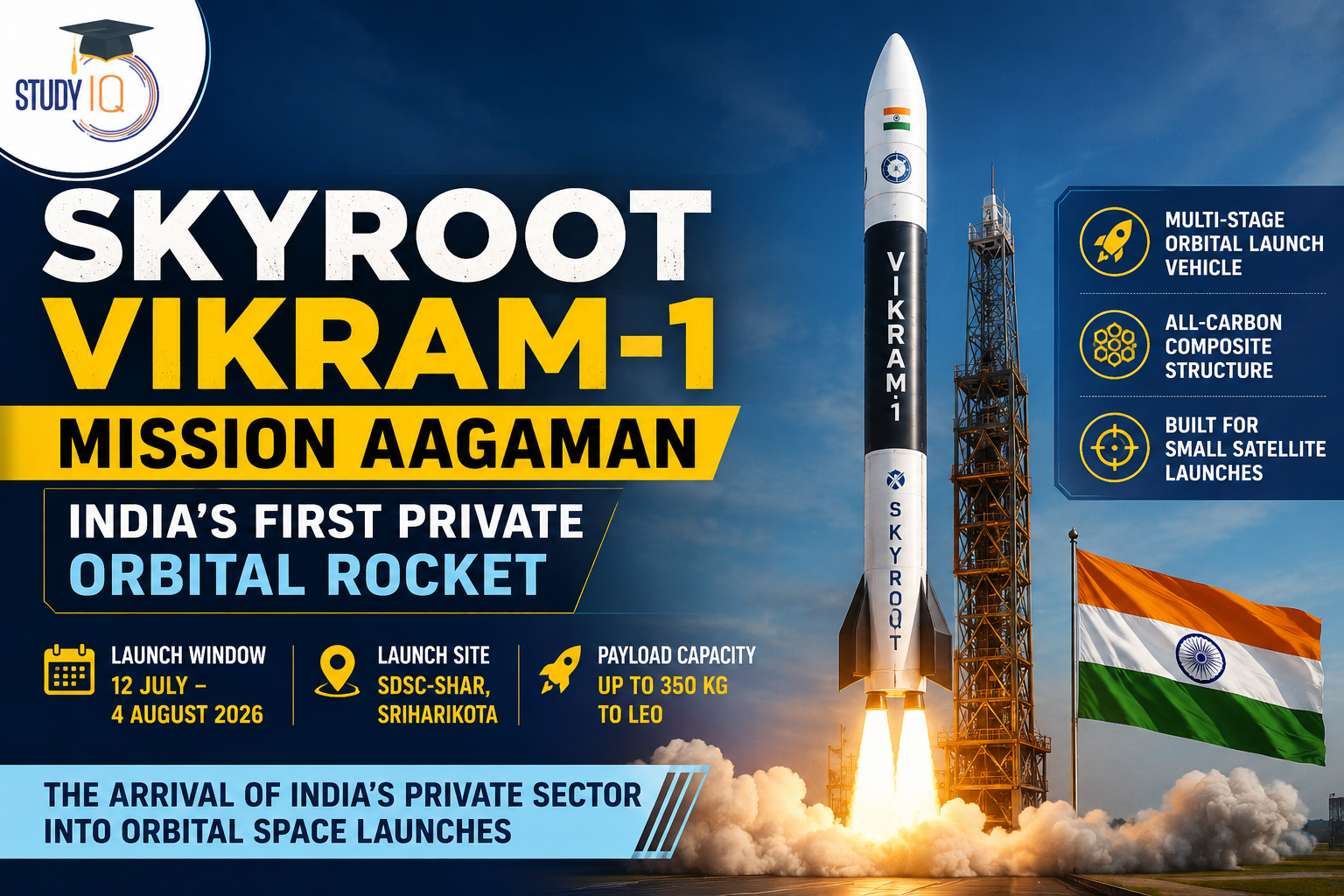
India’s private space sector is poised to achieve a historic milestone with the launch of Skyroot Aerospace’s Vikram-1, the country’s first privately developed orbital launch vehicle. The maiden mission, named Mission Aagaman (The Arrival), marks a new era for India’s commercial space industry by demonstrating the capability of private companies to independently develop and launch orbital rockets. Scheduled between 12 July and 4 August 2026, the mission will lift off from the Satish Dhawan Space Centre (SDSC), Sriharikota.
What is Vikram-1?
Vikram-1 is India’s first privately built orbital launch vehicle developed by Skyroot Aerospace, a Hyderabad-based space technology startup. Named after Dr. Vikram Sarabhai, the father of India’s space programme, the rocket has been designed to provide affordable, reliable, and on-demand satellite launch services for the global small satellite market.
Unlike Vikram-S, which completed a sub-orbital demonstration flight in 2022, Vikram-1 is capable of placing satellites into orbit, making it suitable for commercial satellite launches.
What is Mission Aagaman?
The inaugural flight of Vikram-1 has been named Mission Aagaman, symbolising the arrival of India’s private sector into orbital space launches.
Objectives of Mission Aagaman
The mission aims to collect real-time flight data that cannot be replicated through ground testing, including:
- Acoustic vibrations
- Thermal conditions during supersonic ascent
- Stage separation performance
- Flight dynamics
- Vehicle stability
- Propulsion efficiency
The data gathered will help Skyroot Aerospace refine future commercial launches and enhance rocket performance.
Launch Schedule
| Particular | Details |
|---|---|
| Mission Name | Mission Aagaman |
| Launch Vehicle | Vikram-1 |
| Launch Window | 12 July – 4 August 2026 |
| Launch Site | Satish Dhawan Space Centre (SDSC), Sriharikota |
| Mission Type | Maiden Orbital Launch |
| Payload | Indian startups and international commercial satellites |
Vikram-1 Specifications
Rocket Overview
| Feature | Specification |
|---|---|
| Height | Approximately 20–24 metres |
| Structure | All-carbon composite airframe |
| Number of Stages | Four |
| Launch Capability | Orbital Launch Vehicle |
Propulsion System
| Stage | Engine |
|---|---|
| First Stage | Kalam-1200 (Solid Fuel) |
| Second Stage | Kalam-250 (Solid Fuel) |
| Third Stage | Kalam-100 (Solid Fuel) |
| Fourth Stage | Raman-I (Liquid Fuel Engine) |
Payload Capacity
| Orbit | Capacity |
|---|---|
| Low Earth Orbit (LEO) | Up to 350 kg |
| Sun-Synchronous Orbit (SSO) | Up to 260 kg |
| Target Orbit | 450 km altitude, 60° inclination |
Advanced Technologies Used in Vikram-1
1. All-Carbon Composite Structure
Vikram-1 features an all-carbon composite body instead of conventional metallic structures. This lightweight design:
- Reduces overall rocket mass
- Improves payload capacity
- Enhances fuel efficiency
- Lowers launch costs
2. 3D-Printed Rocket Engines
Skyroot Aerospace extensively uses additive manufacturing (3D printing) for engine components.
Benefits include:
- Faster production
- Reduced manufacturing cost
- Simplified engine design
- Higher manufacturing precision
The Kalam solid rocket motors and Raman-I liquid engine incorporate advanced 3D-printed components.
3. Indigenous Guidance, Navigation and Control (GNC)
The rocket uses a fully indigenous Guidance, Navigation and Control (GNC) system that autonomously:
- Tracks the flight path
- Maintains vehicle stability
- Performs trajectory corrections
- Ensures precise satellite deployment
Why Vikram-1 is Significant for India
The successful launch of Vikram-1 would represent a landmark achievement for India’s private space ecosystem.
Its significance includes:
- First privately developed Indian orbital launch vehicle
- Strengthens India’s commercial space capabilities
- Demonstrates indigenous rocket development by the private sector
- Supports the growing global small satellite launch market
- Boosts India’s position as a competitive launch service provider
- Encourages innovation following India’s space sector reforms
The mission reflects the success of policy reforms that opened India’s space sector to private participation, enabling startups to contribute alongside national space agencies.
Vikram-1 vs Vikram-S
| Feature | Vikram-S | Vikram-1 |
|---|---|---|
| Launch Year | 2022 | 2026 |
| Mission Type | Sub-orbital | Orbital |
| Purpose | Technology Demonstrator | Commercial Satellite Launch Vehicle |
| Satellite Deployment | No | Yes |
| Commercial Capability | Limited | Full Operational Capability |
While Vikram-S validated several key technologies during its sub-orbital flight, Vikram-1 is designed to routinely place satellites into Low Earth Orbit (LEO) and Sun-Synchronous Orbit (SSO).
 Oor Pare Prehistoric Site: Location, Roc...
 Assam Election 2026: Exit Poll, Result D...
 Great Indian Bustard (GIB): Features, Th...













 WhatsApp





