Table of Contents
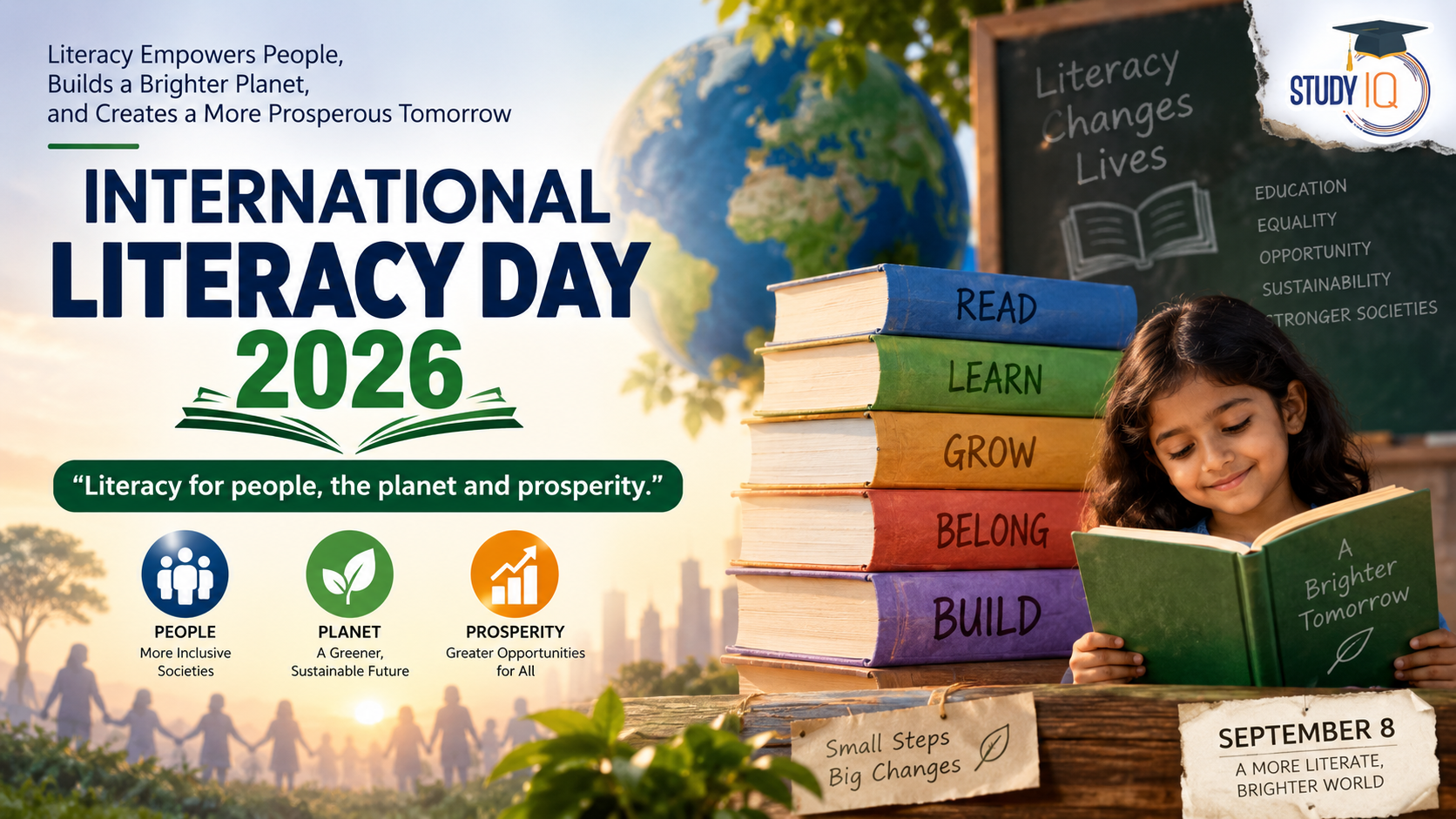
International Literacy Day 2026 is observed on September 8 every year to highlight the importance of literacy as a fundamental human right and a foundation for education, employment, social participation and sustainable development. In 2026, the observance marks its 60th anniversary.
The International Literacy Day 2026 theme is “Literacy for people, the planet and prosperity.” The theme highlights how literacy can promote inclusion, environmental awareness, better livelihoods and sustainable development.
Read Also: UPSC Daily Current Affairs 2026
International Literacy Day 2026: Key Facts
| Particular | Details |
|---|---|
| Date | September 8, 2026 |
| Theme | “Literacy for people, the planet and prosperity” |
| Proclaimed by | UNESCO |
| Proclaimed in | 1966 |
| First observed | 1967 |
| 2026 milestone | 60th anniversary |
| Global celebration | Chiapas, Mexico |
| Key SDG | SDG 4 – Quality Education |
| SDG Target | Target 4.6 – Literacy and numeracy |
Why Is International Literacy Day Celebrated?
International Literacy Day aims to raise awareness about the importance of literacy and encourage governments, educators and organisations to expand access to quality education.
Literacy is more than the ability to read and write. It enables individuals to:
- Access and understand information
- Exercise their rights
- Participate in social and civic life
- Improve employment opportunities
- Develop skills
- Pursue lifelong learning
- Make informed decisions
International Literacy Day 2026 Theme
The theme “Literacy for people, the planet and prosperity” connects literacy with three important dimensions:
People
Literacy promotes social inclusion, equality, participation and empowerment, helping individuals access opportunities and essential services.
Planet
Literacy can improve people’s ability to understand environmental challenges, climate-related information and sustainable practices.
Prosperity
Literacy strengthens access to education, employment, skills and economic opportunities, contributing to individual and community development.
Global Literacy Challenges
Despite considerable progress, universal literacy remains a global challenge.
UNESCO-related estimates indicate that approximately 739 million youth and adults lacked basic literacy skills based on 2024 data. Around four in 10 children are also not reaching minimum proficiency in reading.
Literacy gaps are often associated with poverty, inequality, gender disparities, conflict and limited access to quality education.
International Literacy Day 2026 Celebration
UNESCO’s global International Literacy Day celebration will be held on September 8–9, 2026, in Chiapas, Mexico, in collaboration with the Government of Mexico.
The event will bring together education ministers, experts, teachers and learners to discuss:
- Global literacy progress
- Persistent literacy gaps
- Emerging challenges
- Policy solutions
- Future literacy programmes
The UNESCO International Literacy Prizes will also recognise outstanding literacy initiatives from around the world.
History of International Literacy Day
UNESCO proclaimed September 8 as International Literacy Day in 1966 during its 14th General Conference. The first International Literacy Day was observed in 1967.
Over the years, the focus of the observance has expanded beyond basic reading and writing to include digital literacy, inclusion, multilingual education, lifelong learning and sustainable development.
International Literacy Day and SDG 4
Literacy is closely linked with Sustainable Development Goal 4 (SDG 4), which seeks to ensure inclusive and equitable quality education and promote lifelong learning opportunities for all.
SDG Target 4.6 calls for ensuring that all youth and a substantial proportion of adults achieve literacy and numeracy by 2030.
Why Is Literacy Important?
Literacy contributes to development at both individual and societal levels. It can help people access healthcare information, understand financial and government services, secure employment and participate more effectively in society.
In the digital age, literacy is also increasingly connected with the ability to find, understand, evaluate and use information responsibly.
International Literacy Day 2026: Significance
The 60th anniversary of International Literacy Day provides an opportunity to assess six decades of progress while addressing the millions of people who remain excluded from basic literacy.
The 2026 theme reinforces the idea that literacy is not merely an educational outcome. It is an important tool for building inclusive societies, sustainable communities and prosperous economies.
International Literacy Day 2026: Key Takeaways
- Date: September 8
- 2026 Theme: Literacy for people, the planet and prosperity
- UNESCO proclaimed it: 1966
- First observed: 1967
- 2026: 60th anniversary
- Global celebration: Chiapas, Mexico
- Adults lacking basic literacy skills: Around 739 million
- Major SDG: SDG 4
- Literacy target: SDG 4.6
- Core message: Literacy is a foundation for education, opportunity, inclusion and sustainable development.
UPSC IAS Live GS P2I Foundation 2027 Pratigya August Evening Batch 2 (Basic)
FAQs on International Literacy Day 2026
Q1. When is International Literacy Day 2026 observed?
International Literacy Day 2026 is observed on September 8, 2026.
Q2. What is the theme of International Literacy Day 2026?
The theme is “Literacy for people, the planet and prosperity.”
Q3. When was International Literacy Day first observed?
The first International Literacy Day was observed in 1967, after UNESCO proclaimed it in 1966.
Q4. Where will UNESCO’s global International Literacy Day 2026 celebration be held?
The global celebration is scheduled for Chiapas, Mexico, on September 8–9, 2026.
Q5. Which SDG is closely associated with literacy?
Literacy is closely linked with SDG 4 – Quality Education, particularly Target 4.6.
 India-China Border Tensions 2026: LAC, I...
 Career247 Rebrands as Adda247 Skills to ...
 GRAP Stage I Explained: AQI Limits, Meas...












 WhatsApp