
Table of Contents
Poompuhar: A Maritime Heritage Site in News
Poompuhar, also known as Kaveripattinam or Puhar, is an ancient port settlement on the Tamil Nadu coast. It has recently gained attention as the third phase of underwater archaeological exploration is underway around the site.
The exploration aims to identify and study submerged archaeological remains and improve our understanding of this ancient maritime settlement’s evolution.
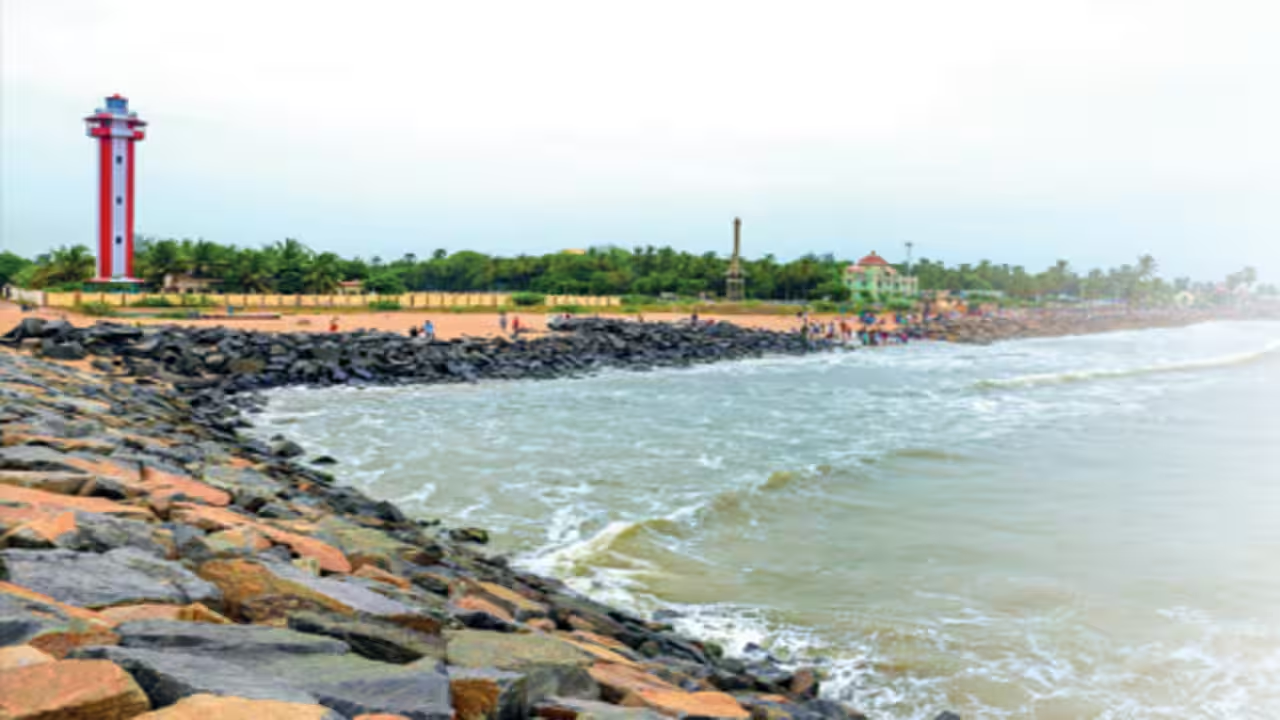
Where is Poompuhar Located?
- State: Tamil Nadu
- District: Mayiladuthurai
- Geographical setting: Near the mouth of the Kaveri River, where it meets the Bay of Bengal.
- Its location at the river–sea interface helped Poompuhar develop as an important centre of maritime trade and commerce.
Historical Significance
Poompuhar was an important Chola-era port and maritime centre. Its strategic coastal location enabled interaction between the Tamil region and trading networks across the Indian Ocean.
The settlement is particularly important for understanding:
- Ancient Tamil maritime traditions
- Indian Ocean trade networks
- Chola commercial activities
- Coastal urbanisation
- Early port infrastructure and overseas contacts
Poompuhar in Sangam Literature
Poompuhar is not significant only because of archaeological evidence. It also occupies an important place in Tamil literary traditions.
The ancient city is prominently associated with works such as:
- Silappadikaram
- Manimekalai
These texts provide valuable descriptions and cultural references relating to the city’s urban life, commerce, society and maritime character.
Read Also: UPSC Daily Current Affairs 2026
Why is Underwater Archaeology Important at Poompuhar?
A major feature of Poompuhar is the presence of archaeological evidence beneath the sea and along the submerged coastal landscape.
Underwater archaeological exploration can help researchers investigate:
- Submerged structures
- Ancient habitation areas
- Artefacts and cultural remains
- Evidence of maritime activity
- Changes in the ancient coastline
Such evidence can complement literary and terrestrial archaeological findings to reconstruct the history of Poompuhar.
Why Did Parts of Poompuhar Become Submerged?
The submergence of parts of the ancient settlement has been associated with long-term coastal and marine processes.
Possible factors under investigation include:
- Marine erosion
- Shoreline changes
- Coastal geomorphological processes
- Changes around the Kaveri delta
- Other natural processes affecting coastal settlements
The exact sequence and extent of submergence require archaeological, geological and oceanographic evidence.
Significance for India’s Maritime Heritage
Poompuhar provides an important window into India’s ancient maritime connections. Its location on the Bay of Bengal places it within the wider network of ports that connected the Indian subcontinent with Southeast Asia and other parts of the Indian Ocean world.
The site therefore contributes to the study of:
Ancient ports → Indian Ocean trade → Tamil maritime history → Coastal archaeology → Underwater cultural heritage

UPSC IAS Live GS P2I Foundation 2027 Pratigya August Evening Batch 2 (Basic)
Conclusion
The renewed underwater exploration of Poompuhar is significant not merely as an archaeological exercise but as an effort to reconstruct India’s maritime and cultural past. The submerged remains can potentially provide new evidence about ancient port urbanism, trade networks and environmental changes along the Tamil Nadu coast.
Poompuhar thus represents the intersection of archaeology, maritime history, literature and coastal geomorphology, making it an important site for understanding India’s ancient engagement with the wider Indian Ocean world.
 India-China Border Tensions 2026: LAC, I...
 Career247 Rebrands as Adda247 Skills to ...
 GRAP Stage I Explained: AQI Limits, Meas...














 WhatsApp