
Table of Contents
Context
The convergence of civil disputes and criminal liability in India has historically posed intricate legal and practical challenges. A recent decision by the Allahabad High Court in Vikash Kumar v. State of Uttar Pradesh has once again highlighted a persistent difficulty in criminal jurisprudence: the concurrent application of charges pertaining to cheating and criminal breach of trust. The Court noted that the simultaneous invocation of both violations does not render the proceedings unlawful, especially at a preliminary stage where the exact nature of the offence remains undetermined.
This observation indicates a prevalent prosecution practice. In various financial and commercial conflicts, claims of non-payment or misappropriation of funds frequently lead to the concurrent application of Sections 420 and 406 of the Indian Penal Code, 1860 (IPC), which are currently reflected in Sections 318 and 316 of the Bharatiya Nyaya Sanhita, 2023 (BNS). This poses a significant doctrinal investigation: Is it possible for cheating and criminal breach of trust to coexist within the same factual circumstances?

Legal Framework: IPC and BNS Regulations
The offences of cheating and criminal breach of trust are codified under:
- Section 420 IPC / Section 318 BNS – Cheating and dishonestly inducing the delivery of property
- Section 406 IPC / Section 316 BNS – Criminal Breach of Trust
Both charges entail aspects of dishonesty; yet, their legal components and conceptual underpinnings differ markedly. Grasping this distinction is crucial to preventing doctrinal ambiguity and the improper application of criminal law.
Cheating: Definition and Fundamental Components
Cheating is delineated in Section 415 of the Indian Penal Code and is subject to punishment under Section 420 of the same code. The essence of the offence lies in deception at the very inception.
In Hari Prasad Chamaria v. Bishun Kumar Surekha, the Supreme Court determined that a mere failure to fulfil a promise does not constitute cheating unless there is an inherent dishonest motive from the outset.
In S.W. Palanitkar v. State of Bihar, the Court elucidated that:
- There must be deceitful persuasion.
- The inducement must result in the transfer of property or a change in status.
- The purpose to mislead must be present at the moment of persuasion.
Consequently, cheating is essentially a pre-contractual violation, grounded in original dishonest intent.
Criminal Breach of Trust: Definition and Fundamental Elements
The criminal breach of trust, as delineated in Section 405 of the IPC and subject to punishment under Section 406 of the IPC, functions within a distinct legal framework.
The fundamental components comprise:
- Delegation of property or authority over property
- Subsequent fraudulent misappropriation or conversion
- Infringement of legal directive or contractual duty
Unlike cheating, the original transaction is legitimate, and the offence emerges from subsequent abuse.
The Supreme Court in S.W. Palanitkar v. State of Bihar underscored that entrustment is essential for criminal breach of trust. The offence cannot be substantiated without entrustment.
Doctrinal Distinction: Timing of Dishonest Intention
The most critical distinction between cheating and criminal breach of trust lies in the timing of dishonest intention:
| Aspect | Cheating | Criminal Breach of Trust |
| Nature of transaction | Fraudulent from the beginning | Lawful at inception |
| Timing of intention | At the time of inducement | Develops after entrustment |
| Key element | Deception | Entrustment |
| Legal consequence | Inducement leading to delivery | Misuse of entrusted property |
This distinction was reaffirmed in Delhi Race Club (1940) Ltd. v. State of Uttar Pradesh, where the Supreme Court observed that the two offences are mutually exclusive in their foundational elements and cannot ordinarily coexist on the same set of facts.
What is the rationale for the simultaneous invocation of both offences? Procedural Adaptability
Notwithstanding their doctrinal dissimilarity, both offences are often cited concurrently in FIRs. This seeming inconsistency is elucidated by procedural law.
Section 221 of the Code of Criminal Procedure, 1973 (CrPC), presently incorporated in Section 244 of the Bharatiya Nagarik Suraksha Sanhita, 2023 (BNSS), permits alternative or additional charges in instances of ambiguity concerning the precise nature of the offence.
The section specifically authorises:
- Prosecuting an individual for several offences
- Alternative framing of charges
- Continuing notwithstanding the ambiguity of the legal classification
The instance in Section 221 elucidates that if an act potentially constitutes theft, cheating, or criminal breach of trust, the accused may be prosecuted for any or all of these offences.
Consequently, at the investigation and charge-framing phase, the invocation of both crimes is legally permissible.
Judicial Analysis of Procedural Adaptability
The finding in Vikash Kumar v. State of U.P. conforms to this procedural framework. The Court acknowledged that at the bail stage, it is premature to definitively ascertain the nature of the offence.
Nonetheless, this flexibility is not unconditional. Judicial bodies have regularly determined that:
- Procedural liberty cannot supersede fundamental legal norms.
- Charges must eventually correspond with the evidence documented.
- The principle of mutual exclusivity of offences must be upheld during the conviction phase.
Improper Utilisation in Commercial and Financial Conflicts
A major issue stemming from this practice is the criminalisation of civil disputes. In numerous instances of contract violation or non-payment, parties employ criminal statutes as a coercive strategy.
The Supreme Court in Pepsi Foods Ltd. v. Special Judicial Magistrate warned that:
- Criminal proceedings should not be commenced automatically.
- Issuing a summons to an accused individual is a grave affair.
- Courts must exercise judicial discretion prior to issuing a process.
In Hari Prasad Chamaria v. Bishun Kumar Surekha, the Court cautioned against conflating contractual violations with criminal crimes.
Influence on Bail and Quashing Jurisprudence
The concurrent assertion of cheating and criminal breach of trust yields practical ramifications in:
- Bail applications: The existence of numerous grave offences may affect judicial perception.
- Quashing petitions under Section 482 CrPC: In quashing petitions under Section 482 of the Criminal Procedure Code, courts must evaluate whether the elements of either offence are established.
- Judicial proceedings: Ambiguity in charges may hinder adjudication.
Judicial bodies frequently determine that neither charge is entirely substantiated, resulting in acquittals or the annulment of proceedings.
Requirement for Doctrinal Precision
The persistent ambiguity underscores the necessity for:
- Enhanced training for investigative officers
- Meticulous examination by magistrates throughout the cognisance phase
- Distinct separation between civil and criminal liability
The Supreme Court in Delhi Race Club (2024) underscored the importance of comprehending the doctrinal differentiation between these offences, advocating for enhanced legal precision in their enforcement.
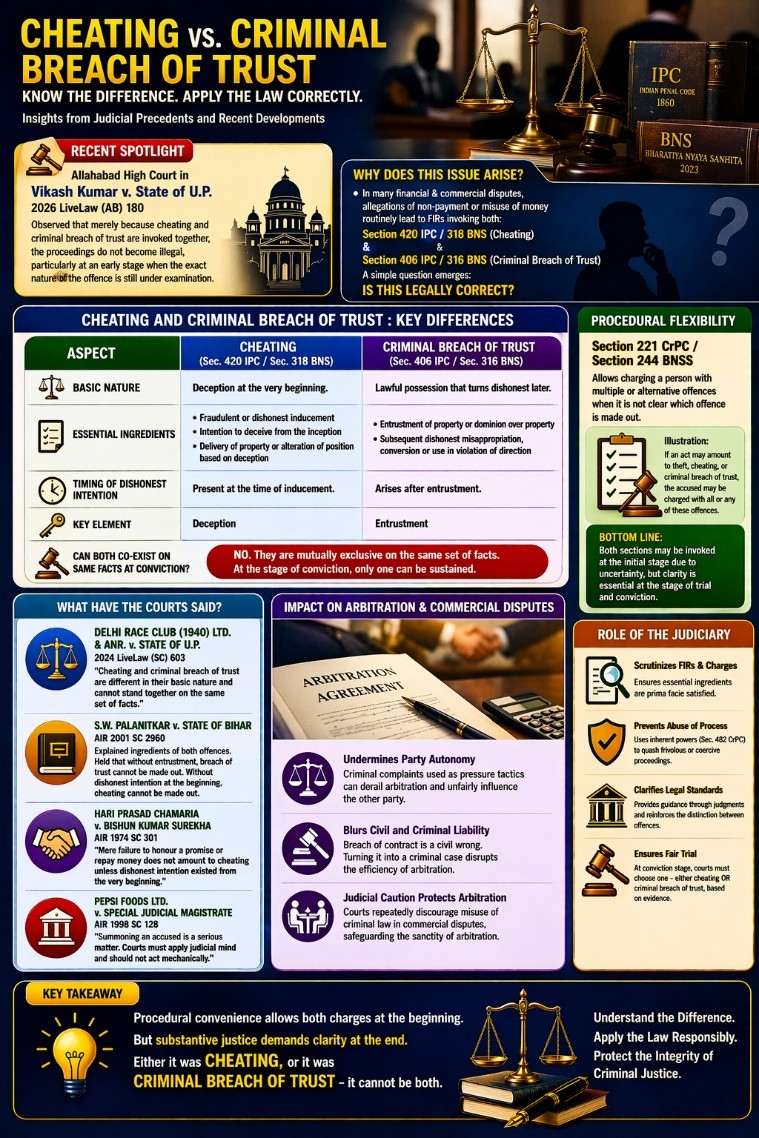
Procedural Flexibility in Criminal Law: The Function of Section 221 CrPC / Section 244 BNSS
The doctrinal distinction between cheating and criminal breach of trust is evident, criminal procedure allows for a certain degree of flexibility. Section 221 of the Code of Criminal Procedure, 1973 (now Section 244 of the Bharatiya Nagarik Suraksha Sanhita, 2023) permits the formulation of alternative or numerous charges when the exact nature of the offence remains ambiguous.
This rule recognises that, throughout the inquiry or charge formulation phase, facts may not be completely established. Thus, it allows the prosecution to indict an accused for various offences, including cheating and criminal breach of trust, where the evidence is inconclusive.
The statutory example clearly states that if an act may qualify as theft, cheating, or criminal breach of trust, the accused may be charged with any or all of these offences. Consequently, the concurrent application of Sections 420 and 406 IPC (or their BNS counterparts) at the preliminary stage is legally valid.
Nonetheless, this procedural flexibility is not limitless. It is designed as a provisional measure to resolve evidence ambiguity, not as a replacement for thorough legal examination.
The Essential Differentiation during the Conviction Phase
A basic principle arises from judicial precedents: although several charges may coexist from the outset, they cannot result in concurrent convictions based on the same factual circumstances.
During the adjudication phase, the court must conduct a meticulous assessment of evidence to ascertain the exact nature of the offence. The mutually exclusive components of cheating and criminal breach of trust require a conclusive determination:
- If fraudulent intent was there at the outset – Deception
- If the entrustment was legitimate but subsequently misappropriated – Criminal Breach of Trust
The court cannot rationally uphold both verdicts simultaneously, as this would contradict the chronological structure of mens rea inherent to each act.
This principle embodies the overarching dedication of criminal law to accuracy, equity, and doctrinal consistency.
Judicial Caution Regarding the Misapplication of Criminal Law in Civil Conflicts
A persistent issue in Indian criminal jurisprudence is the exploitation of penal provisions in fundamentally civil or economic conflicts. Judicial authorities have constantly warned against converting business disputes into criminal charges.
In Hari Prasad Chamaria v. Bishun Kumar Surekha, the Supreme Court determined that a mere failure to honour a promise or refund a debt does not amount to cheating unless fraudulent intent is demonstrated from the beginning.
In Pepsi Foods Ltd. v. Special Judicial Magistrate, the Court underscored that summoning an accused in a criminal prosecution is a significant issue necessitating judicial deliberation. The mechanical application of criminal laws compromises the integrity of the justice system.
These judgements emphasise that criminal law should not be utilised as a coercive instrument for debt collection or commercial advantage.
Convergence of Commercial and Arbitration Disputes
The abuse of criminal law is especially evident in commercial and arbitration disputes. Parties frequently utilise criminal complaints as a strategic instrument to apply pressure in contractual disputes.
This approach compromises the integrity of alternative dispute resolution methods, such as arbitration. Arbitration aims to offer a civil, efficient, and specialised venue for the resolution of business disputes. The simultaneous commencement of criminal procedures undermines this framework and inserts coercive aspects into what ought to be a civil adjudicative process.
The Supreme Court has consistently underscored that criminal law must not be employed to evade contractual remedies or to coerce parties in commercial conflicts. The differentiation between civil liability and criminal culpability must be meticulously maintained.
Conclusion
The legal framework regarding cheating and criminal breach of trust demonstrates a careful equilibrium between procedural adaptability and substantive accuracy. The law allows for the concurrent invocation of both offences at the preliminary stage to resolve evidentiary ambiguity, but it requires clarity and consistency during adjudication.
The differentiation between the two offences, anchored in the timing of fraudulent purpose and the existence of entrustment, is essential to criminal law. Judicial precedents have constantly underscored that these offences cannot coexist under the same factual circumstances at the conviction stage.
The recurrent abuse of these rights in commercial disputes highlights the necessity for enhanced judicial scrutiny and institutional change. Courts must persist in preserving the integrity of criminal law by averting its conversion into an instrument of coercion.
Ultimately, the premise is both simple and profound: procedural convenience cannot supersede substantive fairness. While cheating and criminal breach of trust may initially coincide in a case, the resolution must ultimately be obvious and legally coherent.

 Supreme Court on Plaint Amendment After ...
 Supreme Court on Children's Right to Int...
 Supreme Court Dowry Enforcement Order 20...








 WhatsApp