Table of Contents
Context
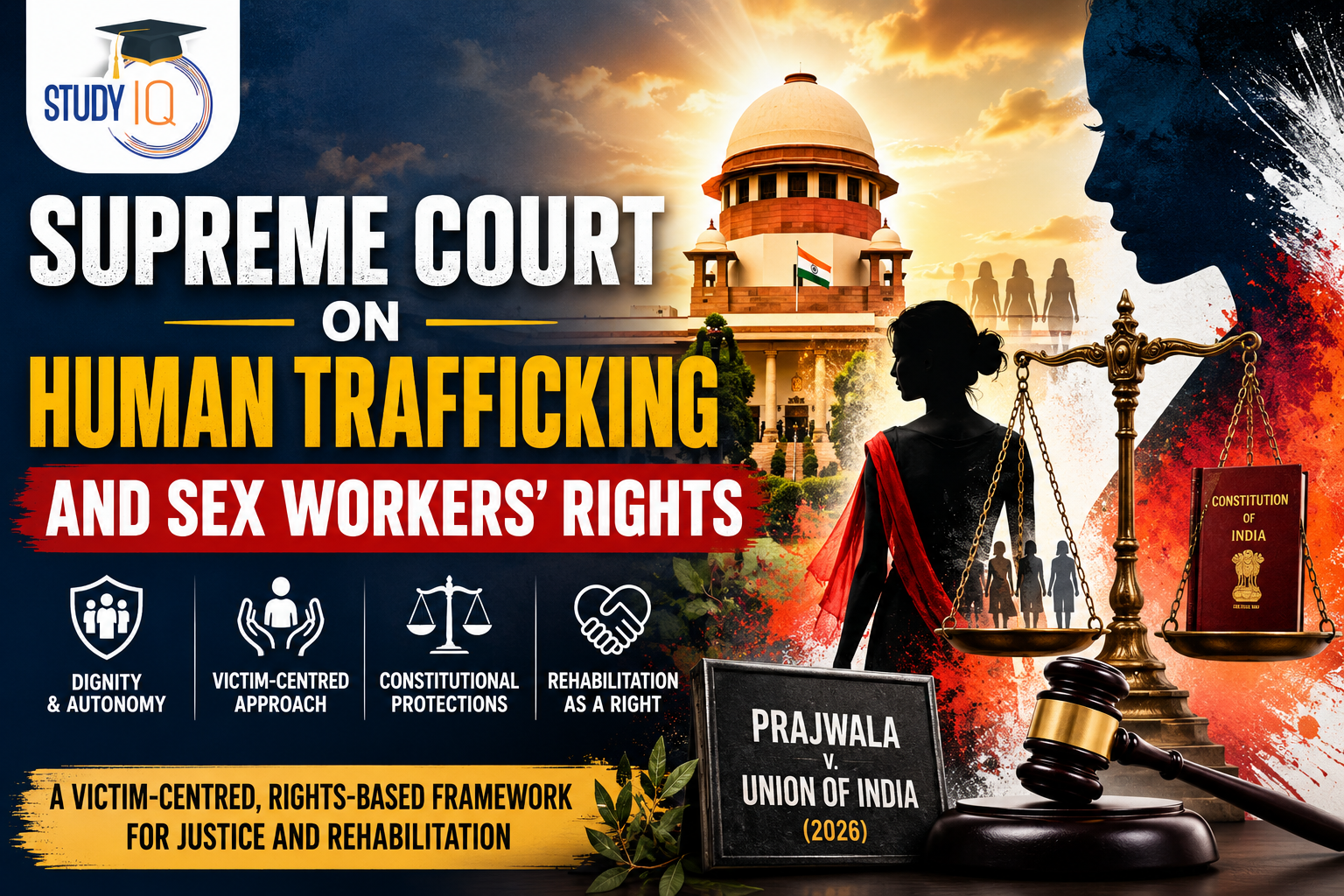
In a seminal judgement in Prajwala v. Union of India (2026 LiveLaw (SC) 574), the Supreme Court of India conducted an extensive analysis of human trafficking, commercial sexual exploitation, victim rehabilitation, and the rights of sex workers within modern constitutional law. The decision signifies a substantial transition from a paternalistic and institutional paradigm to a victim-centred and rights-based framework rooted in constitutional principles of dignity, autonomy, liberty, and equality.
The decision resulted from an extensive public interest litigation initiated in 2004, which developed into an ongoing judicial endeavour to rectify the systemic deficiencies in trafficking prevention, victim rescue, rehabilitation, and reintegration. The Supreme Court, exercising its authority under Articles 32 and 142 of the Constitution, established a nationwide Victim Protection Plan and issued mandatory directives to the Union Government, States, and Union Territories.
The judgement is founded on a transformative principle: trafficking victims and adult sex workers must not be seen as passive subjects of state intervention. They are persons with rights whose choices, desires, and autonomy merit constitutional recognition.
Read Also: Judiciary Current Affairs
Understanding Human Trafficking and Commercial Sexual Exploitation in India
Human trafficking persists as a significant human rights issue facing India. It encompasses the recruitment, transportation, transfer, harbouring, or receiving of individuals using force, coercion, fraud, exploitation of vulnerability, or other illicit methods for the purpose of exploitation. Commercial sexual exploitation represents one of the most widespread forms of trafficking. Women and children are often victimised by organised trafficking networks that operate across state and international borders. Victims frequently endure violence, coerced prostitution, debt bondage, incarceration, psychological maltreatment, and the denial of fundamental liberties.
The issue is exacerbated by poverty, gender disparity, social marginalisation, inadequate education, migration vulnerabilities, and weak institutional protections. Notwithstanding the presence of numerous legal measures, trafficking persists due to inadequate enforcement mechanisms, poor rehabilitation systems, and societal stigmatisation of survivors. The Supreme Court noted that the current legal framework is deficient in providing a comprehensive and uniform system for victim protection and rehabilitation.
Constitutional Underpinnings of Anti-Trafficking Safeguards
The constitutional foundation for addressing trafficking is predominantly located in Article 23 of the Constitution, which explicitly forbids human trafficking and forced labour. Article 23 holds a distinctive status among fundamental rights as it enforces a direct constitutional ban on exploitative conduct. Article 21 additionally ensures the right to life and personal liberty. Article 21 has undergone extensive judicial interpretation, now encompassing dignity, privacy, bodily integrity, autonomy, livelihood, housing, health, and rehabilitation.
The Supreme Court has consistently affirmed that the right to life encompasses more than mere biological survival. It encompasses the right to exist with dignity and devoid of exploitation. Thus, trafficking victims are entitled not only to liberation from exploitation but also to rehabilitation, social reintegration, psychological recovery, and active involvement in decisions that impact their future. The Court underscored that rehabilitation should be seen as a fundamental duty arising directly from Article 21, rather than simply a legislative welfare initiative.
Legislative Framework Regulating Trafficking and Sexual Exploitation
India’s anti-trafficking framework presently functions through many statutes. The Immoral Traffic (Prevention) Act, 1956 (ITPA) is the primary statute governing offences relating to prostitution and trafficking for commercial sexual exploitation. The Juvenile Justice (Care and Protection of Children) Act, the Protection of Children from Sexual Offences Act (POCSO), the Bharatiya Nyaya Sanhita, and several state-implemented welfare systems offer further safeguards.
Nevertheless, the Supreme Court noted that these statutes often function independently and lack sufficient coordination. The Court also recognised significant shortcomings in the execution of rehabilitative measures, victim identification protocols, and institutional accountability systems. The Court emphasised a primary issue over the ITPA framework’s propensity to equate trafficking victims with consenting adult sex workers, neglecting to acknowledge the substantial disparities in their situations.
The Rights of Sex Workers in Indian Constitutional Law
An important element of the decision is the Court’s acknowledgement of the constitutional rights of adult sex workers. Indian law does not penalise consensual sex work performed by adults. Instead, it penalises actions such as operating brothels, soliciting individuals for prostitution, trafficking, and exploiting humans for financial gain through sexual acts.
The Supreme Court reiterated principles established in Budhadev Karmaskar v. State of West Bengal (2022), affirming that adult sex workers are entitled to equal legal protection and must not face discrimination, harassment, or arbitrary interference. The Court noted in Budhadev Karmaskar that consensual sex work is not unlawful and that sex workers possess the same fundamental rights as all other citizens. The decision underscored that dignity is independent of one’s profession and that sex workers are entitled to protection under Articles 14, 19, and 21. The Court in Prajwala emphasised that voluntary adult sex workers should not be indiscriminately classified as trafficking victims necessitating mandatory rescue and institutionalisation. This approach weakens autonomy and neglects the fundamental assurance of personal liberty.
The Issue of Merging Trafficking with Prostitution
The judgement notably acknowledges that trafficking and prostitution are distinct concepts. The Court noted that the ITPA presently encompasses a varied and diversified array of individuals. This include individuals trafficked involuntarily, those who may have initially been trafficked but subsequently engage in sex work voluntarily, and adults who autonomously select sex work as a means of livelihood. Notwithstanding these distinctions, all such individuals are frequently subjected to the same legal procedures under Section 17 of the ITPA.
The Court warned that adopting a uniform approach could result in profoundly inequitable outcomes. It jeopardises the autonomy of voluntary adult sex workers while inadequately addressing the specific vulnerabilities encountered by authentic trafficking victims. The Court maintains that a rights-based legal system must acknowledge these distinctions and customise actions accordingly.
Agency of Victims and the Doctrine of Consent
A salient characteristic of the judgement is its focus on victim agency. The Supreme Court unequivocally dismissed paternalistic presuppositions inherent in conventional rehabilitation frameworks. It noted that decisions regarding rescue, rehabilitation, imprisonment, reintegration, and future placement significantly impact the life, liberty, and dignity of the individual involved.
Consequently, such judgements must consider the victim’s requests with appropriate significance. The Court asserted that it would be fundamentally incongruous with constitutional principles to estimate a victim’s future without taking into account the victim’s genuine desires. Consequently, victim consent should be the paramount element in decisions regarding rehabilitation and reintegration. This approach signifies a significant legal transition from institutional authority to individual autonomy, embodying wider constitutional principles of dignity, self-determination, and substantive freedom.
The Supreme Court’s Victim Protection Plan: A Revolutionary Framework
The Supreme Court, acknowledging the lack of a comprehensive and enforceable national framework for the treatment of trafficking survivors, exercised its exceptional powers under Articles 32 and 142 of the Constitution to establish a thorough Victim Protection Plan applicable nationwide.
The Court noted that, notwithstanding numerous legislative measures and social initiatives, trafficking victims frequently experience disparate treatment throughout jurisdictions. Rescue operations, shelter conditions, rehabilitation processes, legal aid services, and reintegration measures exhibit considerable variability, engendering uncertainty and compromising the constitutional rights of survivors.
To rectify these shortcomings, the Court provided comprehensive directives encompassing all phases of the anti-trafficking procedure, including victim identification, rescue operations, temporary incarceration, rehabilitation, reintegration, prosecution assistance, institutional coordination, and long-term welfare. The decision underscored that the aim was not solely administrative change but the establishment of a victim-centred system that prioritises dignity, autonomy, and empowerment.
Threshold Investigation and Identification of Voluntary Adult Sex Workers
The judgement introduces a threshold inquiry process, which is one of its most unique components. The Court determined that when an adult is presented before a Magistrate under Section 17 of the Immoral Traffic (Prevention) Act, authorities must first ascertain whether the subject is a consenting adult sex worker or a victim of trafficking.
The Court asserts that this investigation must consider three essential questions. Initially, it is essential to ascertain whether the individual perceives her participation in commercial sex labour as voluntary. Secondly, she desires to be placed in long-term protective custody. Third, the authenticity of any preference articulated by her must be assessed to ensure it is truly free and devoid of pressure or improper influence.
The Court mandated that qualified social workers help in this evaluative process. Nevertheless, the victim’s account must be given paramount importance. This directive signifies a significant shift from prior procedures, wherein all individuals rescued from prostitution-related circumstances were consistently subjected to institutionalisation, irrespective of their preferences.
Preeminence of Victim Consent
The Court consistently emphasised that victim agreement should be the fundamental criterion in decisions regarding rehabilitation and reintegration. The decision states that rehabilitation must not serve as a means for the State to replace the individual’s judgement. The State has a fundamental duty to offer rehabilitation chances, but it lacks the jurisdiction to enforce rehabilitation upon a competent adult’s preferences.The Court noted that the right to rehabilitation includes access to housing, education, counselling, vocational training, healthcare, compensation, and social assistance. The constitutional promise of rehabilitation does not permit involuntary confinement or mandatory institutionalisation.
A Magistrate may only overlook a victim’s expressed preference in extraordinary circumstances. Such conditions encompass scenarios in which the victim’s liberation would subject her to a significant risk to life or safety, or where the perceived assent results from coercion, threats, intimidation, manipulation, or undue influence. The Court mandated that any deviation from the victim’s preferences must be substantiated by comprehensive written justifications.
Minors as Victims and Augmented Safeguarding Protocols
The Court prioritised autonomy for consenting adults while adopting a more protective stance for youngsters. The decision mandated enhanced integration between the anti-trafficking framework and the established child protection systems under the Juvenile Justice Act and the Protection of Children from Sexual Offences Act.
The Court underscored the essential function of Child Welfare Committees, Anti-Human Trafficking Units, One Stop Centres, Legal Services Authorities, and child protection agencies. It emphasised that child trafficking necessitates specialised action due to children’s inability to provide informed consent legally. Rehabilitation initiatives for child victims must emphasise physical safety, psychological recovery, educational access, family reunification, and long-term social reintegration. The Court acknowledged that child trafficking constitutes one of the most severe infringements of constitutional rights and necessitates synchronised institutional responses at all levels.
Rehabilitation as a Constitutional Right
The judgement significantly acknowledges rehabilitation as a fundamental aspect of the right to life and dignity as stipulated in Article 21. The Court noted that rescue alone cannot rectify the damages inflicted by trafficking. Survivors often endure significant physical, psychological, emotional, social, and economic repercussions. In the absence of substantial rehabilitation, victims continue to be susceptible to re-trafficking, exploitation, social marginalisation, and impoverishment.
The Victim Protection Plan establishes minimum requirements for shelter houses, healthcare facilities, mental health services, vocational training programs, educational possibilities, compensation procedures, legal assistance, and witness protection measures.
The Court underscored that rehabilitation should not be perceived solely as physical removal from exploitative settings. Instead, it entails reinstating the individual’s ability to make significant choices, engage in societal activities, and seek a life of dignity. This rights-based perspective illustrates the broader development of Article 21 jurisprudence, which increasingly acknowledges positive obligations of the State.
Accountability of Institutions and Coordination Among Agencies
The decision recognised insufficient coordination among governmental entities as a significant impediment to effective anti-trafficking initiatives. The Court mandated that each State and Union Territory appoint designated nodal officials to oversee the implementation of the Victim Protection Plan. The Chief of the Anti-Trafficking Bureau, with the rank of Additional Director General of Police, was appointed as the Police Nodal Officer, whilst the Secretary of the Women and Child Development Department was appointed as the Government Nodal Officer.
States were instructed to inform accredited welfare organisations under the ITPA and compile district-specific lists of trained social welfare professionals. The Court underscored that trafficking investigations, victim rehabilitation, child protection, legal assistance, and social welfare functions should be conducted through unified institutional procedures instead of disjointed administrative frameworks.
Legislative Reforms Proposed by the Supreme Court
The decision encompasses not just immediate directives but also comprehensive suggestions for legislative reform. The Court urged the Union Government to reevaluate Sections 7, 8, and 20 of the Immoral Traffic (Prevention) Act. It was noted that these regulations are often applied against trafficking victims, so compromising their victim status and subjecting them to criminalisation.
The Court advised the implementation of clear protections to prevent the prosecution of individuals who are victims or suspected victims of trafficking under these regulations. The Bench also condemned the rehabilitation paradigm based on imprisonment currently integrated into the ITPA. According to current regulations, victims may be housed in protective facilities for durations ranging from one to three years.
The Court asserts that extended detention may convert rehabilitation into a punitive experience that compromises liberty and autonomy. It thus encouraged the government to establish more personalised and less restrictive rehabilitation schemes.
Confronting Law Enforcement Misconduct and Procedural Malfeasance
The Court voiced apprehension about occurrences of police malfeasance during anti-trafficking operations. Submissions presented to the Court revealed instances of arbitrary imprisonment, victim mistreatment, delayed appearances before Magistrates, and exploitation by law enforcement officials.
Thus, the Court advised the establishment of distinct offences aimed at addressing police wrongdoing in trafficking instances. It proposed establishing a rebuttable presumption of wrongful imprisonment when rescued individuals are not presented before a Magistrate within the stipulated timeframe. These proposals demonstrate the Court’s dedication to preventing anti-trafficking measures from serving as tools for rights breaches.
Global Standards and the Palermo Protocol
The decision also assessed India’s adherence to international anti-trafficking standards, specifically the Palermo Protocol. The Court observed a significant discrepancy between the Bharatiya Nyaya Sanhita and the Palermo Protocol. International law does not necessitate evidence of coercive methods for child trafficking. The simple act of recruiting, transporting, transferring, harbouring, or receiving a kid for exploitative purposes is adequate.
Nevertheless, the Court noted that the existing domestic system necessitates evidence of the “means” component even in cases involving minor victims. The Bench characterised this disparity as an issue necessitating immediate legislative intervention. The Court underscored the necessity for local law to more closely conform to globally recognised anti-trafficking norms.
Significant Judicial Precedents
The decision is founded on an extensive body of constitutional law regarding dignity, trafficking, rehabilitation, and the rights of sex workers.
In Vishal Jeet v. Union of India (1990), the Supreme Court mandated that governments address child prostitution and trafficking by coordinated social welfare initiatives.
In Gaurav Jain v. Union of India (1997), the Court emphasised the necessity for rehabilitation and educational prospects for the offspring of sex workers.
In Budhadev Karmaskar v. State of West Bengal (2022), the Court acknowledged the dignity and constitutional rights of sex workers, instructing authorities to refrain from harassing consenting persons involved in voluntary sex work.
In Suchita Srivastava v. Chandigarh Administration (2009), the Court underscored personal autonomy and decisional freedom, concepts that significantly impact the current judgement. Collectively, these decisions facilitated the establishment of a constitutional framework focused on dignity, autonomy, and equality.
Societal Implications of the Decision
The importance of the decision beyond the legal domain. Historically, trafficking victims and sex workers have frequently been perceived via paternalistic perspectives that emphasise control over empowerment. Such methodologies often disregard individual autonomy and reinforce societal shame.
The Supreme Court’s ruling contests these assumptions by confirming that disadvantaged individuals are rights-bearing citizens entitled to constitutional safeguards. The ruling promotes a more compassionate and rights-based approach by differentiating trafficking from consensual sex work, highlighting informed consent, acknowledging rehabilitation as a constitutional right, and insisting on institutional accountability. It further reinforces India’s overarching dedication to gender justice, human dignity, child protection, and substantive equality.
Conclusion
The decision of the Supreme Court in Prajwala v. Union of India is a pivotal point in Indian constitutional law regarding human trafficking, rehabilitation, and the rights of sex workers. The Court has developed a comprehensive Victim Protection Plan to address persistent deficiencies in victim identification, rescue operations, rehabilitation services, and institutional coordination.
The decision prioritises the victim within the legal system. It acknowledges that trafficking survivors are not mere passive receivers of governmental aid but rather autonomous individuals whose choices, dignity, and aspirations warrant respect. The Court’s emphasis on victim consent, distinct treatment of voluntary adult sex workers, child-sensitive safeguards, and substantial rehabilitation demonstrates a deep commitment to constitutional principles.
The decision additionally functions as a summons for legislative reform. The recommendations concerning police accountability, reform of the ITPA, alignment with international norms, and the implementation of comprehensive anti-trafficking legislation offer a framework for future reform. The decision ultimately confirms a vital constitutional principle: the struggle against trafficking must not only penalise exploiters but also restore the dignity, autonomy, and humanity of the exploited individuals. By doing so, the Supreme Court has reinforced the fundamental guarantees of justice, liberty, equality, and dignity for some of society’s most vulnerable individuals.
 Supreme Court on Plaint Amendment After ...
 Supreme Court on Children's Right to Int...
 Supreme Court Dowry Enforcement Order 20...








 WhatsApp