Table of Contents
Context
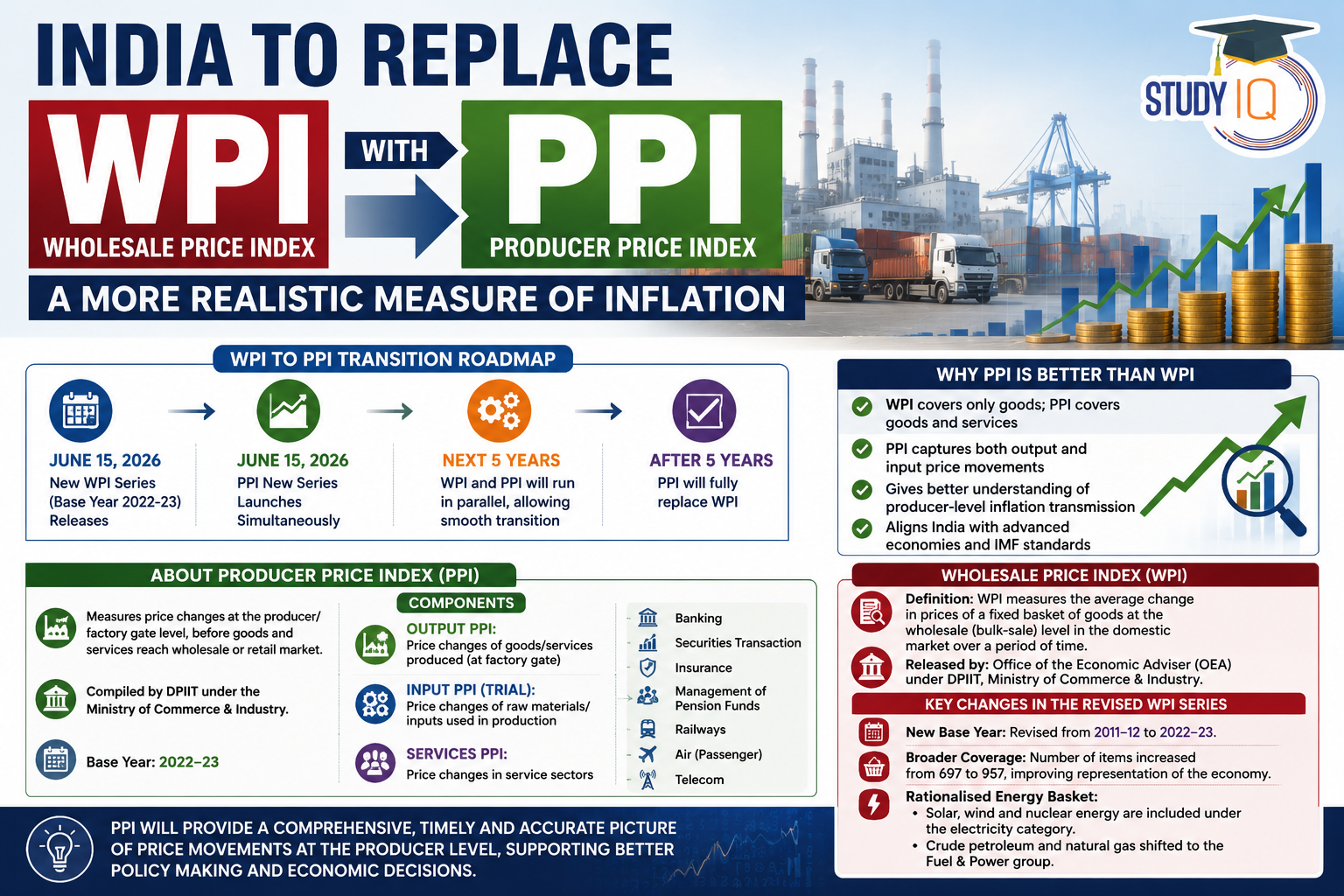
The Centre announced phasing out of the Wholesale Price Index (WPI) over the next five years, replacing it with the Producer Price Index (PPI) for a more realistic assessment of inflationary trends.
WPI to PPI transition
- WPI new series (base year 2022-23) releases on June 15, 2026, replacing old 2011-12 series
- PPI new series also launches on June 15, 2026 simultaneously
- WPI will continue for 5 years alongside PPI, gives users time to switch from WPI to PPI
- WPI currently embedded in price escalation clauses in contracts, 5-year window allows smooth transition
- After 5 years, PPI will fully replace WPI
About PPI
- Producer Price Index (PPI) measures price changes at the producer/factory gate level, capturing prices before goods and services reach the wholesale or retail market.
- Compiled by DPIIT under the Ministry of Commerce & Industry.
- Base year: 2022–23
- Components:
- Output PPI: Price changes of goods/services produced (at factory gate)
- Input PPI (Trial) : Price changes of raw materials/inputs used in production
- Services PPI: Price changes in service sectors
- Banking, Securities Transaction, Insurance, Management of Pension Funds, Railways, Air (Passenger), Telecom
Why PPI is better than WPI
- WPI covers only goods; PPI covers goods and services
- PPI captures both output and input price movements
- Gives better understanding of producer-level inflation transmission
- Aligns India with advanced economies and IMF standards
|
Wholesale Price Index (WPI) |
| ● Definition: WPI measures the average change in prices of a fixed basket of goods at the wholesale (bulk-sale) level in the domestic market over a period of time.
● Released by: Office of the Economic Adviser (OEA) under the Department for Promotion of Industry and Internal Trade (DPIIT), Ministry of Commerce & Industry. Key Changes in the Revised WPI Series ● New Base Year: Revised from 2011–12 to 2022–23. ● Broader Coverage: Number of items increased from 697 to 957, improving representation of the economy. ● Rationalised Energy Basket: ○ Solar, wind and nuclear energy are included under the electricity category. ○ Crude petroleum and natural gas shifted to the Fuel & Power group. |
 Why Do Stampedes Occur in India? Crowd P...
 Strategic Disinvestment in India: IDBI B...
 Women’s Livelihoods in India: Challeng...














 WhatsApp