
Table of Contents
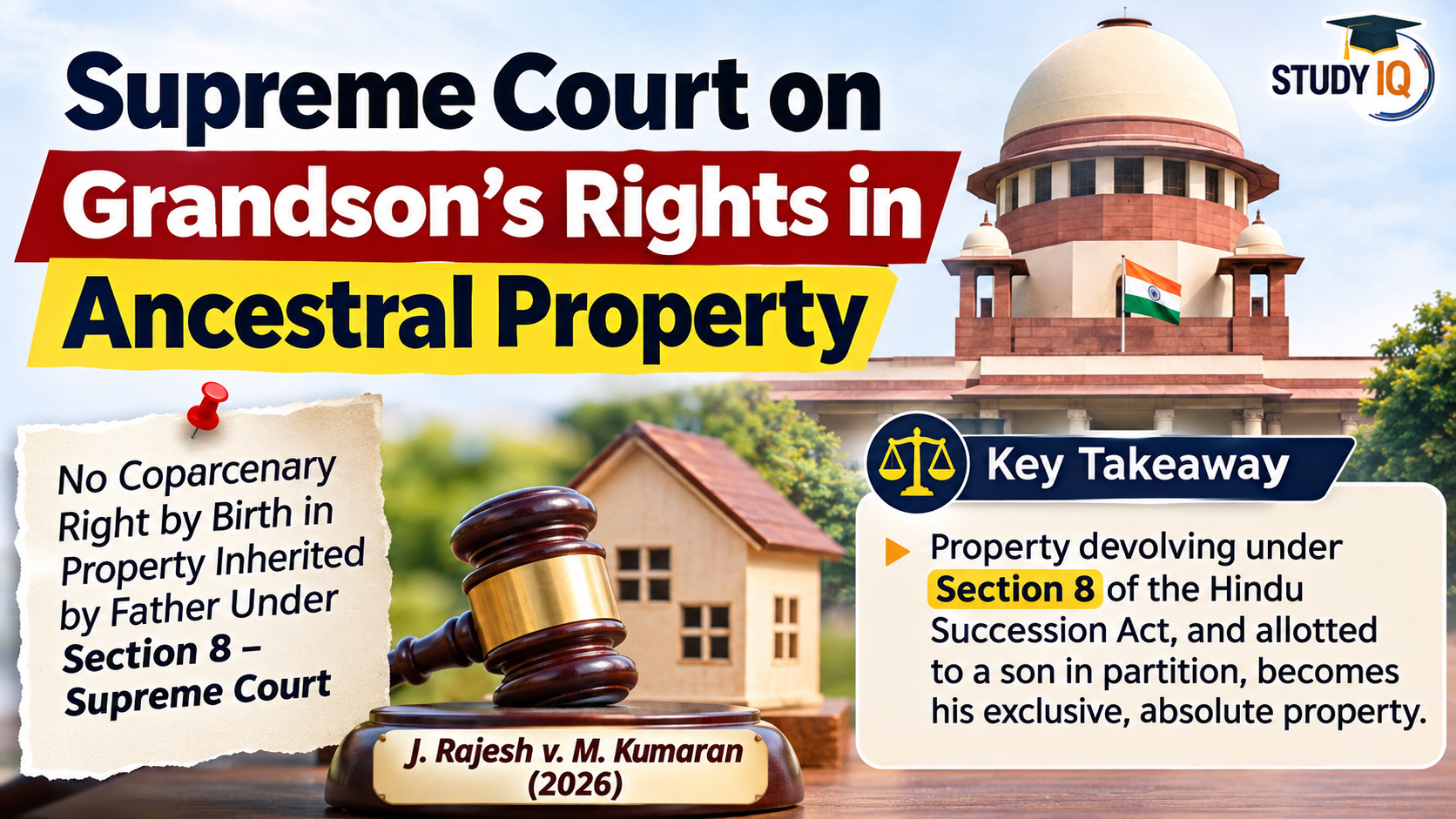
Does every property inherited from a paternal grandfather automatically become “ancestral/coparcenary property” in the hands of the father, giving his son (the grandson) an immediate right by birth to restrain its sale? Settling a nearly three-decade-old property battle, the Supreme Court of India on November 6, 2026, delivered a reportable judgment in J. Rajesh (Minor) Through His Mother and Natural Guardian J. Gomathi v. M. Kumaran (Dead) Through LRs & Ors. [2026 INSC 1208 | 2026 LiveLaw (SC) 1148].
A Division Bench comprising Justice Augustine George Masih and Justice Sunita Agarwal (with Justice Sunita Agarwal authoring the judgment) held that when a Hindu male dies intestate and his property devolves upon his Class I legal heirs under Section 8 of the Hindu Succession Act, 1956 (HSA), and is subsequently partitioned among them, the share allotted to a son becomes his exclusive, absolute property. The divided son’s own son (the grandson)—who was not even born when succession opened upon the grandfather’s death—cannot invoke Section 6 of the HSA or state coparcenary amendments to claim a coparcenary birthright over that property or challenge its alienation by his father.
Case Overview: Quick-Glance Summary Table
| Case Parameter | Official Verified Details |
| Case Title | J. Rajesh (Minor) Through His Mother and Natural Guardian J. Gomathi v. M. Kumaran (Dead) Through LRs & Ors. (Civil Appeal No. 7020 of 2012) |
| Citations & Date | 2026 INSC 1208 | 2026 LiveLaw (SC) 1148 | Decided on November 6, 2026 |
| Court & Bench | Supreme Court of India | Justice Augustine George Masih and Justice Sunita Agarwal |
| Author of Judgment | Justice Sunita Agarwal |
| Statutes Involved | Hindu Succession Act, 1956 (Preamble, Section 4, Section 6, Section 8, Section 19, and the Schedule of Class I Heirs); Section 29-A, Hindu Succession (Tamil Nadu Amendment) Act, 1989 |
| Key Precedents Relied Upon | Commissioner of Wealth Tax, Kanpur v. Chander Sen (1986) 3 SCC 567; Yudhishter v. Ashok Kumar (1987) 1 SCC 204; Bhanwar Singh v. Puran (2008) 3 SCC 87 |
| Core Holding | Property devolving upon Class I heirs under Section 8 of the Hindu Succession Act, 1956, and allotted to a son in a family partition ceases to bear any joint family or coparcenary character. The father holds his partitioned share as his absolute individual property, and his son (the grandson) acquires no coparcenary right by birth in it. |
Factual Matrix & Chronology of the 29-Year Litigation
- The Grandfather’s Estate & 1993 Partition Suit: The dispute centered on an 1,811 sq. ft. house property in Chennai originally owned by the appellant’s paternal grandfather, Ramakrishnan (also referred to as N. Ramachandran in the record). Following the grandfather’s intestate death, his daughter instituted a suit for partition (O.S. No. 5003 of 1993) against his widow and sons (Class I heirs).
- Birth of the Appellant & 1994 Compromise Decree: While the partition suit was pending, the appellant ( Rajesh) was born on January 6, 1994, to Defendant No. 1 (his father). Shortly thereafter, on February 3, 1994, the partition suit was decreed on the basis of a compromise, under which the 1,811 sq. ft. property fell to the share of the appellant’s father.
- 1997 Sale Deeds by the Father: Treating the allotted share as his exclusive property, the appellant’s father sold the entire 1,811 sq. ft. plot to bona fide purchasers (Defendant Nos. 2 and 3) via two registered sale deeds dated April 3, 1997, and April 17, 1997.
- The Minor Son’s Suit & Divergent Rulings Below: In 1997, the appellant (then a minor, suing through his mother) instituted a civil suit claiming a half share (1/2) in the property on the premise that it was ancestral/coparcenary property in which he acquired a right by birth on January 6, 1994—Importantly, without even seeking a prayer to set aside the 1997 sale deeds. While the Trial Court granted a preliminary decree of partition in favour of the grandson, the Madras High Court reversed the decree on August 11, 2010, holding that the property was the father’s absolute estate under Section 8 of the HSA.
Key Legal Issues Examined by the Supreme Court
- Section 6 (Coparcenary Survivorship/Birthright) vs. Section 8 (Intestate Succession): When a grandfather’s estate devolves upon his sons, daughters, and widow upon his intestate death and is divided among them, is the share received by a son governed by Mitakshara coparcenary principles (Section 6) or intestate succession to Class I heirs (Section 8)?
- Status of a “Son’s Son” (Grandson) Under the Schedule: Can a grandson whose father is alive claim to be a Class I heir or a coparcener by birth in property inherited by his father under Section 8 of the HSA?
- Impact of Partition & Tamil Nadu Amendment (Section 29-A): Did the birth of the grandson on January 6, 1994—twenty-eight days before the compromise partition decree dated February 3, 1994—or the operation of Section 29-A of the Hindu Succession (Tamil Nadu Amendment) Act, 1989 vest any coparcenary birthright in him?
Deep-Dive Analysis of the Supreme Court’s Ratio Decidendi
1. The Statutory Override: Section 8 Excludes a “Son’s Son” When the Father Is Alive
Examining the Preamble and Section 4 of the Hindu Succession Act, 1956—which gives overriding effect to the Act over any pre-existing text, rule, or interpretation of traditional Hindu Law inconsistent with it—Justice Sunita Agarwal highlighted the fundamental transformation wrought by Section 8 of the HSA.
Under traditional uncodified Mitakshara law, a son, grandson (son’s son), and great-grandson (son’s son’s son) acquired an interest by birth in ancestral property. However, when Parliament enacted Section 8 read with the Schedule of Class I Heirs, it deliberately included the “son of a pre-deceased son” in Class I, while excluding a “son’s son” whose father is alive. Reaffirming the locus classicus Commissioner of Wealth Tax, Kanpur v. Chander Sen (1986) 3 SCC 567 and Yudhishter v. Ashok Kumar (1987) 1 SCC 204, the Bench held:
“The express words of Section 8 of the Hindu Succession Act, 1956 cannot be ignored and must prevail. With the Preamble reiterating that the Act is to ‘amend and codify’ the law, the express statutory language which excludes a son’s son (while including the son of a predeceased son) cannot be bypassed by falling back on traditional Mitakshara notions.”
Consequently, property that devolves upon a Hindu male’s son under Section 8 is inherited by him in his individual capacity and not as the Karta of his own joint family vis-à-vis his son.
2. Severance of Joint Status Upon Partition (Bhanwar Singh v. Puran)
Relying heavily on Bhanwar Singh v. Puran (2008) 3 SCC 87, the Supreme Court explained that once the grandfather died intestate and his estate devolved upon his Class I heirs (widow, sons, and daughters) and was partitioned among them, the property completely lost any joint family or coparcenary character. Under Section 19 of the HSA, heirs succeeding together under Section 8 take the property as tenants-in-common and not as joint tenants.
Once the 1994 compromise partition allotted the 1,811 sq. ft. plot to the appellant’s father, he became its sole and exclusive owner with full statutory authority to alienate it in 1997 without needing his minor son’s consent or proving “legal necessity.”
3. Why Neither Birth Before the Compromise Decree Nor Section 29-A (Tamil Nadu Amendment) Helped the Grandson
The appellant’s counsel argued that because the grandson was born on January 6, 1994—just before the compromise decree was formally recorded on February 3, 1994—and because Section 29-A of the Hindu Succession (Tamil Nadu Amendment) Act, 1989 recognized daughters as coparceners in a subsisting Mitakshara coparcenary, a coparcenary existed in which the grandson took a birthright.
Rejecting both contentions, the Bench pointed out two fatal flaws:
- Succession Opened Before the Grandson’s Birth: Succession to the grandfather’s estate opened on the date of the grandfather’s death, which occurred before 1993 (when the aunt filed the partition suit)—well before the appellant was born on January 6, 1994. Since the appellant was not even in existence when succession opened, no coparcenary interest could possibly devolve upon him.
- Inapplicability of Section 6 & Section 29-A: Both Section 6 of the HSA and Section 29-A of the Tamil Nadu Amendment Act presuppose the existence of an undivided Mitakshara coparcenary property at the time succession opens. Where the grandfather’s estate devolved on Class I heirs under Section 8 and was partitioned among them, neither Section 6 nor Section 29-A had any application.
Master Comparison Chart for Judiciary Exams: Section 6 vs. Section 8 of the Hindu Succession Act, 1956
| Parameter | Coparcenary Property (Section 6 HSA, 1956) | Intestate Succession to Males (Section 8 HSA, 1956) |
| Nature of Property Covered | Undivided interest in a Mitakshara Coparcenary / HUF property (unpartitioned four-generation lineal property or property thrown into common hotchpotch). | Separate/self-acquired property of a Hindu male dying intestate, OR share allotted to an heir upon partition of the ancestor’s estate among Class I heirs. |
| Mode of Acquisition | By Birth (for sons and, post-2005 Amendment / State Amendments, daughters of a coparcener in a subsisting coparcenary). | By Inheritance / Opening of Succession upon the death of the intestate male under Section 8 read with the Schedule. |
| Status of “Son’s Son” (Grandson) | Acquires a right by birth only if the property remains an undivided ancestral Mitakshara coparcenary in the father’s hands. | Excluded from Class I of the Schedule if his father is alive; acquires no right by birth in property inherited by his father under Section 8. |
| Mode of Holding (Section 19 HSA) | Held as Joint Tenants (with fluctuating shares until partition, though survivorship is replaced by testamentary/intestate succession post-2005). | Held by co-heirs as Tenants-in-Common (with fixed, defined individual shares under Section 19(b) HSA). |
| Father’s Power of Alienation | Restricted; Karta/father can alienate undivided coparcenary property only for legal necessity, benefit of estate, or indispensable religious duties. | Absolute and unrestricted; the father holds the share as his exclusive individual property and can sell or gift it without his son’s consent. |
| Leading Supreme Court Authorities | Vineeta Sharma v. Rakesh Sharma (2020) 9 SCC 1; Rohit Chauhan v. Surinder Singh (2013) 9 SCC 419 | CWT v. Chander Sen (1986) 3 SCC 567; Bhanwar Singh v. Puran (2008) 3 SCC 87; J. Rajesh v. M. Kumaran (2026 INSC 1208) |
Important Note for Judiciary Aspirants (Distinguishing Rohit Chauhan vs. J. Rajesh): In Mains and Viva-Voce, examiners frequently test the subtle distinction between two situations:
- If a coparcenary property is partitioned solely between coparceners (e.g., between a father and his brothers), the share received by a coparcener remains his separate property while he is unmarried/childless, but revives its coparcenary character the moment a son or daughter is born to him (Rohit Chauhan v. Surinder Singh, 2013).
- Conversely, where a grandfather dies intestate leaving behind Class I female and male heirs (widow, daughters, sons), and the estate devolves under Section 8 of the HSA (taking as tenants-in-common under Section 19) and is partitioned among them, the share falling to the son’s lot loses its coparcenary character permanently and becomes his exclusive individual property, in which his son gets no right by birth (CWT v. Chander Sen, 1986; Bhanwar Singh v. Puran, 2008; Rajesh v. M. Kumaran, 2026 INSC 1208).
Prelims & Mains Practice Corner
Prelims Practice MCQs
Q1. In J. Rajesh (Minor) v. M. Kumaran (Dead) Through LRs & Ors. (2026 INSC 1208 / 2026 LiveLaw (SC) 1148), decided on November 6, 2026, a Supreme Court Bench of Justices Augustine George Masih and Sunita Agarwal held that:
(A) A grandson always acquires a coparcenary right by birth in any property inherited by his father from his paternal grandfather, regardless of Section 8 of the Hindu Succession Act, 1956
(B) Where the property of a Hindu male dying intestate devolves upon his Class I heirs under Section 8 of the Hindu Succession Act, 1956, and is partitioned among them, the share allotted to a son becomes his exclusive property and his own son (grandson) cannot claim any coparcenary right by birth in it
(C) Section 8 of the Hindu Succession Act, 1956 includes a “son’s son” (whose father is alive) as a Class I heir
(D) A father can never sell property received in a compromise partition decree without prior permission of the District Court under Section 8 of the Hindu Minority and Guardianship Act, 1956
Correct Answer: (B) Where the property of a Hindu male dying intestate devolves upon his Class I heirs under Section 8 of the Hindu Succession Act, 1956, and is partitioned among them, the share allotted to a son becomes his exclusive property and his own son (grandson) cannot claim any coparcenary right by birth in it
Statutory Explanation: Relying on CWT v. Chander Sen (1986) and Bhanwar Singh v. Puran (2008), the Supreme Court in J. Rajesh v. M. Kumaran (2026 INSC 1208) held that once property devolves under Section 8 of the HSA upon Class I heirs and is partitioned, it ceases to be coparcenary property; the father holds his share as absolute owner and his son has no birthright in it.
Q2. Under Section 19 of the Hindu Succession Act, 1956, if two or more heirs succeed together to the property of an intestate, in what manner do they take the property (save as otherwise expressly provided in the Act)?
(A) Per stirpes and as joint tenants with right of survivorship
(B) Per capita and as tenants-in-common, and not as joint tenants
(C) Per capita and as coparceners in a Hindu Undivided Family
(D) Per stirpes and as trustees for their lineal descendants
Correct Answer: (B) Per capita and as tenants-in-common, and not as joint tenants
Statutory Explanation: Section 19 of the Hindu Succession Act, 1956 (“Mode of succession of two or more heirs”) expressly stipulates that if two or more heirs succeed together to the property of an intestate, they shall take the property: (a) save as otherwise expressly provided in this Act, per capita and not per stirpes; and (b) as tenants-in-common and not as joint tenants.
Q3. Which of the following relatives is NOT listed as a Class I heir in the Schedule to the Hindu Succession Act, 1956?
(A) Son of a pre-deceased son
(B) Daughter of a pre-deceased daughter
(C) Son of a living son (Grandson whose father is alive)
(D) Widow of a pre-deceased son
Correct Answer: (C) Son of a living son (Grandson whose father is alive)
Statutory Explanation: Class I of the Schedule to the Hindu Succession Act, 1956 includes the son of a pre-deceased son and daughter of a pre-deceased daughter, etc., but deliberately excludes a son’s son whose father is still alive at the time succession opens—a decisive statutory point highlighted in CWT v. Chander Sen (1986) and reaffirmed in J. Rajesh v. M. Kumaran (2026 INSC 1208).
Mains Descriptive Practice Question
Question (15 Marks | 150–200 Words): “The express words of Section 8 of the Hindu Succession Act, 1956, read with the Preamble and Section 4, have fundamentally modified the traditional Mitakshara concept of a grandson’s right by birth in paternal property.” Critically analyze this statement in light of the Supreme Court’s November 2026 ruling in J. Rajesh (Minor) v. M. Kumaran (2026 INSC 1208), clearly distinguishing devolution under Section 8 from coparcenary rights under Section 6 of the Act.
Model Answer Approach:
- Introduction: State the traditional Mitakshara rule (where a son, grandson, and great-grandson acquired an unobstructed heritage / Apratibandha Daya by birth in ancestral property) and contrast it with the overriding codification under Sections 4, 8, and 19 of the Hindu Succession Act, 1956, citing Rajesh v. M. Kumaran (2026 INSC 1208).
- Core Doctrinal Analysis (Chander Sen, Bhanwar Singh & Rajesh): Explain that under the Schedule to Section 8, a “son’s son” (whose father is alive) is consciously excluded from Class I heirs. When a grandfather dies intestate leaving Class I heirs, they inherit as tenants-in-common (Section 19 HSA). Upon partition among them, the share allotted to a son becomes his exclusive individual property, not HUF/coparcenary property vis-à-vis his own son.
- Conclusion: Conclude by noting that in Rajesh (2026), because succession opened upon the grandfather’s death prior to the appellant’s birth and resulted in a partition among Class I heirs, neither Section 6 nor Section 29-A (Tamil Nadu Amendment) applied, leaving the father free to alienate his share as absolute owner.
Master Family Law & 2026 Landmark Judgments with StudyIQ Judiciary
In every State Judicial Services Examination (PCS-J)—including Maharashtra (MPSC 286 Posts), UP PCS-J, Bihar, Madhya Pradesh, Rajasthan, Delhi, Haryana, and Chhattisgarh Judiciary—questions on the Hindu Succession Act, 1956 (Sections 6, 8, 14, and 19) and coparceners’ rights form the backbone of the Civil Law / Family Law Paper.
Enroll in the StudyIQ Judiciary Live Foundation Batch (Gold) today to turn complex property and succession doctrines into your highest-scoring strength:
- 1,500+ Hours of Live & Recorded Classes: Exhaustive coverage of Hindu Law, Muslim Law, CPC, Transfer of Property Act, Contract, Specific Relief, and the dual criminal codes (BNS/IPC, BNSS/CrPC, BSA/IEA) taught by top legal educators and former judicial officers.
- Daily Mains Answer Writing & Judgment Drafting: Step-by-step evaluation with personalized feedback to help you weave recent November 2026 Supreme Court precedents seamlessly into your Mains answers.
- Curated Legal Current Affairs & Case Law Digests: Daily coverage of every reportable Supreme Court and High Court decision mapped directly to your state syllabus.
- One-on-One Mentorship & Local Law Modules: Dedicated state-specific modules and interview preparation tailored to your target judiciary exam.
Explore daily legal updates at StudyIQ Judiciary Current Affairs and StudyIQ Current Affairs, or call our academic counsellors at 76-4000-3000 today to join the batch!
Frequently Asked Questions (FAQs)
Q1. What did the Supreme Court decide in J. Rajesh v. M. Kumaran (2026 INSC 1208) on November 6, 2026? A Supreme Court Bench of Justice Augustine George Masih and Justice Sunita Agarwal held that when a paternal grandfather dies intestate and his property devolves upon his Class I heirs under Section 8 of the Hindu Succession Act, 1956, and is partitioned among them, the share allotted to the father becomes his exclusive individual property. His son (the grandson) cannot claim a coparcenary right by birth in that property or challenge its sale by the father.
Q2. Is a grandson (whose father is alive) a Class I heir under the Hindu Succession Act, 1956? No. Under the Schedule to Section 8 of the Hindu Succession Act, 1956, only the son of a pre-deceased son is included as a Class I heir. A grandson whose father is alive at the time succession opens is excluded from Class I heirs.
Q3. Can a father sell property he received under Section 8 of the Hindu Succession Act without his son’s consent? Yes. As reaffirmed by the Supreme Court in CWT v. Chander Sen (1986), Bhanwar Singh v. Puran (2008), and J. Rajesh v. M. Kumaran (2026 INSC 1208), property inherited by a Hindu male under Section 8 and allotted to him in a family partition is held by him as its absolute and exclusive owner, allowing him to sell or transfer it without requiring his son’s consent.
Q4. Why did Section 6 of the Hindu Succession Act, 1956 not apply in J. Rajesh v. M. Kumaran (2026)? Section 6 governs the devolution of an undivided interest in a subsisting Mitakshara coparcenary property. In J. Rajesh (2026), succession to the grandfather’s estate had already opened prior to the grandson’s birth and devolved upon Class I heirs under Section 8, followed by a compromise partition that severed any joint status.
Read Also: Judiciary Current Affairs
 Ramkishan Digambar Jadhav Case 2026: Sup...
 Supreme Court on Plaint Amendment After ...
 Supreme Court on Children's Right to Int...





 WhatsApp






