
Table of Contents
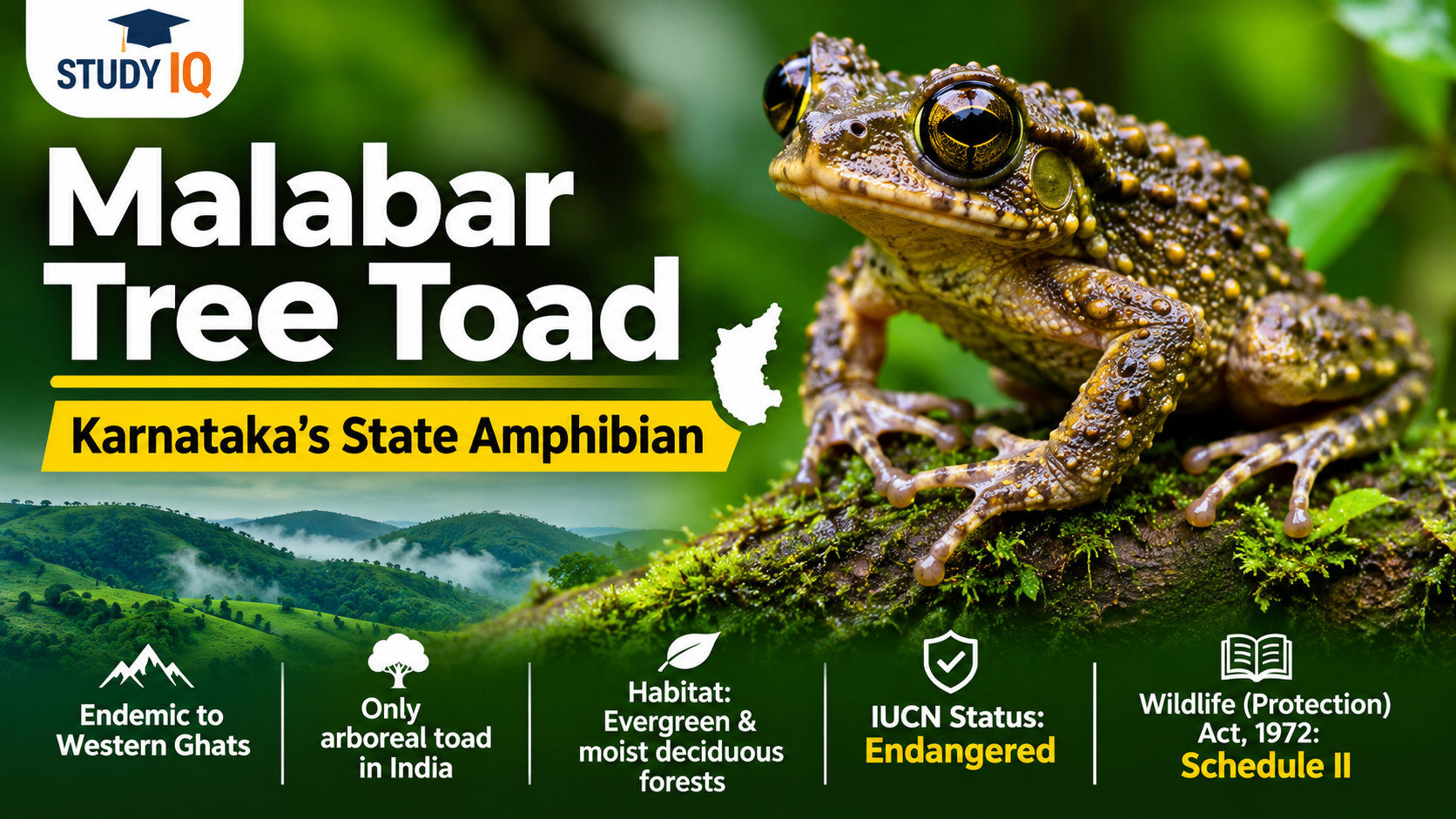
Karnataka has become the first Indian state to declare an official state amphibian by recognising the Malabar Tree Toad (Pedostibes tuberculosus) as its state amphibian. The decision highlights the ecological importance of the Western Ghats and the need to conserve its unique amphibian diversity.
Read Also: UPSC Daily Current Affairs 2026
Malabar Tree Toad: Latest News
-
The Karnataka Forest, Ecology and Environment Department has officially declared the Malabar Tree Toad as the state’s amphibian.
-
It is locally known as Malenadina Mara Gantikappe or Petu.
-
The declaration aims to promote awareness about amphibian conservation and biodiversity in the Western Ghats.
About Malabar Tree Toad
-
Scientific Name: Pedostibes tuberculosus
-
Genus: Pedostibes
-
It is the only species belonging to the monotypic genus Pedostibes.
-
It was first discovered in 1876.
-
After remaining unrecorded for more than a century, it was rediscovered in 1980 in Silent Valley National Park, Kerala.
Habitat and Distribution
-
Endemic Region: India’s Western Ghats.
-
Habitat:
-
Tropical evergreen forests.
-
Moist deciduous forests.
-
Areas along streams and tree cavities.
-
-
Altitude: Approximately 50 metres to over 1,000 metres above sea level.
-
It is primarily associated with humid forest ecosystems.
Unique Characteristics
-
It is an arboreal toad, meaning it spends much of its life on trees.
-
Unlike most toads, which are ground-dwelling, it has specialised climbing abilities.
-
It descends to the ground for breeding in temporary water pools near streams.
-
Its breeding cycle generally occurs between March and June, before the onset of the monsoon.
Conservation Status
| Parameter | Status |
|---|---|
| IUCN Red List | Endangered |
| Wildlife (Protection) Act, 1972 | Schedule II |
| Distribution | Endemic to Western Ghats |
Ecological Significance
-
Amphibians play an important role in maintaining ecological balance.
-
They help control insect populations, including agricultural pests.
-
They serve as indicators of environmental health because of their sensitivity to habitat and climatic changes.
-
The Malabar Tree Toad represents the unique biodiversity of the Western Ghats, a globally recognised biodiversity hotspot.
Major Conservation Concerns
-
Habitat loss due to deforestation and human activities.
-
Degradation of freshwater breeding habitats.
-
Climate change and changing rainfall patterns.
-
Fragmentation of forest ecosystems.
-
Limited awareness about lesser-known amphibian species.
Important Facts at a Glance
-
Karnataka’s state amphibian: Malabar Tree Toad.
-
Scientific name: Pedostibes tuberculosus.
-
First discovered: 1876.
-
Rediscovered: 1980.
-
Rediscovery location: Silent Valley National Park, Kerala.
-
Endemic to: Western Ghats.
-
Habitat: Evergreen and moist deciduous forests.
-
IUCN status: Endangered.
-
Special feature: Arboreal (tree-dwelling) lifestyle.

 National Legal Services Day 2026: Histor...
 Global Innovation Index 2026: India Rank...
 UNESCO Memory of the World Register 2026...














 WhatsApp






