
Table of Contents
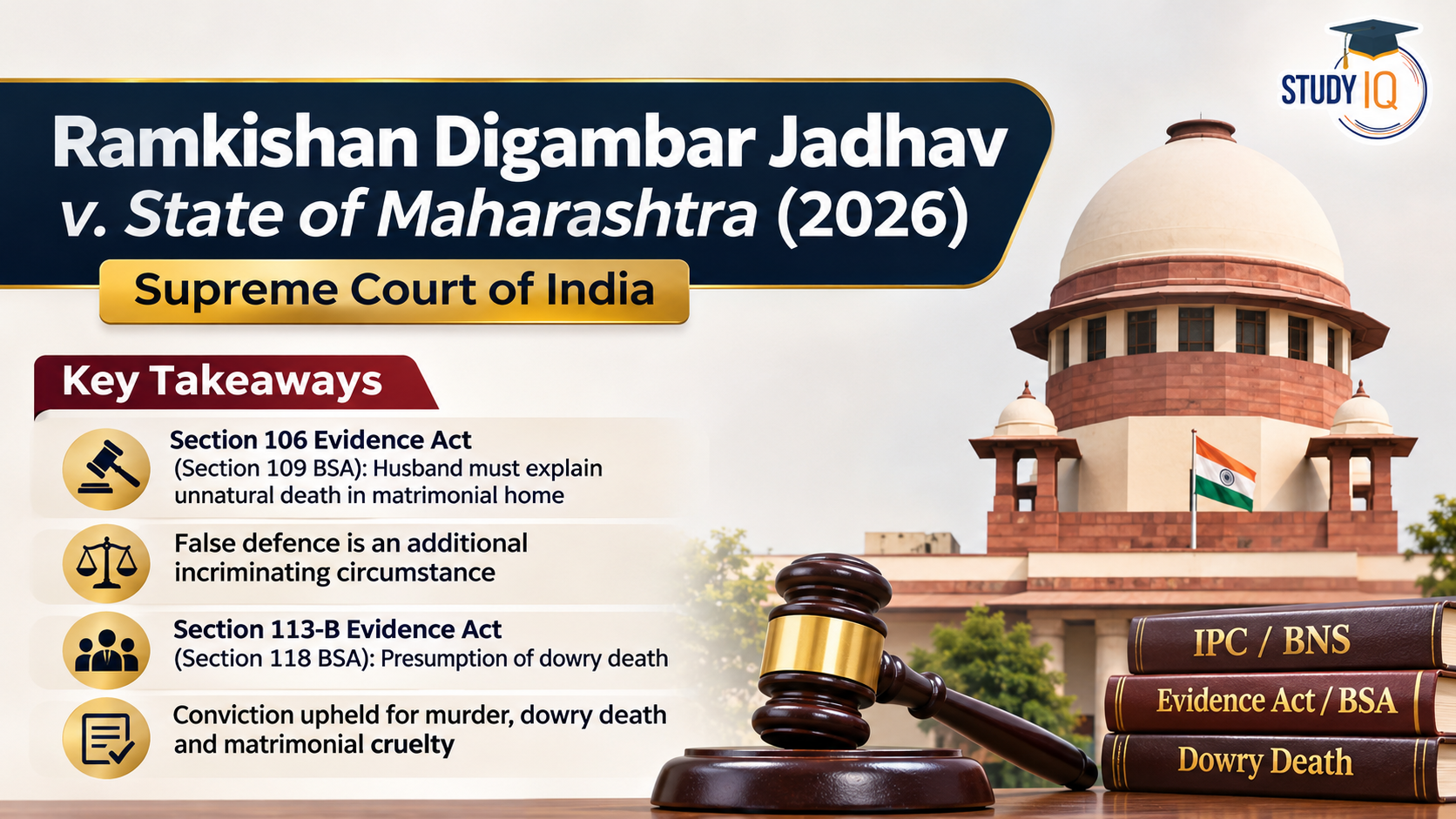
The Supreme Court of India, on November 2, 2026, delivered an important judgment in Ramkishan Digambar Jadhav v. State of Maharashtra (2026 INSC 1187). The Court upheld the conviction and life imprisonment of a husband for murdering his wife inside their matrimonial home, emphasising the evidentiary importance of a false defence in cases involving circumstantial evidence.
The judgment highlights the application of Section 106 of the Indian Evidence Act, 1872 (Section 109 of the Bharatiya Sakshya Adhiniyam, 2023) and the statutory presumption of dowry death under Section 113-B of the Evidence Act (Section 118 of the BSA, 2023).
The Supreme Court clarified that when a woman dies an unnatural death inside her matrimonial home in the exclusive presence of her husband, he must provide a plausible explanation regarding the circumstances of her death. A demonstrably false explanation can become an additional incriminating circumstance completing the chain of evidence.
Ramkishan Digambar Jadhav Case 2026: Key Highlights
| Particulars | Details |
|---|---|
| Case Name | Ramkishan Digambar Jadhav v. State of Maharashtra |
| Citation | 2026 INSC 1187 |
| Judgment Date | November 2, 2026 |
| Court | Supreme Court of India |
| Bench | Justice Sandeep Mehta and Justice Devendra Kumar Upadhyaya |
| Major Provisions | Sections 302, 304-B and 498-A IPC |
| New Criminal Laws | Sections 103, 80 and 85 BNS |
| Evidence Provisions | Sections 106 and 113-B Evidence Act |
| Corresponding BSA Provisions | Sections 109 and 118 |
| Major Issue | Unnatural death inside the matrimonial home and burden of explanation |
Background of the Ramkishan Digambar Jadhav Case
The case concerned the death of Vimalbai, who died within nine months of her marriage to Ramkishan Digambar Jadhav.
According to the prosecution, Vimalbai was subjected to physical violence, mental harassment, threats and starvation by her husband and matrimonial family over unlawful dowry demands.
She was subsequently found dead inside her matrimonial home.
Husband’s Defence and Medical Evidence
At the time of the incident, the husband was present with Vimalbai inside the room.
He claimed that while they were engaged in sexual intercourse, she suddenly suffered a seizure and died accidentally.
However, the post-mortem examination established that her death was homicidal and caused by asphyxia due to strangulation.
The medical findings contradicted the husband’s explanation.
Decisions of the Lower Courts
-
Trial Court (1998): Convicted the accused under Sections 498-A and 304-B read with Section 34 IPC but acquitted the husband of murder under Section 302 IPC.
-
Bombay High Court (2013): Reversed the acquittal under Section 302 IPC, holding that the circumstances established the husband’s guilt. It imposed life imprisonment.
-
Supreme Court (2026): Dismissed the appeals and upheld the convictions.
Major Supreme Court Observations in Ramkishan Digambar Jadhav Case
1. Section 106 Evidence Act: Burden of Proof in Matrimonial Death Cases
Section 106 of the Indian Evidence Act deals with the burden of proving facts that are especially within the knowledge of a person.
Its corresponding provision is Section 109 of the Bharatiya Sakshya Adhiniyam, 2023.
The Supreme Court emphasised that crimes committed inside a matrimonial home, particularly within a bedroom, may not have independent eyewitnesses.
When the prosecution establishes the following circumstances:
-
Previous dowry harassment and cruelty.
-
Homicidal death caused by strangulation.
-
Exclusive presence of the husband with the deceased at the relevant time.
The husband is expected to explain the circumstances surrounding the unnatural death.
However, Section 106 does not remove the prosecution’s initial responsibility to establish its case beyond reasonable doubt.
2. False Defence as an Additional Link in Circumstantial Evidence
The Supreme Court highlighted the importance of a false explanation offered by an accused.
In this case, the husband claimed that his wife had suffered an accidental seizure during sexual intercourse.
However, the post-mortem findings established death by strangulation, contradicting his explanation.
The Court treated this false defence as an additional incriminating circumstance that strengthened the prosecution’s case and completed the chain of circumstantial evidence.
The judgment relied on established principles laid down in important cases, including:
-
Sharad Birdhichand Sarda v. State of Maharashtra.
-
Trimukh Maroti Kirkan v. State of Maharashtra.
3. Section 113-B Evidence Act: Presumption as to Dowry Death
Section 113-B of the Indian Evidence Act provides for a statutory presumption regarding dowry death.
Its corresponding provision under the Bharatiya Sakshya Adhiniyam, 2023, is Section 118.
Under Section 304-B IPC, a death may be treated as dowry death when:
-
A woman dies due to burns, bodily injury or otherwise than under normal circumstances.
-
The death occurs within seven years of marriage.
-
She was subjected to cruelty or harassment by her husband or his relatives.
-
Such cruelty or harassment was in connection with dowry demands.
-
The cruelty or harassment occurred soon before her death.
Once these foundational conditions are established, the Court shall presume that the accused caused the dowry death, unless the presumption is rebutted.
In the present case, the prosecution evidence established persistent dowry-related cruelty before Vimalbai’s death.
IPC and Evidence Act vs BNS and BSA: Important Sections
The judgment is particularly important for Judiciary, UPSC and State PCS examinations because it connects important provisions of the old criminal laws with the new criminal codes.
| Legal Provision | Old Law | New Law |
|---|---|---|
| Murder | Section 302 IPC | Section 103(1) BNS |
| Dowry Death | Section 304-B IPC | Section 80 BNS |
| Cruelty by Husband or Relatives | Section 498-A IPC | Section 85 BNS |
| Definition of Cruelty | Explanation to Section 498-A IPC | Section 86 BNS |
| Common Intention | Section 34 IPC | Section 3(5) BNS |
| Burden of Proof of Facts Especially Within Knowledge | Section 106 Evidence Act | Section 109 BSA |
| Presumption as to Dowry Death | Section 113-B Evidence Act | Section 118 BSA |
Important: Section 85 BNS prescribes punishment for cruelty by a husband or his relatives, while Section 86 defines cruelty.
Can an Accused Be Convicted Under Both Murder and Dowry Death Provisions?
Yes. Murder and dowry death are distinct offences with different legal ingredients.
Section 302 IPC (Section 103 BNS) deals with murder, whereas Section 304-B IPC (Section 80 BNS) deals with dowry death.
Where the prosecution establishes that a woman was murdered and also satisfies the statutory requirements of dowry death, the accused may be convicted under both provisions.
In Ramkishan Digambar Jadhav v. State of Maharashtra, the Supreme Court upheld the convictions relating to murder, dowry death and matrimonial cruelty.
The judgment reinforces the principle that the existence of a dowry death does not automatically exclude criminal liability for murder when the evidence independently establishes the offence.
Significance of the Judgment for Judiciary and UPSC Aspirants
The judgment is important for understanding the relationship between circumstantial evidence, statutory presumptions and the burden of proof.
Its major examination takeaways include:
-
Section 106 Evidence Act and Section 109 BSA deal with facts especially within a person’s knowledge.
-
Section 113-B Evidence Act and Section 118 BSA provide for the presumption of dowry death.
-
Section 80 BNS deals with dowry death.
-
Section 103(1) BNS deals with punishment for murder.
-
A false explanation can constitute an additional incriminating circumstance.
-
Section 106 does not relieve the prosecution of its initial burden of proving the case.
-
Murder and dowry death convictions can coexist when their respective legal ingredients are established.
For Judiciary aspirants, the judgment is particularly relevant to questions concerning the law of evidence, circumstantial evidence, dowry death and the application of the new criminal laws.
Frequently Asked Questions (FAQs)
Q1. What is the Ramkishan Digambar Jadhav case of 2026?
The case concerns the Supreme Court’s judgment upholding the husband’s murder, dowry death and cruelty convictions following the homicidal strangulation of his wife inside their matrimonial home.
Q2. What did the Supreme Court say about Section 106 of the Evidence Act?
The Court emphasised that when an unnatural homicidal death occurs inside a matrimonial home in the exclusive presence of the husband, he must explain the circumstances of the death, particularly when the relevant facts are within his special knowledge.
Q3. What is the corresponding provision of Section 106 Evidence Act under BSA 2023?
Section 109 of the Bharatiya Sakshya Adhiniyam, 2023.
Q4. Which section of BSA deals with the presumption as to dowry death?
Section 118 of the Bharatiya Sakshya Adhiniyam, 2023, corresponding to Section 113-B of the Indian Evidence Act.
Q5. Can a person be convicted under both Section 302 and Section 304-B IPC?
Yes. Both offences can apply when their respective legal ingredients are independently established by the prosecution.
Q6. Which Supreme Court cases are important for understanding circumstantial evidence in matrimonial deaths?
Sharad Birdhichand Sarda v. State of Maharashtra and Trimukh Maroti Kirkan v. State of Maharashtra are important precedents.
Conclusion
The Ramkishan Digambar Jadhav v. State of Maharashtra (2026) judgment highlights the importance of circumstantial evidence and the statutory burden of explanation in cases involving unnatural deaths inside matrimonial homes. It also reinforces the application of statutory presumptions relating to dowry death under the new criminal law framework.
For Judiciary and competitive examination aspirants, the decision provides an important opportunity to understand the interplay between the BNS, BSA and established principles of criminal jurisprudence.
Read Also: Judiciary Current Affairs
 Supreme Court on Plaint Amendment After ...
 Supreme Court on Children's Right to Int...
 Supreme Court Dowry Enforcement Order 20...





 WhatsApp






