
Table of Contents
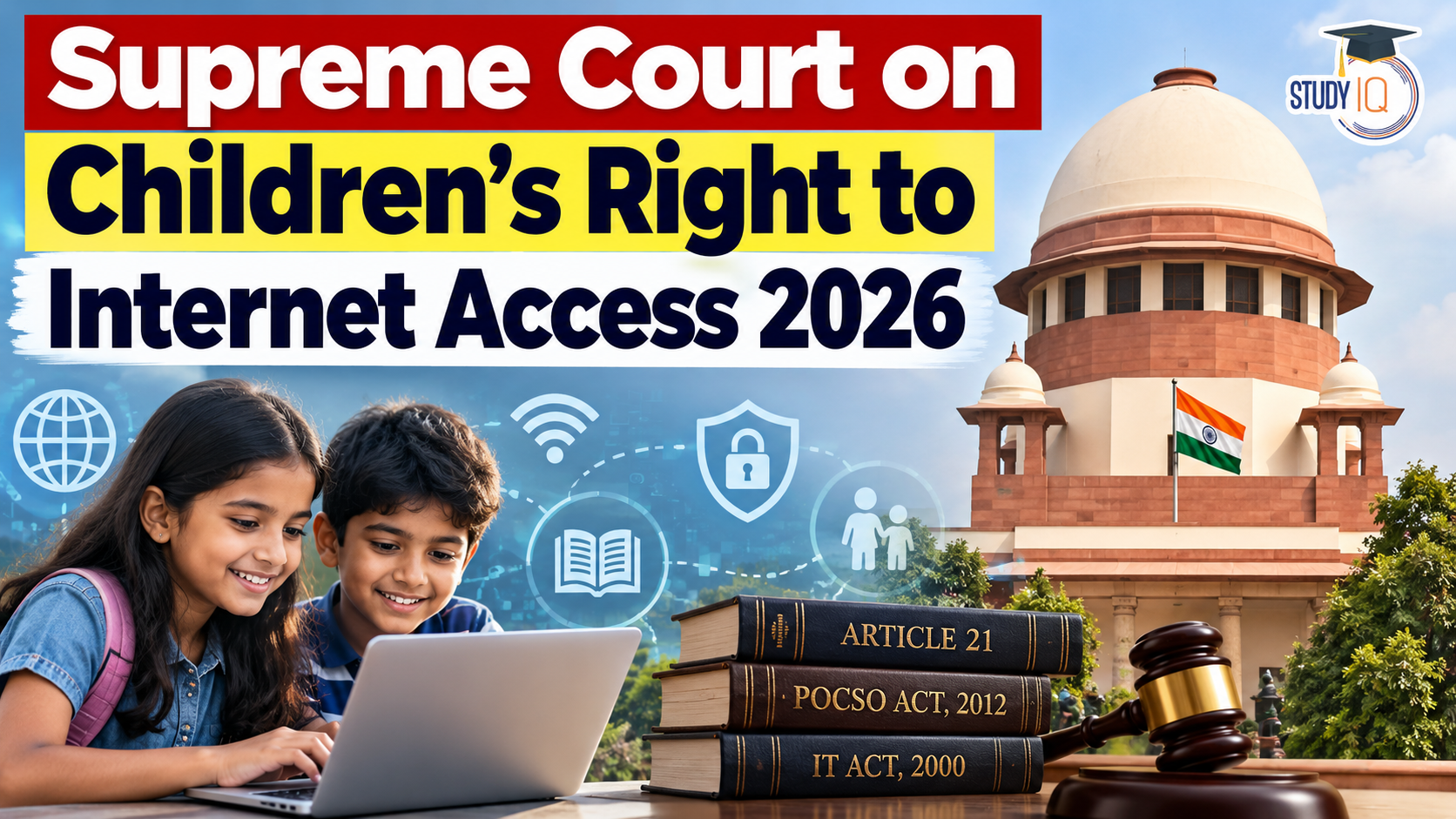
The Supreme Court of India has addressed an important constitutional question concerning children’s digital rights and online safety in Just Rights for Children Alliance & Anr. v. S. Harish & Ors. According to the supplied material, an order dated October 15, 2026, examined how the State can protect children from online sexual exploitation without imposing a blanket prohibition on their internet access.
The central principle is that children’s safety and digital freedom must be protected together. Internet access can support education, information, skill development and personal growth, particularly for children living in rural and economically disadvantaged areas.
The ruling connects constitutional provisions, including Articles 19(1)(a), 21 and 21A, with statutory safeguards under the Protection of Children from Sexual Offences (POCSO) Act, 2012, and the Information Technology Act, 2000.
Supreme Court Judgment 2026: Key Highlights
The supplied material identifies the following major aspects of the judgment:
- Constitutional rights: Recognition of children’s internet access as an aspect of fundamental rights under Articles 19(1)(a) and 21.
- No blanket prohibition: Child protection should not automatically result in a complete ban on internet use by minors.
- Child Mode: Examination of age-appropriate digital environments and parental guidance tools.
- National CSEAM Database: A proposed centralised mechanism to support the detection and removal of Child Sexual Exploitation and Abuse Material (CSEAM).
- Mandatory reporting: Emphasis on reporting suspected offences in accordance with applicable provisions of the POCSO Act.
- Rehabilitation: Greater attention to teacher training, parental awareness and psychological support for child victims.
Constitutional Provisions Involved
Article 19(1)(a): Freedom of Speech and Expression
Article 19(1)(a) guarantees citizens the right to freedom of speech and expression. Internet access has become an important medium through which people obtain information, communicate ideas and participate in public life.
For children, digital access can facilitate learning, creativity and access to educational resources. However, the exercise of constitutional freedoms must be understood alongside the need for appropriate safeguards against exploitation and harmful content.
Article 21: Right to Life and Personal Liberty
Article 21 protects life and personal liberty. Its interpretation has developed to encompass dimensions of dignity, privacy and meaningful access to essential opportunities.
The judgment, as described in the supplied material, links children’s digital access with their personal development and educational opportunities. It highlights the need to protect children from online abuse without unnecessarily excluding them from the digital world.
Article 21A: Right to Education
Article 21A provides for free and compulsory education for children between six and fourteen years of age.
Digital platforms can supplement formal education through online classes, digital libraries and educational resources. A blanket restriction on internet access may disproportionately affect children who depend on online resources because of geographical or economic barriers.
Article 39(e) and Article 39(f): Directive Principles of State Policy
These provisions direct the State to protect children from abuse and ensure that they receive opportunities to develop in conditions of freedom and dignity.
Together, these constitutional principles support an approach that combines access to educational and digital opportunities with effective protection against exploitation.
Why Is a Blanket Ban on Children’s Internet Access Problematic?
A complete prohibition may appear to be a straightforward response to online risks, but it can also create significant disadvantages.
- First, it can restrict educational opportunities. Children who depend on digital learning resources may lose access to lessons, study materials and skill-development opportunities.
- Second, it may deepen the digital divide. Children in remote and economically disadvantaged communities may have fewer alternatives to online education and information.
- Third, it does not necessarily eliminate online exploitation. Effective prevention requires reporting mechanisms, platform accountability, awareness and timely law-enforcement intervention.
A more balanced approach would combine age-appropriate access, privacy-conscious safeguards, parental guidance, digital literacy and effective enforcement against offenders.
Child Mode, Age Verification and Online Safety
The supplied material highlights the importance of age-appropriate digital environments rather than complete exclusion from online platforms.
Potential safeguards include:
- Age-appropriate content filtering: Limiting children’s exposure to harmful or unsuitable material.
- Parental guidance tools: Providing parents and guardians with appropriate mechanisms to supervise children’s digital activities.
- Privacy-preserving age verification: Designing age checks that avoid unnecessary collection or disclosure of children’s personal information.
- Digital literacy: Teaching children how to recognise grooming, exploitation and unsafe online interactions.
- Reporting mechanisms: Ensuring children can report abuse without fear of stigma or punishment.
Such safeguards should be designed to protect children while respecting their privacy and developmental needs.
National Database for Child Sexual Exploitation and Abuse Material (CSEAM)
The material describes a proposed National Database for Child Sexual Exploitation and Abuse Material as an important component of the Court’s approach.
CSEAM refers to material that documents or depicts the sexual exploitation or abuse of children. The terminology places emphasis on the harm suffered by victims rather than describing the material as ordinary pornography.
A centralised detection and removal mechanism could support efforts to identify known abusive material and reduce its repeated circulation. Cryptographic hashing and automated detection tools may help platforms identify matching files.
However, the effectiveness of such a system would depend on appropriate legal authority, data security, safeguards against false positives, accountability and protection against misuse.
POCSO Act, 2012: Mandatory Reporting and Child Protection
The Protection of Children from Sexual Offences (POCSO) Act, 2012, establishes a legal framework to protect children against sexual offences.
Sections 19, 20 and 21
- Section 19: Provides for reporting information about the commission of, or apprehension of, specified sexual offences against children.
- Section 20: Establishes reporting obligations for personnel of specified media, studios and photographic facilities who become aware of sexually exploitative material involving children, as provided by the Act.
- Section 21: Prescribes punishment for failure to report or record a case in accordance with the applicable statutory requirements.
The supplied material emphasises that simply removing abusive content from a platform does not necessarily satisfy separate statutory reporting obligations.
Section 67B of the Information Technology Act, 2000
Section 67B addresses specified forms of electronic publication, transmission and other activities involving sexually explicit material depicting children, including certain forms of online abuse and exploitation.
Section 79 of the Information Technology Act, 2000
Section 79 establishes a conditional safe-harbour framework for intermediaries. Its protection is subject to statutory requirements and applicable conditions.
The broader legal issue is how intermediary protections interact with obligations under special criminal laws, including mandatory reporting requirements. Platform compliance must therefore be assessed against the applicable statutory provisions rather than assuming that content removal alone resolves every legal obligation.
Connection with the Bharatiya Nyaya Sanhita and BNSS
The judgment’s broader legal context also connects child protection with India’s new criminal-law framework.
- Section 75 of the Bharatiya Nyaya Sanhita (BNS), 2023: Addresses sexual harassment and specifies forms of conduct covered by the provision.
- Section 95 of the BNS, 2023: Addresses hiring, employing or engaging a child to commit an offence.
- Section 173 of the Bharatiya Nagarik Suraksha Sanhita (BNSS), 2023: Governs the recording of information relating to cognizable offences, including provisions relevant to electronic information and reporting.
- Section 63 of the Bharatiya Sakshya Adhiniyam (BSA), 2023: Deals with the admissibility of electronic or digital records subject to the applicable statutory requirements.
These provisions demonstrate the importance of coordinating constitutional safeguards, specialised child-protection legislation, criminal investigation and digital evidence rules.
Role of Parents, Schools and Digital Platforms
Protecting children online requires coordinated action by multiple stakeholders.
- Parents and guardians should promote safe internet habits, communicate openly with children and help them recognise suspicious interactions.
- Schools and teachers can provide age-appropriate digital literacy, explain consent and personal boundaries, and create accessible channels for reporting abuse.
- Digital platforms should implement suitable safety measures, respond to reports of exploitation and comply with applicable legal obligations.
- Government agencies and law-enforcement authorities must ensure that reporting systems, investigations and victim-support services operate effectively.
- Mental-health professionals can provide counselling and rehabilitation to children affected by online exploitation, with support tailored to their individual needs.
Frequently Asked Questions (FAQs)
1. What is the significance of the Supreme Court’s 2026 ruling on children’s internet access?
According to the supplied material, the ruling emphasises that children’s digital access and online safety must be protected together, rather than treating a blanket ban as the default solution.
2. Which constitutional provisions are relevant to children’s digital rights?
Articles 19(1)(a), 21 and 21A are central to the discussion, alongside Directive Principles such as Articles 39(e) and 39(f).
3. What is CSEAM?
CSEAM stands for Child Sexual Exploitation and Abuse Material. The term focuses on the exploitation and abuse suffered by children rather than framing the material as ordinary pornography.
4. What is the role of the POCSO Act in online child protection?
The POCSO Act criminalises specified sexual offences against children and establishes reporting obligations. Sections 19, 20 and 21 are particularly relevant to reporting and failures to report covered offences.
5. Can internet safety be achieved through a blanket ban alone?
A blanket ban can restrict educational access without necessarily eliminating online exploitation. A balanced approach combines age-appropriate safeguards, digital literacy, reporting mechanisms, platform accountability and law-enforcement action.
Conclusion
The debate over children’s internet access reflects a wider constitutional challenge: how can the State protect vulnerable individuals without unnecessarily restricting their freedoms?
An effective child-safety framework must recognise the educational and developmental value of digital access while responding firmly to sexual exploitation, grooming and other forms of online abuse. Privacy-conscious age verification, age-appropriate platform features, mandatory reporting where legally required and victim-centred rehabilitation can contribute to this balance.
For examination aspirants, the issue illustrates the practical relationship between fundamental rights, Directive Principles, statutory duties and technology governance. The central lesson is that child protection and digital freedom should be pursued as complementary objectives, supported by proportionate safeguards and effective accountability.
Read Also: Judiciary Current Affairs
 Supreme Court Dowry Enforcement Order 20...
 Supreme Court Modifies 3-Year Practice R...
 Doctrine of Per Incuriam Explained: Supr...






 WhatsApp






