Table of Contents
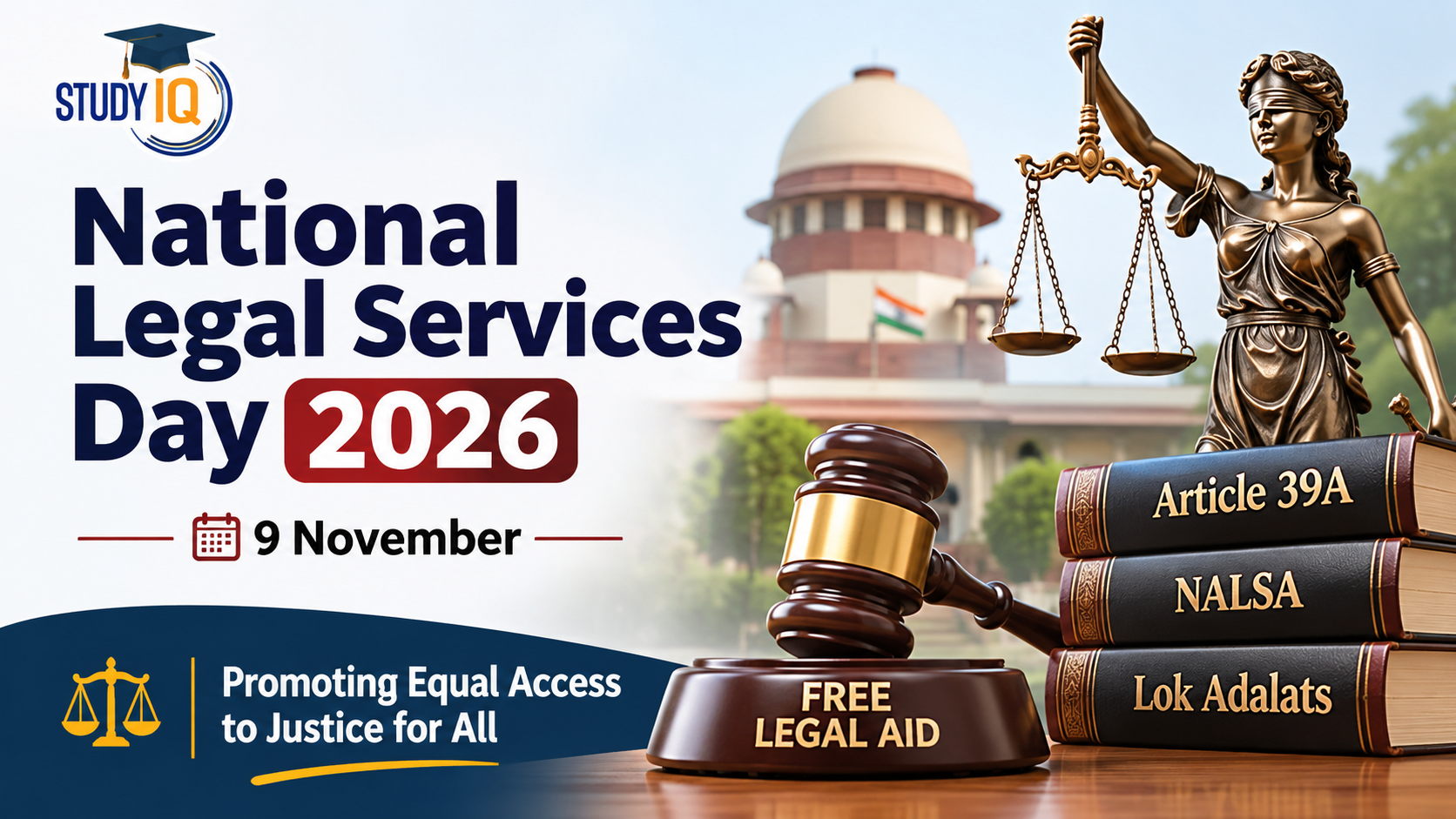
National Legal Services Day 2026 is observed on 9 November in India to promote equal access to justice and awareness about free legal aid. The day commemorates the implementation of the Legal Services Authorities Act, 1987, which came into force on 9 November 1995. It highlights the constitutional commitment to ensuring that no citizen is denied justice because of economic or social disadvantages.
Free legal aid, Lok Adalats, legal awareness programmes and institutional mechanisms established under the National Legal Services Authority (NALSA) play an important role in making justice accessible, affordable and inclusive.
Read Also: UPSC Daily Current Affairs 2026
National Legal Services Day 2026: Key Highlights
| Particulars | Details |
|---|---|
| Observed on | 9 November |
| Country | India |
| First observed | 1995 |
| Legal basis | Legal Services Authorities Act, 1987 |
| Act came into force | 9 November 1995 |
| Constitutional provision | Article 39A |
| Nodal institution | NALSA |
| Main objective | Equal justice and free legal aid |
History and Background of National Legal Services Day
The idea of free legal aid is rooted in the constitutional vision of social and economic justice.
Important developments include:
-
42nd Constitutional Amendment Act, 1976: The Constitution was amended to insert Article 39A to promote equal justice and free legal aid.
-
Legal Services Authorities Act, 1987: Parliament enacted this legislation to establish a statutory framework for providing free legal services.
-
Implementation in 1995: The Act came into force on 9 November 1995.
-
Establishment of NALSA: The National Legal Services Authority was constituted to coordinate and monitor legal aid programmes across the country.
-
Annual observance: 9 November is observed as National Legal Services Day to spread awareness about legal rights and free legal services.
Objectives of National Legal Services Day
The major objectives are:
-
Equal access to justice: Ensure that financial or social disadvantages do not prevent citizens from approaching courts.
-
Free legal assistance: Provide legal advice, representation and other legal services to eligible individuals.
-
Legal awareness: Educate citizens about constitutional rights, legal remedies and statutory protections.
-
Protection of vulnerable sections: Support women, children, SCs, STs, persons with disabilities and other eligible groups.
-
Alternative dispute resolution: Encourage Lok Adalats and other mechanisms for speedy dispute resolution.
-
Reduce judicial burden: Promote settlement of suitable disputes outside conventional court proceedings.
Constitutional Provisions Related to Free Legal Aid
The Indian Constitution provides the foundation for equal justice and access to legal remedies.
| Article / Provision | Significance |
|---|---|
| Article 14 | Guarantees equality before the law and equal protection of laws. |
| Article 21 | Protects life and personal liberty, including fair trial safeguards. |
| Article 39A | Directs the State to provide equal justice and free legal aid. |
| 42nd Amendment, 1976 | Inserted Article 39A into the Constitution. |
| Legal Services Authorities Act, 1987 | Establishes the statutory framework for legal aid and Lok Adalats. |
Article 39A: Equal Justice and Free Legal Aid
Article 39A is a Directive Principle of State Policy (DPSP) under Part IV of the Constitution.
It directs the State to:
-
Ensure that the legal system promotes justice on the basis of equal opportunity.
-
Provide free legal aid through suitable legislation, schemes or other mechanisms.
-
Prevent denial of justice due to economic or other disabilities.
Although Directive Principles are not directly enforceable by courts, they are fundamental to governance and guide the State in framing policies.
Who Is Eligible for Free Legal Aid in India?
Under Section 12 of the Legal Services Authorities Act, 1987, the following categories of people are entitled to free legal services, subject to the statutory conditions:
-
Members of Scheduled Castes (SCs) and Scheduled Tribes (STs).
-
Victims of human trafficking or begar.
-
Women and children.
-
Persons with disabilities.
-
Victims of mass disasters, ethnic violence, caste atrocities, floods, droughts, earthquakes and industrial disasters.
-
Industrial workmen.
-
Persons in custody, including those in protective homes, juvenile justice institutions and psychiatric hospitals or nursing homes.
-
Individuals whose annual income is below the prescribed limit.
Important: The income eligibility limit varies depending on the relevant government notification and the court or authority concerned.
National Legal Services Authority (NALSA)
The National Legal Services Authority (NALSA) is the apex statutory body responsible for implementing and monitoring legal aid programmes across India.
It was constituted under the Legal Services Authorities Act, 1987, and became operational on 9 November 1995.
Major functions of NALSA:
-
Formulate policies and principles for providing legal services.
-
Distribute funds and grants to State Legal Services Authorities.
-
Organise Lok Adalats at different levels.
-
Promote legal literacy and awareness.
-
Coordinate legal aid programmes across the country.
-
Monitor the quality of free legal services.
Structure of Legal Services Authorities in India
| Authority | Level | Leadership |
|---|---|---|
| NALSA | National | Chief Justice of India (Patron-in-Chief); Supreme Court Judge (Executive Chairman) |
| State Legal Services Authority (SLSA) | State | Chief Justice of High Court (Patron-in-Chief) |
| District Legal Services Authority (DLSA) | District | District Judge (Chairman) |
| Taluk Legal Services Committee (TLSC) | Taluk | Senior Civil Judge or other designated judicial officer (Chairman) |
Lok Adalats: An Important Instrument of Access to Justice
Lok Adalats are alternative dispute resolution forums established under Section 19 of the Legal Services Authorities Act, 1987.
They aim to resolve disputes through mutual agreement and compromise, reducing the cost and delay associated with conventional litigation.
Key features of Lok Adalats:
-
Provide an accessible, inexpensive dispute-resolution mechanism.
-
Encourage compromise and mutual settlement.
-
Handle pending court cases and eligible pre-litigation disputes.
-
An award passed by a Lok Adalat is deemed to be a decree of a civil court.
-
The award is final and binding on the parties, with no appeal against it.
Types of Lok Adalats:
-
National Lok Adalats
-
State Lok Adalats
-
Permanent Lok Adalats
-
Special Lok Adalats
Permanent Lok Adalats primarily deal with disputes relating to public utility services, such as transport, postal services, electricity and water supply, subject to statutory conditions.
Major Legal Aid Initiatives in India
Several initiatives aim to improve access to legal services, particularly for disadvantaged communities.
| Initiative | Main Objective |
|---|---|
| Tele-Law | Provides pre-litigation legal advice through digital platforms and Common Service Centres. |
| Nyaya Bandhu | Connects eligible beneficiaries with pro bono advocates. |
| Legal Aid Defence Counsel System (LADCS) | Provides legal representation in criminal cases to eligible persons. |
| Legal Literacy Camps | Spread awareness about legal rights and remedies. |
| Para-Legal Volunteers | Act as a bridge between communities and legal services institutions. |
| Lok Adalats | Promote amicable settlement of disputes. |
Significance of National Legal Services Day
1. Strengthening access to justice
Free legal aid helps economically disadvantaged individuals access courts and legal remedies.
2. Protection of fundamental rights
Legal assistance strengthens the protection of life, personal liberty and fair trial rights under Article 21.
3. Empowerment of vulnerable communities
Women, children, SCs, STs, persons with disabilities and other eligible groups receive institutional support to protect their legal rights.
4. Reduction in judicial pendency
Lok Adalats and alternative dispute resolution mechanisms help resolve suitable disputes without prolonged litigation.
5. Strengthening the rule of law
Equal access to legal remedies strengthens public confidence in democratic institutions and the justice delivery system.
6. Promoting digital justice
Tele-Law and other technology-based initiatives help overcome geographical and informational barriers to legal assistance.
How to Apply for Free Legal Aid in India?
Eligible individuals can approach the nearest legal services institution through the following methods:
-
Online application: Apply through the official NALSA website.
-
Offline application: Submit a written application to the District or State Legal Services Authority.
-
In-person assistance: Visit the nearest DLSA or Taluk Legal Services Committee.
-
Through a Para-Legal Volunteer: Seek assistance from a designated volunteer.
-
Legal aid helpline: Contact NALSA through its toll-free helpline at 15100.
Depending on eligibility and the nature of the case, assistance may include legal advice, appointment of an advocate, preparation of legal documents and representation before courts.
Challenges in the Delivery of Free Legal Aid
Despite the statutory framework, several challenges affect the effective implementation of legal aid in India:
-
Lack of awareness about the availability of free legal services.
-
Shortage of trained legal aid lawyers in rural and remote areas.
-
Delays in providing legal assistance.
-
Uneven quality of legal representation.
-
Digital divide and limited internet accessibility.
-
Social stigma and lack of trust in formal legal institutions.
Strengthening legal aid infrastructure, improving lawyer accountability, increasing awareness and expanding digital outreach are essential to address these challenges.

 Malabar Tree Toad: Karnataka’s State A...
 Global Innovation Index 2026: India Rank...
 UNESCO Memory of the World Register 2026...













 WhatsApp