Table of Contents
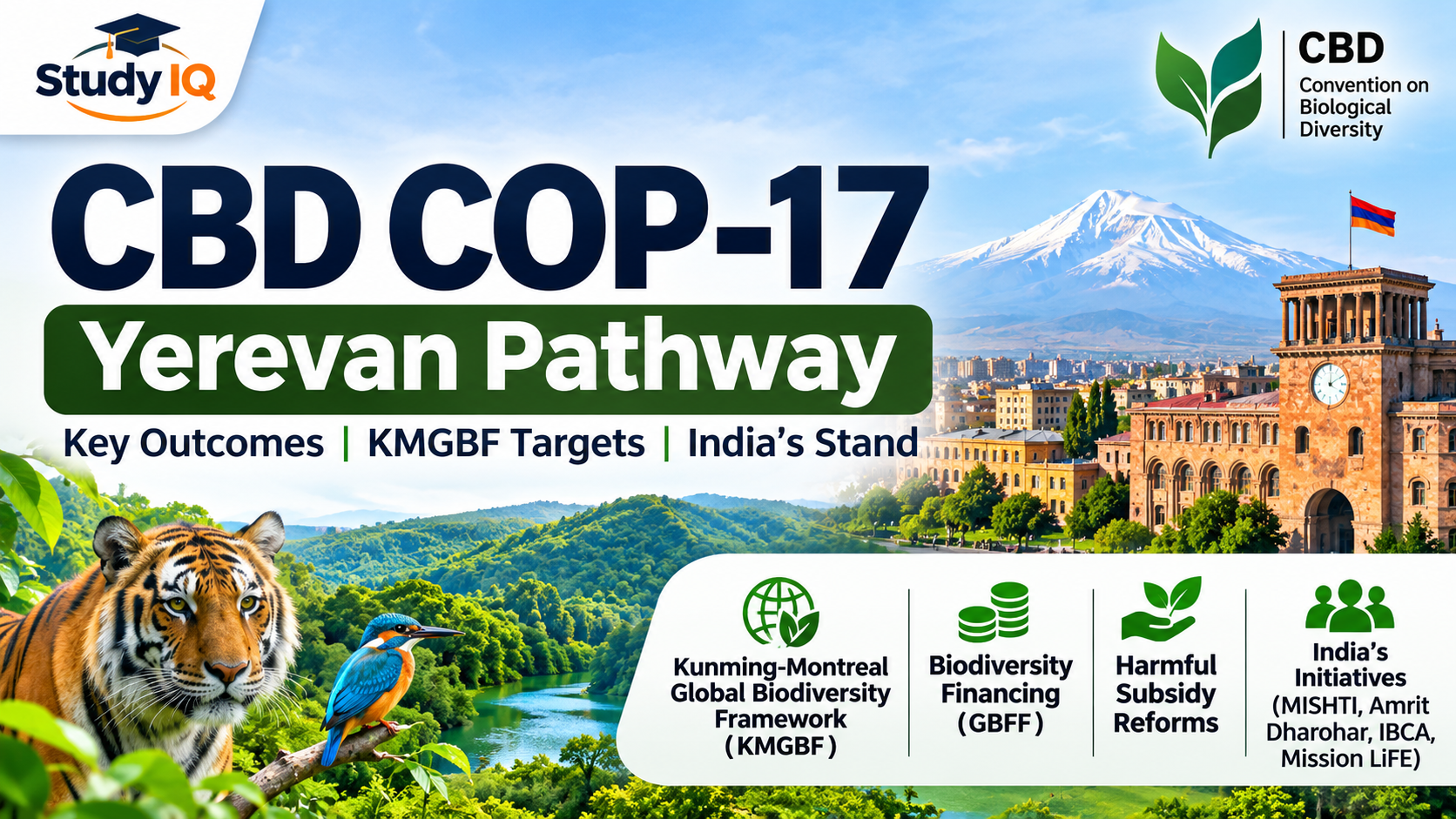
The 17th Conference of the Parties (COP-17) to the Convention on Biological Diversity (CBD) marked an important step in strengthening global biodiversity conservation efforts. Held in Yerevan, Armenia, the conference focused on accelerating the implementation of the Kunming-Montreal Global Biodiversity Framework (KMGBF) and achieving its 2030 biodiversity targets.
The adoption of the Yerevan Pathway reflects the growing urgency to translate international biodiversity commitments into measurable action, particularly through adequate financial support, technology transfer and stronger national implementation mechanisms.
What is the Yerevan Pathway?
The Yerevan Pathway is a negotiated roadmap adopted at CBD COP-17 to accelerate the implementation of the KMGBF by 2030.
It emerged from the first global review of collective progress under the biodiversity framework, which revealed that the world is not on track to achieve its biodiversity targets.
Its major priorities include:
-
Accelerating implementation: Strengthening national efforts to achieve the 23 biodiversity targets by 2030.
-
Biodiversity financing: Mobilising adequate and predictable financial resources, particularly for developing countries.
-
Reforming harmful subsidies: Encouraging countries to accelerate reforms of incentives that damage biodiversity.
-
Technology transfer: Improving access to scientific knowledge, technology and capacity-building.
-
Mainstreaming biodiversity: Integrating biodiversity conservation into national budgets, economic policies and development planning.
-
Monitoring and accountability: Strengthening biodiversity indicators, reporting and assessment mechanisms.
The conference adopted nearly 50 decisions covering protected areas, forests, marine biodiversity, invasive alien species and other important conservation issues.
Convention on Biological Diversity+2
About the Kunming-Montreal Global Biodiversity Framework (KMGBF)
The Kunming-Montreal Global Biodiversity Framework was adopted at the 15th Conference of the Parties (COP-15) in December 2022.
It provides a global roadmap to halt and reverse biodiversity loss and achieve a world living in harmony with nature by 2050.
Key features of KMGBF
1. Four long-term goals for 2050
The framework establishes four overarching goals relating to:
-
Maintaining and restoring ecosystem integrity.
-
Sustainable use and management of biodiversity.
-
Fair and equitable sharing of benefits from genetic resources.
-
Adequate means of implementation, including finance, technology and capacity-building.
2. Twenty-three targets for 2030
Some important targets include:
| Target | Objective |
|---|---|
| Target 2 | Restore at least 30% of degraded ecosystems. |
| Target 3 | Conserve at least 30% of terrestrial and inland water areas and marine and coastal areas. |
| Target 18 | Identify and eliminate, phase out or reform harmful incentives and subsidies. |
| Target 19 | Mobilise at least $200 billion annually for biodiversity by 2030. |
| Target 22 | Ensure participation and representation of Indigenous Peoples and local communities. |
3. Financial mechanism
The Global Biodiversity Framework Fund (GBFF) was established to support the implementation of the KMGBF. It is hosted by the Global Environment Facility (GEF).
The fund aims to mobilise resources for biodiversity conservation, particularly in developing countries.
India’s Position at CBD COP-17
India emphasised that biodiversity conservation must be based on equity, national circumstances and the principle of common but differentiated responsibilities.
Its major concerns and positions included:
1. Equitable biodiversity financing
India stressed that developed countries must fulfil their financial obligations under Article 20(2) of the CBD.
India called for:
-
Predictable and adequate financial resources.
-
Technology transfer to developing countries.
-
Capacity-building support.
-
Respect for national priorities and sovereignty.
India also opposed shifting existing financial responsibilities onto developing countries.
Press Information Bureau
2. Reform of harmful subsidies
One of the important negotiation issues was the reform of subsidies harmful to biodiversity.
India, along with Russia and Saudi Arabia, supported flexibility in the final language concerning subsidy reforms.
The final text encouraged countries to accelerate the implementation of Target 18 in accordance with their national circumstances, priorities and capabilities.
This reflects the tension between global environmental commitments and national economic priorities.
Carbon Brief+1
3. India’s biodiversity conservation initiatives
India highlighted several flagship initiatives demonstrating its commitment to biodiversity conservation.
MISHTI Scheme
Mangrove Initiative for Shoreline Habitats and Tangible Incomes. It promotes mangrove restoration along India’s coastline.
Amrit Dharohar
Promotes the conservation of wetlands, particularly Ramsar sites, through community participation and sustainable livelihoods.
International Big Cat Alliance (IBCA)
Promotes international cooperation for the conservation of seven major big cat species.
Mission LiFE
Encourages environmentally responsible lifestyles and individual behavioural changes for sustainable development.
Significance of CBD COP-17
The conference is significant for several reasons:
-
Implementation gap: It highlighted the gap between international biodiversity commitments and actual conservation outcomes.
-
Financial equity: It reinforced the importance of predictable funding for developing countries.
-
Policy integration: It encouraged governments to integrate biodiversity into economic and development policies.
-
Community participation: It strengthened recognition of Indigenous Peoples and local communities in biodiversity governance.
-
Global cooperation: It provided a renewed roadmap for achieving the 2030 biodiversity targets.
Challenges Ahead
Despite progress, several challenges remain:
-
Inadequate financial resources for biodiversity conservation.
-
Continued dependence on harmful subsidies in agriculture, fisheries and other sectors.
-
Weak implementation of National Biodiversity Strategies and Action Plans (NBSAPs).
-
Conflicts between economic development and ecological sustainability.
-
Limited monitoring, accountability and institutional capacity.
The effectiveness of the Yerevan Pathway will ultimately depend on how countries translate international commitments into measurable domestic action.
Conclusion
CBD COP-17 and the Yerevan Pathway represent an important transition from setting global biodiversity targets to accelerating their implementation. However, achieving the 2030 goals requires more than international declarations. It demands adequate financing, technology transfer, institutional capacity and meaningful participation of local communities.
For India, the central challenge is to balance economic development with ecological sustainability while ensuring equitable global responsibility for biodiversity conservation.
Important facts to remember
-
CBD: Convention on Biological Diversity (1992).
-
COP-15: Kunming-Montreal Global Biodiversity Framework adopted in 2022.
-
COP-17: Yerevan, Armenia, 19–30 October 2026.
-
Yerevan Pathway: Roadmap to accelerate KMGBF implementation.
-
KMGBF: Four goals for 2050 and 23 targets for 2030.
-
GBFF: Hosted by the Global Environment Facility.
-
COP-18: Scheduled to be held in Quito, Ecuador, in 2028.
Convention on Biological Diversity+2
Important factual clarification: The KMGBF is a global policy framework adopted under the CBD, not a separate legally binding treaty imposing mandatory targets. However, the CBD itself is a legally binding international convention.

 UNESCO Memory of the World Register 2026...
 Draft National Steel Policy 2047: Vision...
 VISTAR Scheme 2026–31: Objectives, Fea...













 WhatsApp