Table of Contents
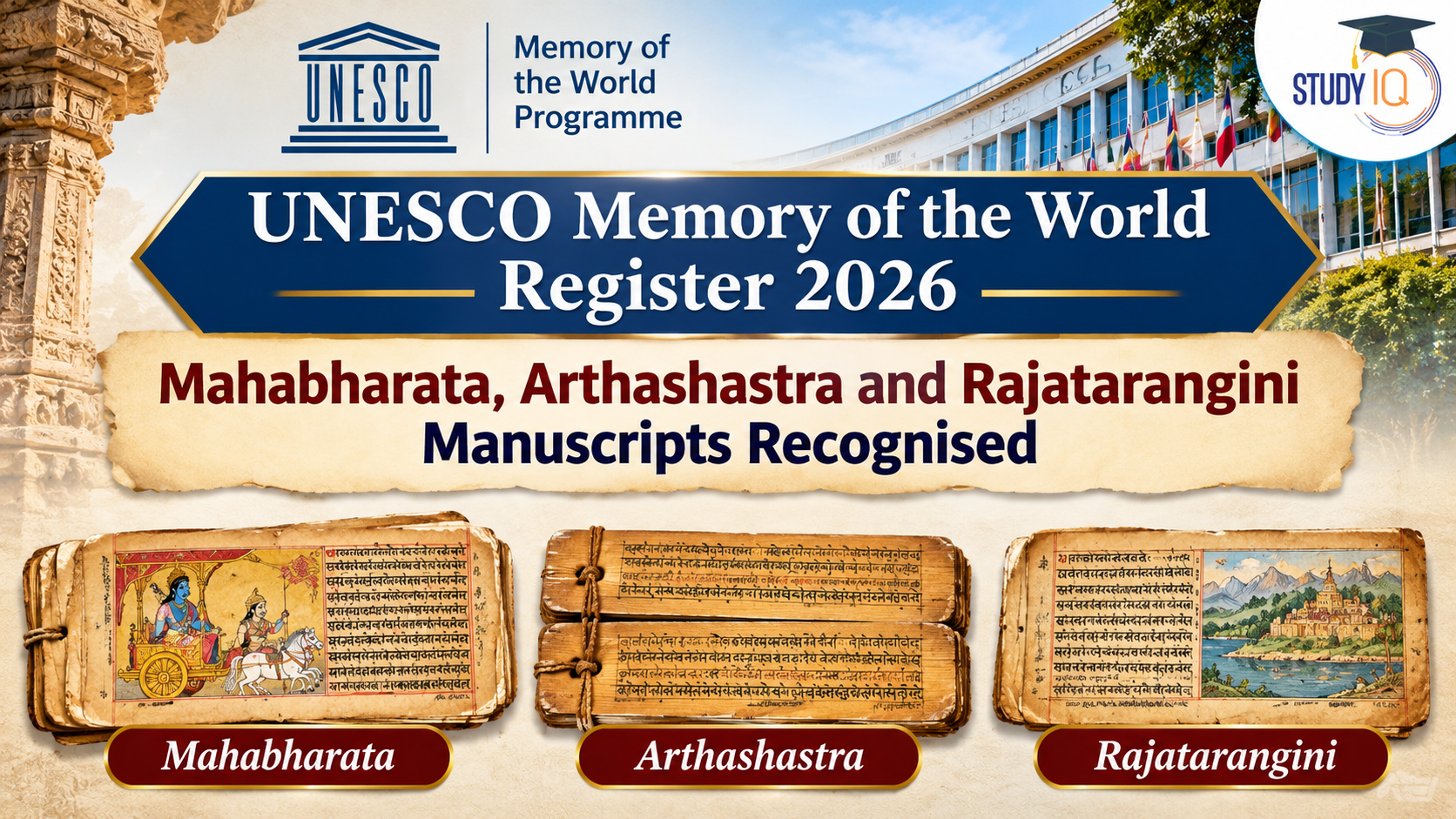
In November 2026, UNESCO inscribed manuscripts of the Mahabharata, Kautilya’s Arthashastra and Kalhana’s Rajatarangini on its Memory of the World Asia-Pacific Regional Register. The decision was taken during the 11th Session of the Memory of the World Asia-Pacific Regional Register held in Jakarta, Indonesia.
The recognition highlights India’s contribution to global documentary heritage, historical scholarship, philosophy, literature and political thought. With these three additions, India’s total inscriptions in the Asia-Pacific Regional Register now total six.
About UNESCO’s Memory of the World Programme
- Launched: 1992 by UNESCO.
- Objective: To preserve and provide access to the world’s documentary heritage.
- Focus: Manuscripts, historical documents, archives, photographs, audiovisual materials and other documentary records.
- Significance: It promotes the preservation of documentary heritage and raises awareness about its historical, cultural and intellectual importance.
The programme recognises documentary heritage at different levels, including the International Register and regional registers.
The Memory of the World Asia-Pacific Regional Register focuses on documentary heritage of outstanding significance to the Asia-Pacific region.
Three Indian Manuscripts Recognised by UNESCO
1. Mahabharata
- Nature: Ancient Indian epic and one of the world’s longest literary works.
- Content: Explores Dharma, morality, duty, justice, politics, philosophy and human relationships.
- Significance: It contains the Bhagavad Gita, a philosophical dialogue between Lord Krishna and Arjuna.
- Manuscript recognised: The Birch-bark (Burjapatra) Manuscript of Mahabharata.
- Location: Bhandarkar Oriental Research Institute, Pune, Maharashtra.
Importance: The Mahabharata represents India’s literary and philosophical traditions and provides insights into ancient Indian society, ethical values and political thought.
2. Kautilya’s Arthashastra
- Author: Kautilya, also known as Chanakya or Vishnugupta.
- Period: Ancient India, generally associated with the Mauryan period.
- Nature: A comprehensive treatise on governance, administration and statecraft.
- Major themes:
- Public administration and taxation.
- Economic management and trade.
- Diplomacy and foreign policy.
- Intelligence and espionage.
- Military strategy and national security.
- Law, justice and internal administration.
- Manuscript recognised: Kautilya’s Arthashastra, an ancient palm-leaf manuscript.
- Location: Oriental Research Institute, Mysuru, Karnataka.
Importance: Arthashastra provides valuable insights into ancient Indian political institutions, economic administration, diplomacy and the principles of statecraft.
3. Rajatarangini
- Author: Kalhana.
- Period: 12th century CE.
- Subject: History of Kashmir.
- Nature: A historical chronicle documenting the rulers and political developments of Kashmir.
- Language: Sanskrit.
- Manuscript recognised: The Manuscript of Rajatarangini by Kalhana.
- Location: Oriental Research Library, Sri Pratap Singh Library Complex, Srinagar, Jammu and Kashmir.
Importance: Rajatarangini is an important source for understanding Kashmir’s political history, dynasties, administration and society. It is particularly significant for its historical approach to documenting the past.
India’s Previous Inscriptions in the Regional Register
Before the 2026 recognition, three Indian documentary heritage collections were inscribed in the Asia-Pacific Regional Register in 2024:
- Ramcharitmanas: Illustrated manuscripts of Tulsidas’ celebrated literary work, featuring miniature paintings.
- Panchatantra: A rare 15th-century manuscript containing animal fables and moral stories.
- Sahrdayaloka-Locana: An important text associated with Indian poetics and literary aesthetics.
With the latest additions, India’s total number of inscriptions in the regional register has reached six.
Significance of the Recognition
- Cultural preservation: Encourages the conservation of valuable manuscripts and documentary collections.
- Global recognition: Brings India’s intellectual and civilisational heritage to wider international attention.
- Historical scholarship: Strengthens research into India’s political, literary and social history.
- Knowledge traditions: Highlights India’s contributions to philosophy, ethics, governance and literature.
- Intergenerational transmission: Promotes the preservation and accessibility of documentary heritage for future generations.
The Indira Gandhi National Centre for the Arts (IGNCA) played an important role in preparing the nomination dossiers for all three manuscripts.

 CBD COP-17 and Yerevan Pathway 2026: Key...
 Draft National Steel Policy 2047: Vision...
 VISTAR Scheme 2026–31: Objectives, Fea...













 WhatsApp