
Table of Contents
Oil Spill Hazard in India: Context
Shipwreck incidents off Kerala’s coast prompted preparation of a State-specific Oil Spill Contingency Plan (OSCP) to protect its 590 km coastline.
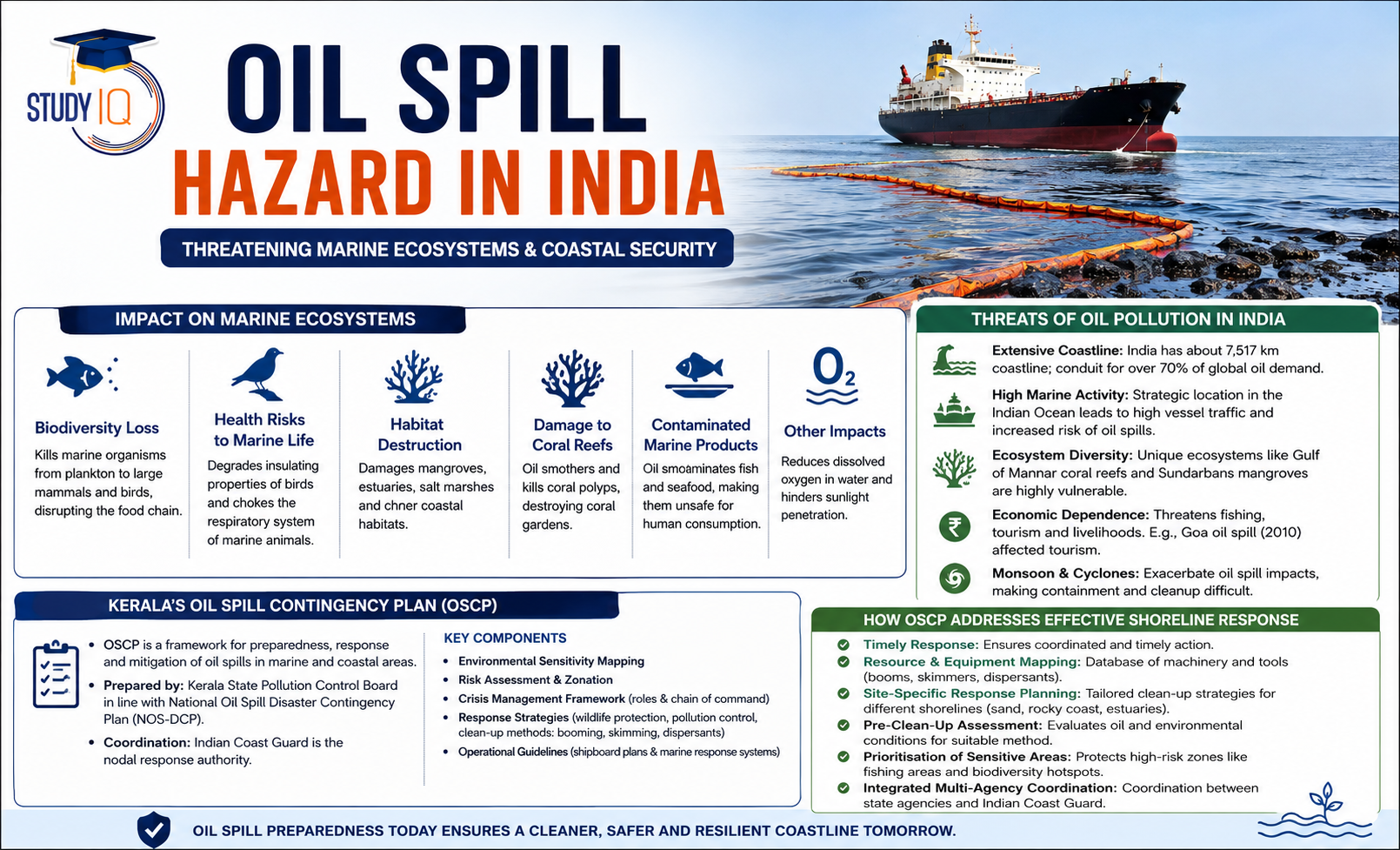
Impact of Oil Spill on Marine Ecosystems
- Biodiversity loss: Oil spill leads to the death of marine organisms, from plankton to large mammals, birds, and fish, severely affecting the food chain.
- g., 2010 Deepwater Horizon oil spill in the Gulf of Mexico resulted in widespread mortality across various marine species.
- Health Risks to Marine Life: degrades insulating properties of birds, chokes the respiratory system of marine animals
- Habitat destruction: damages and destroys important coastal habitats such as mangroves, estuaries and salt marshes.
- g.,the 1989 Exxon Valdez oil spill in Prince William Sound, Alaska led to significant destruction of coastal habitats.
- Damage to Coral Reefs: Oil pollution can smother and kill coral polyps.
- gThe 2020 oil spill in Mauritius destroyed coral gardens and was declared an environmental emergency by the government.
- Contaminated marine products: Oil spills contaminate marine products like fish, etc., and makes them unsafe for human consumption.
- gThe 2021 oil spill in the Red sea led to sea food contamination.
- Other impacts– Oil pollution reduces the amount of dissolved oxygen in water and hinders sunlight penetration etc.
Read Also: UPSC Daily Current Affairs 2026
Threat of Oil Pollution in India
- Extensive coastline: India has a vast coastline of about 7517 km making it highly susceptible to oil pollution incidents. The Indian coastline serves as a conduit for over 70% of the global oil demand.
- High marine activity: Due to its strategic location in the Indian ocean, India witnesses high marine activity making it highly vulnerable to oil spills.
- Ecosystem diversity: India’s marine ecosystem is incredibly diverse, including the unique coral reefs of the Gulf of Mannar and the Sundarbans mangroves, making it highly vulnerable to oil pollution.
- Economic dependence: Oil pollution threatens the livelihoods and industries, including fishing, tourism etc, potentially leading to economic distress in affected regions.
- g., the Goa oil spill in 2010 had adverse effects on the state’s tourism industry
- Monsoon and cyclones exacerbate the impacts of oil spills, making containment and cleanup efforts more challenging.
Kerala’s Oil Spill Contingency Plan (OSCP)
- OSCP is a structured framework for preparedness, response and mitigation of oil spills in marine and coastal areas (aligned with national guidelines).
- Prepared by: Kerala State Pollution Control Board in line with National Oil Spill Disaster Contingency Plan (NOS-DCP), with coordination from agencies like Indian Coast Guard (nodal response authority).
- Key Components
- Environmental Sensitivity Mapping
- Risk Assessment & Zonation
- Crisis Management Framework: Defines roles of departments and chain of command (clear accountability during emergencies).
- Response Strategies: Includes wildlife protection, pollution control and clean-up methods (booming, skimming, dispersants).
- Operational Guidelines: Covers shipboard emergency plans and marine response systems (integrated action plan).
How OSCP Addresses Effective Shoreline Response
- Timely response: With a defined chain of command and responsibilities OSCP ensures coordinated and timely response.
- Resource & Equipment Mapping: Maintains database of machinery and response tools (booms, skimmers, dispersants).
- Site-Specific Response Planning: Tailors clean-up strategies based on shoreline type (sand, rocky coast, estuaries).
- Pre-Clean-Up Assessment: Evaluates oil characteristics and environmental conditions (ensures appropriate method selection).
- Prioritisation of Sensitive Areas: Focuses on protecting high-risk zones (fishing areas, biodiversity hotspots).
- Integrated Multi-Agency Coordination: Ensures coordination between state agencies and Indian Coast Guard (the central nodal agency).
|
Read More Notes |
|
| Environment Notes | Art and Culture Notes |
| Science and Tech | History Notes |
| Geography Notes | Indian Polity Notes |
| General Knowledge | International Relation |
|
Explore StudyIQ Courses |
|
 Nobel Prize in Chemistry 2026: Kagan and...
 India Demonstrates First Free-Space Quan...
 India–EFTA Trade and Economic Partners...














 WhatsApp





