Table of Contents
Context
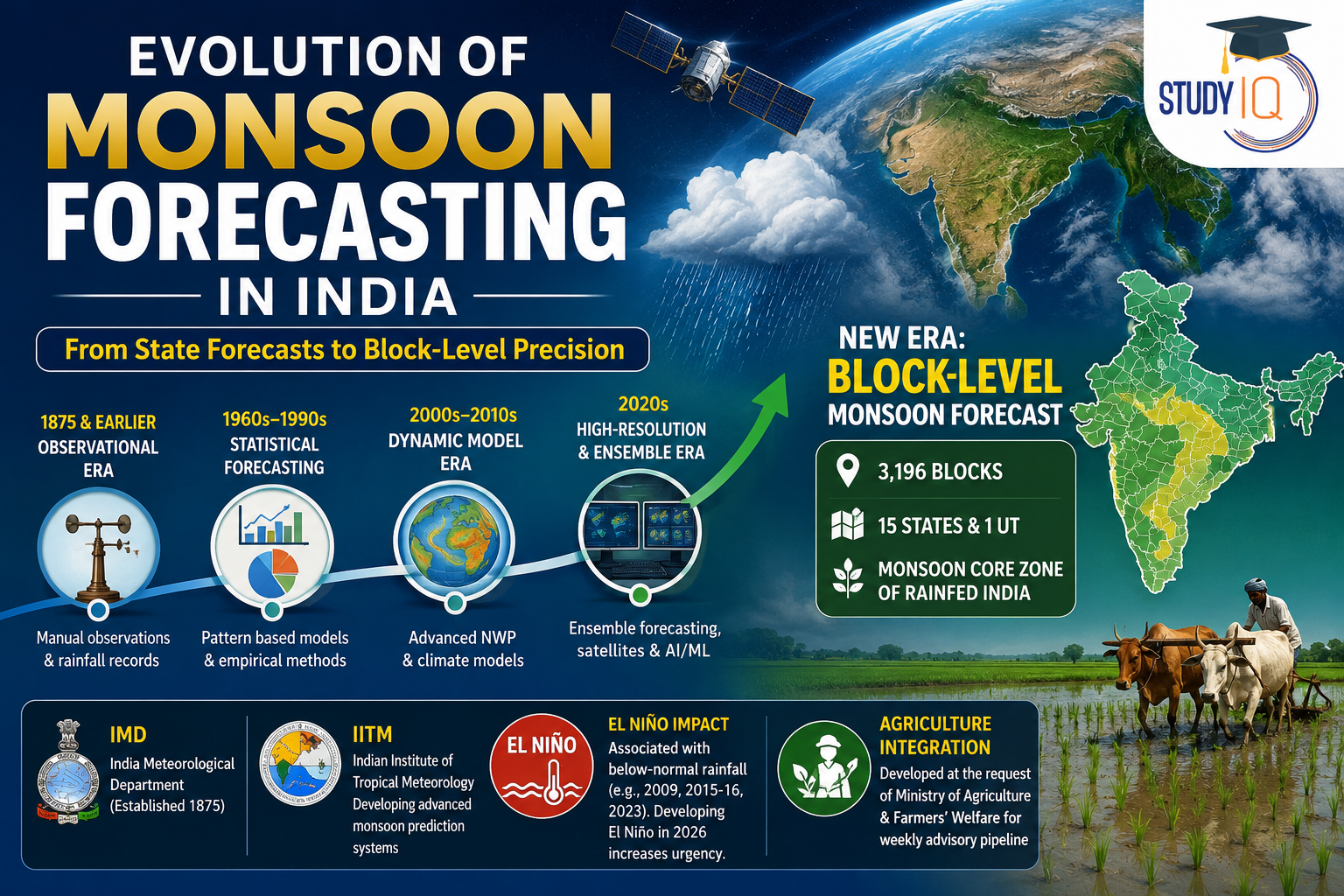
The India Meteorological Department (IMD) unveiled a new forecast system that will, for the first time, generate “block-level” forecasts of the monsoon’s arrival for 3,196 blocks across 15 States and one UT covering the “monsoon core zone” of rainfed India.
|
Monsoon Core Zone |
| ● The “monsoon core zone” (MCZ) of India is a critical agricultural belt extending from the northwest to the southeast across central India, characterized by high sensitivity to monsoon dynamics and a heavy reliance on rainfed agriculture. This region is crucial because its rainfall patterns largely dictate the country’s overall Kharif crop production. |
Static Background
- IMD: India Meteorological Department under Ministry of Earth Sciences; established 1875; India’s apex weather forecasting authority.
- Current forecast resolution: State-level and district-level monsoon onset forecasts; Mumbai monsoon arrival June 10; Delhi ~June 29. Block-level (sub-district) is a new capability.
- Indian Institute of Tropical Meteorology (IITM): Under Ministry of Earth Sciences; developed the blending framework; responsible for India’s monsoon prediction systems.
- El Niño: Warming of central and eastern Pacific Ocean — historically associated with below-normal rainfall over India. El Niño years include 2009 (severe drought), 2015-16, 2023. A developing El Niño in 2026 adds urgency to block-level precision forecasting.
- Agriculture advisory integration: System specifically developed at the request of the Ministry of Agriculture and Farmers’ Welfare to feed into a weekly advisory pipeline.
Types of Forecasts
- Nowcasting (0–6 hrs): Provides ultra-short-term weather updates using real-time data from radars and satellites.
- Short-range (1–3 days): Useful for agriculture and planning; relies on numerical weather prediction (NWP) models.
- Medium-range (4–10 days): Uses dynamic models to simulate atmospheric conditions; forecasts moderate-term patterns.
- Long-range (10 days–2 years): Focuses on seasonal trends like monsoon; involves ocean-atmosphere interactions.
- Ensemble Forecasting: Combines multiple models and parameters to offer more reliable and probabilistic forecasts.
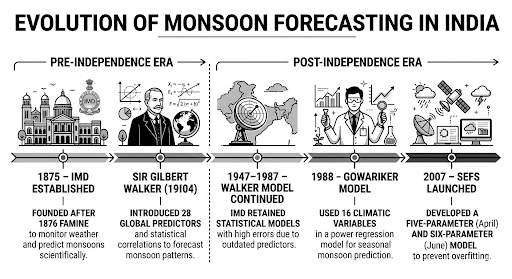
About the Evolution of Monsoon Forecasting in India
|
Read More Notes |
|
| Environment Notes | Art and Culture Notes |
| Science and Tech | History Notes |
| Geography Notes | Indian Polity Notes |
| General Knowledge | International Relation |
|
Explore StudyIQ Courses |
|
 UAPA Act 1967: Key Provisions, Supreme C...
 Sarus Crane: Habitat, Features, Conserva...














 WhatsApp