
Table of Contents
Context
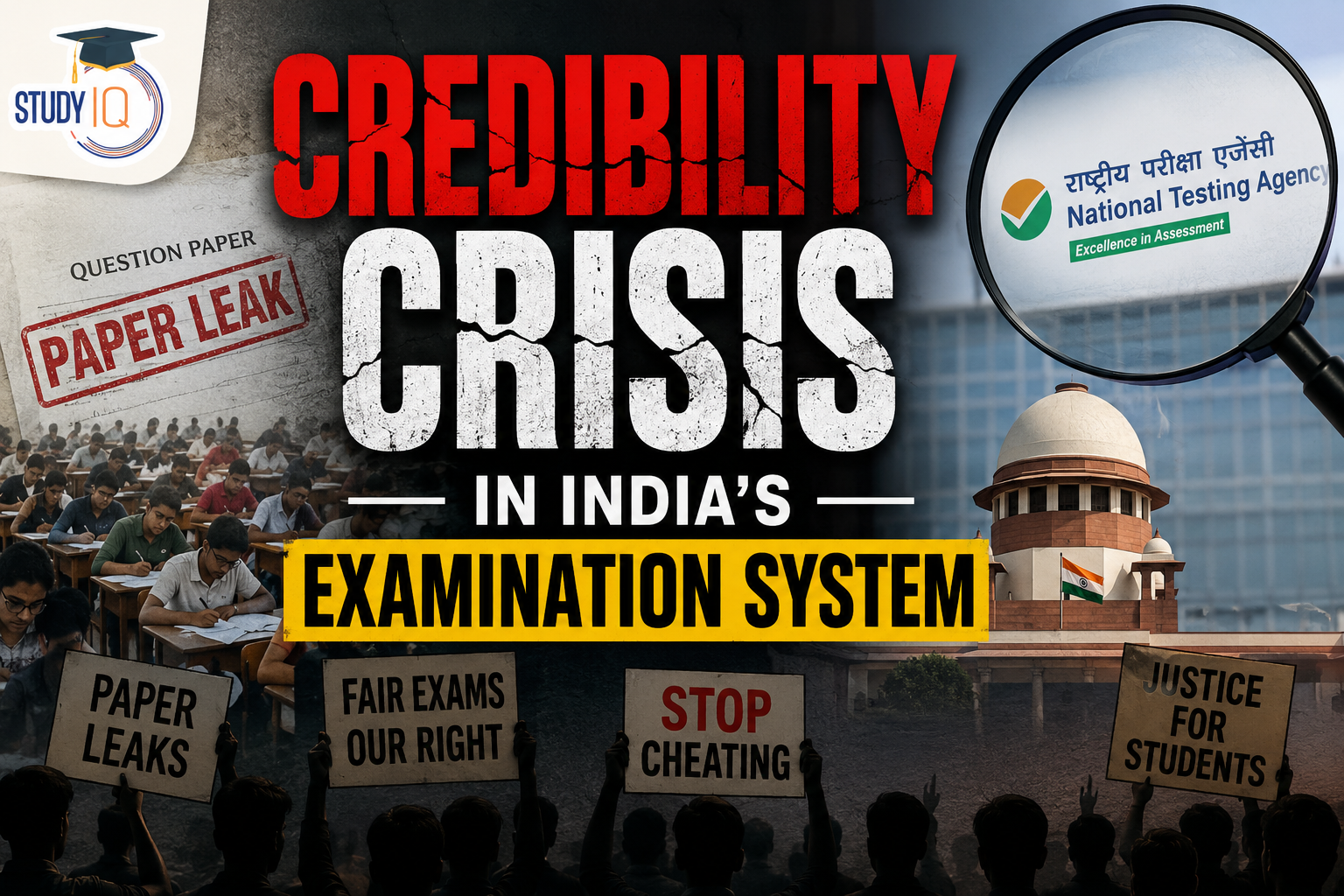
The National Testing Agency (NTA) cancelled the NEET-UG 2026 examination, which was held on May 3 for more than 22 lakh candidates, after allegations of paper leaks and examination malpractices emerged.
Read Also: UPSC Daily Current Affairs 2026
About the National Testing Agency (NTA)
- The National Testing Agency (NTA) was set up as a society under the provisions of the Indian Societies Registration Act, 1860.
- It functions as an autonomous and financially independent body responsible for conducting entrance examinations for admissions to higher educational institutions across India.
- The agency is headed by a distinguished educationist appointed by the Ministry of Human Resource Development.
- Its administrative leadership is managed by a Chief Executive Officer (CEO), who serves as the Director-General and is appointed by the Government.
- NTA also has a Board of Governors consisting of representatives from various user institutions.
Key provisions of the Public Examinations (Prevention of Unfair Means) Act, 2024
- The Act specifies the examinations and authorities covered under its scope, thereby ensuring clarity in implementation.
- The law applies to recruitment and entrance examinations conducted by central agencies such as UPSC, SSC, RRBs, IBPS, and NTA, along with examinations organised by central ministries and departments.
- Individuals involved in paper leaks or similar offences may face imprisonment ranging from three to five years. In cases linked to organised crime, the punishment can extend up to ten years along with substantial monetary penalties.
- The Act identifies around 20 forms of malpractice, including impersonation, tampering with records, and unauthorised access to examination-related materials.
- Investigations are to be carried out by officers of designated rank to ensure strict and effective enforcement.
- A specialised committee has been formed to improve IT security measures and frame protocols for computer-based examinations.
- The Act mainly covers examinations conducted at the central level and does not directly include university or state education board examinations.
- The legislation does not mandate coverage of state-level examinations, it provides a framework that states may adopt while drafting their own anti-cheating laws.
|
Read More Notes |
|
| Environment Notes | Art and Culture Notes |
| Science and Tech | History Notes |
| Geography Notes | Indian Polity Notes |
| General Knowledge | International Relation |
|
Explore StudyIQ Courses |
|
 UAPA Act 1967: Key Provisions, Supreme C...
 Sarus Crane: Habitat, Features, Conserva...














 WhatsApp





