
Table of Contents
Context
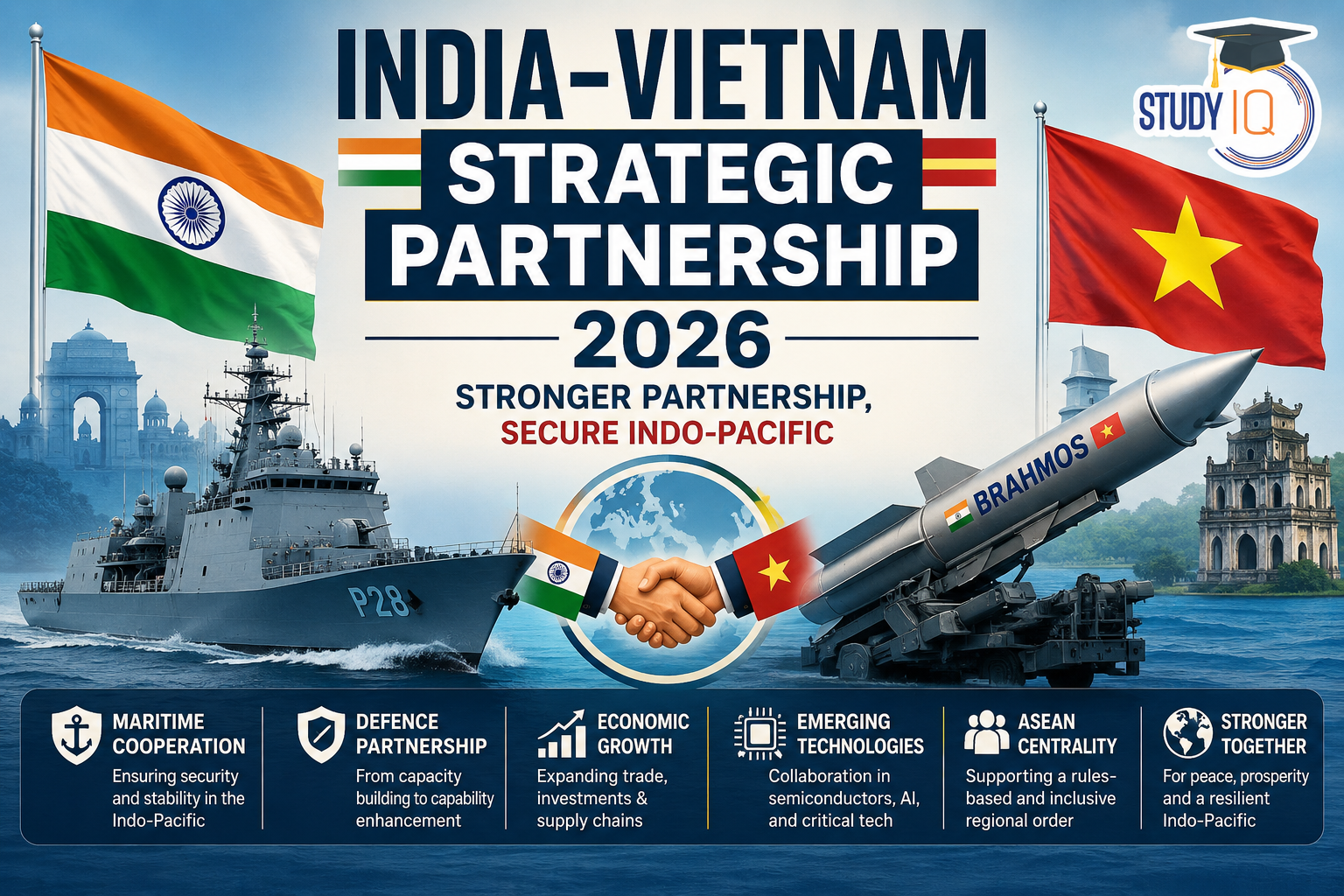
The visit of Tô Lâm to India in 2026 marked the elevation of ties to an Enhanced Comprehensive Strategic Partnership amid changing Indo-Pacific geopolitics.
Read Also: UPSC Daily Current Affairs 2026
Indo-Pacific Dynamics Reshaping the Bilateral Relationship
- China’s Assertiveness: Rising tensions in the South China Sea and maritime coercion are pushing India and Vietnam towards closer strategic coordination.
- g. Both support a rules-based Indo-Pacific order, freedom of navigation and UNCLOS-based maritime governance.
- Shift from Economic to Security-Centric Indo-Pacific: India’s Act East Policy is evolving into a broader Indo-Pacific strategy with greater emphasis on maritime security and defence cooperation.
- Supply Chain Securitisation: Global efforts to reduce dependence on China-centric supply chains are increasing economic and technological cooperation between the two countries.
- Rise of Minilateral Partnerships: India and Vietnam are increasingly cooperating with partners like Japan, Australia and United States for Indo-Pacific stability.
- Competition in Emerging Technologies: Strategic competition in semiconductors, AI, rare earths and critical technologies is driving deeper collaboration.
- ASEAN Centrality: Both pursue independent foreign policies while supporting ASEAN’s central role in regional architecture.
- Defence Cooperation
- INS Kirpan Transfer: India transferred missile corvette INS Kirpan to Vietnam in 2023.
- BrahMos Missile Discussions: Talks on BrahMos exports indicate movement from capacity building to capability enhancement.
- Training & Defence Industry Cooperation: India provides training, Lines of Credit and cooperation in shipbuilding, maritime systems and defence technology.
Issues in the Relationship
- Trade & Connectivity Gaps: Logistics bottlenecks and weak connectivity limit full economic potential.
- Implementation Deficit: Many agreements face delays in execution, especially in defence-industrial cooperation.
- Geopolitical Sensitivities: China factor creates strategic caution in defence and security cooperation.
- Limited Private Sector Participation: Insufficient business-to-business and startup-level integration reduces economic depth.
- Regulatory & Financial Hurdles: Legal frameworks, funding constraints and export regulations affect technology cooperation
Way Forward
- Deepen Maritime Cooperation: Expand naval exercises, maritime domain awareness and coast guard cooperation.
- Strengthen Defence Industrial Ties: Accelerate co-production and defence technology transfer projects like BrahMos.
- Improve Connectivity: Enhance digital, shipping and supply chain connectivity between India and Southeast Asia.
- Expand Economic Partnership: Increase investments in semiconductors, critical minerals, green energy and digital economy.
- Leverage ASEAN Frameworks: Use ASEAN-led institutions to strengthen regional cooperation and Indo-Pacific stability.
- Promote Innovation Collaboration: Encourage startup ecosystems, academic exchanges and emerging technology partnerships.
 UAPA Act 1967: Key Provisions, Supreme C...
 Sarus Crane: Habitat, Features, Conserva...














 WhatsApp





