
Table of Contents
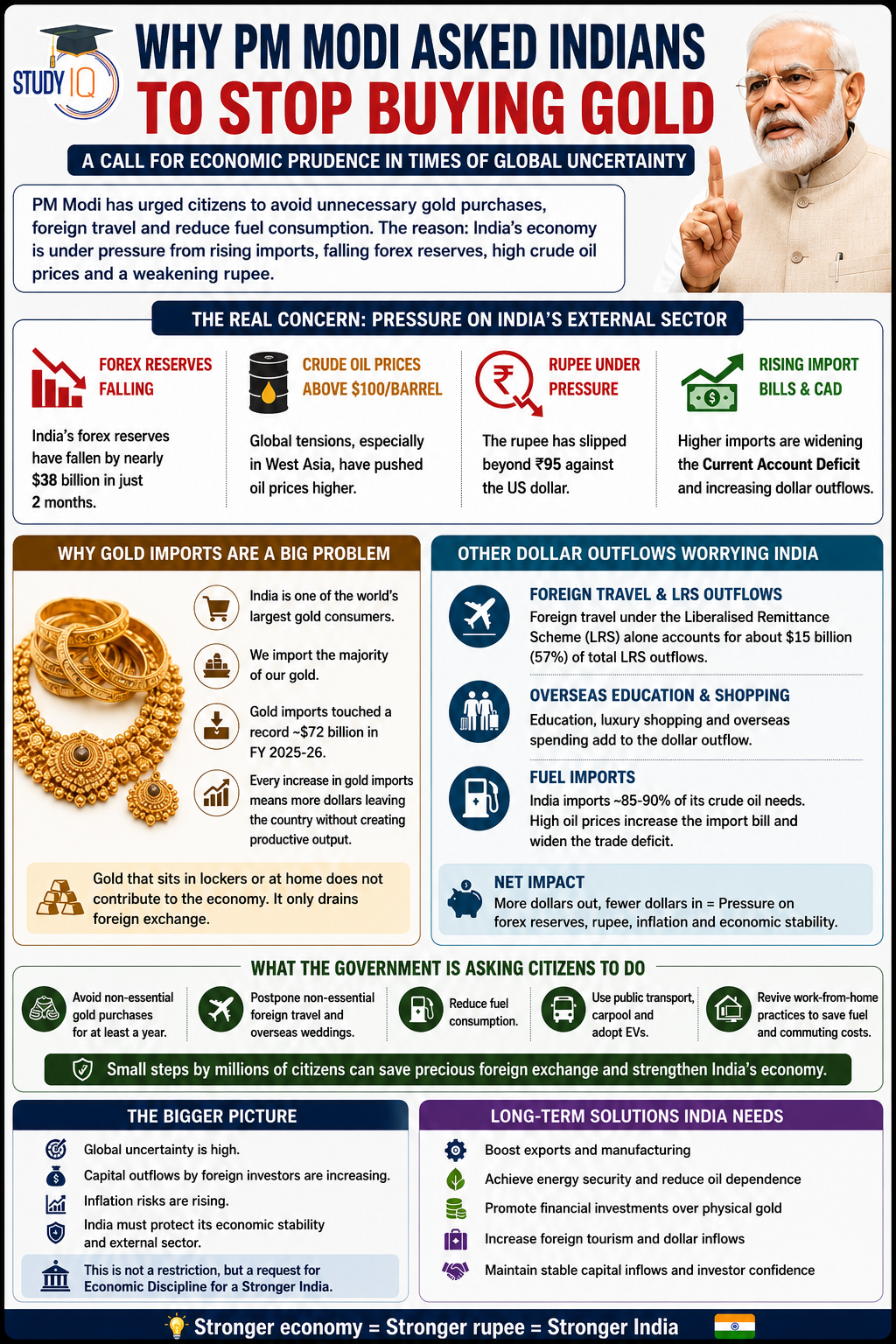
India is facing growing pressure on its economy from rising oil prices, falling foreign exchange reserves, a weakening rupee, and record-high import bills. Against this backdrop, PM Modi recently urged citizens to Stop Buying Gold, foreign travel, and fuel consumption.
For many Indians, the statement appeared unusual. Gold buying is deeply rooted in Indian culture, and international travel has become increasingly common among the middle class. However, the Prime Minister’s appeal is linked to a much larger macroeconomic concern: protecting India’s external financial stability during a period of global geopolitical uncertainty.
According to recent reports, India’s foreign exchange reserves have declined sharply amid rising crude oil prices and increased dollar outflows.
Read Also: UPSC Daily Current Affairs 2026
Stop Buying Gold: Why Is India Worried Right Now?
The biggest concern is India’s external sector.
India imports:
- Nearly 85-90% of its crude oil needs
- A major portion of its gold demand
- Large quantities of electronics and industrial inputs
This means India spends massive amounts of dollars every year on imports.
When oil prices rise globally or imports increase rapidly, India needs more dollars to pay foreign suppliers. That creates pressure on:
- Foreign exchange reserves
- The Indian rupee
- Inflation
- Current Account Deficit (CAD)
Recent geopolitical tensions in West Asia have further worsened the situation by increasing global energy prices and financial uncertainty.
Stop Buying Gold: India’s Forex Reserves Are Falling
One of the key triggers behind the government’s concern is the rapid decline in India’s foreign exchange reserves.
Reports suggest reserves have fallen significantly in recent months as:
- Crude oil import costs increased
- Foreign investors withdrew money from Indian markets
- Demand for dollars surged
- The RBI intervened to stabilize the rupee
The rupee recently weakened beyond ₹95 against the US dollar, reflecting pressure on India’s external finances.
Forex reserves are extremely important because they help:
- Pay import bills
- Stabilize the currency
- Handle external economic shocks
- Maintain investor confidence
If reserves decline too quickly, markets begin worrying about economic vulnerability.
Why Gold Imports Are a Big Problem
India is one of the world’s largest consumers of gold.
Gold has:
- Cultural importance
- Religious significance
- Investment value
- Marriage-related demand
But economically, there is a problem.
India imports most of its gold using foreign currency, especially US dollars. Every increase in gold imports leads to:
- More dollar outflow
- Higher trade deficit
- Greater pressure on forex reserves
Reports indicate India’s gold import bill has surged dramatically in recent years.
The Global Trade Research Initiative (GTRI) supported the Prime Minister’s call, saying excessive bullion imports worsen India’s trade imbalance and external vulnerabilities.
Why Gold Is Different From Other Imports
Not all imports are equally problematic.
For example:
- Crude oil is essential for transport and industry
- Machinery imports support manufacturing
- Semiconductor imports help technology production
But gold imports often do not generate productive economic output.
A large portion of imported gold:
- Remains locked in households
- Sits in lockers
- Functions as savings rather than productive investment
Economists argue that excessive gold imports drain foreign exchange without significantly contributing to industrial productivity.
That is why policymakers repeatedly encourage:
- Gold monetisation schemes
- Financial investments
- Digital assets
- Productive savings instruments
Foreign Travel and Dollar Outflow
The Prime Minister also advised Indians to postpone non-essential foreign travel and overseas weddings.
Why?
Because foreign travel also leads to large dollar outflows.
Under the Liberalised Remittance Scheme (LRS), Indians spend billions of dollars annually on:
- Tourism
- Foreign education
- Overseas shopping
- International weddings
- Luxury spending abroad
Reports suggest foreign travel alone accounts for a major share of outward remittances.
After the pandemic, outbound travel by Indians has surged sharply, while foreign tourist arrivals into India have recovered more slowly.
This creates an imbalance:
- Indians spend dollars abroad
- But India earns fewer foreign exchange inflows from incoming tourists
The result is greater pressure on India’s external account.
Crude Oil: India’s Biggest Vulnerability
The biggest economic risk remains crude oil.
India imports nearly 90% of its oil requirements. Therefore, any rise in global crude prices directly affects:
- Petrol prices
- Diesel prices
- Inflation
- Transport costs
- Fiscal deficit
- Current Account Deficit
The ongoing West Asia conflict has increased fears of supply disruptions and elevated oil prices globally.
Even if actual supply disruptions do not occur, geopolitical uncertainty alone pushes prices higher.
This is why PM Modi encouraged:
- Public transport
- Electric vehicles
- Carpooling
- Reduced fuel usage
- Work-from-home practices
These measures are aimed at reducing India’s oil import dependency.
Why the Rupee Is Weakening
The rupee weakens when:
- Dollar demand rises
- Foreign investment exits increase
- Imports become expensive
- Forex reserves decline
Foreign investors have reportedly withdrawn massive amounts from Indian markets amid global uncertainty and better opportunities elsewhere.
When foreign investors sell Indian assets:
- They convert rupees into dollars
- Dollars leave India
- Pressure increases on the currency
A weak rupee then makes imports even costlier, especially oil and gold.
This creates a dangerous cycle:
Higher imports → More dollar demand → Weaker rupee → Costlier imports → Higher inflation.
Is India Facing an Economic Crisis?
India is not facing a full-scale economic crisis similar to the 1991 Balance of Payments crisis.
India still has:
- Large forex reserves
- Strong domestic demand
- Stable banking systems
- High GDP growth compared to many economies
However, policymakers clearly see warning signs:
- Rising import dependency
- Global geopolitical instability
- Pressure on the rupee
- High oil prices
- Capital outflows
The government’s message is essentially preventive:
“Reduce unnecessary dollar outflows before the situation worsens.”
Why the Government Is Asking Citizens to Participate
Governments often respond to economic stress through:
- Monetary policy
- Fiscal measures
- Import duties
- RBI interventions
But behavioural changes can also help.
If millions of people:
- Reduce unnecessary fuel use
- Delay gold purchases
- Avoid luxury foreign spending
Then aggregate dollar demand falls.
This helps:
- Preserve forex reserves
- Reduce import pressure
- Stabilize the rupee
- Ease inflationary pressure
The government appears to be promoting a “national economic discipline” approach during global uncertainty.
Criticism and Challenges
Despite the economic logic, the appeal has faced criticism.
Many argue:
- Gold is culturally important in India
- Middle-class foreign travel reflects rising aspirations
- Structural problems cannot be solved by citizen restraint alone
Critics also point out that India needs:
- Stronger exports
- Manufacturing expansion
- Energy security
- Better domestic investment opportunities
Without structural reforms, temporary austerity appeals may provide only limited relief.
Others worry that such messaging may signal deeper economic stress than officially acknowledged.
Long-Term Solutions India Needs
To reduce vulnerability, India must focus on:
1. Energy Security
- Renewable energy
- Domestic oil exploration
- EV ecosystem
- Green hydrogen
2. Export Growth
- Manufacturing competitiveness
- High-value exports
- Electronics production
3. Reducing Gold Dependence
- Financial literacy
- Gold monetisation
- Alternative investments
4. Strong Capital Inflows
- Stable FDI
- Investor confidence
- Financial market stability
5. Tourism Expansion
India must attract more international tourists to increase forex earnings.
The Bigger Message Behind PM Modi’s Appeal
The Prime Minister’s statement is ultimately about economic resilience.
India is heavily dependent on imported energy and commodities. During periods of global conflict, emerging economies face:
- Currency pressure
- Inflation risks
- Capital flight
- Import shocks
By asking citizens to reduce discretionary imports and overseas spending, the government is attempting to:
- Conserve foreign exchange
- Stabilize the economy
- Reduce external vulnerabilities
The appeal reflects growing concern that the global economy may remain volatile for an extended period.
Conclusion
PM Modi’s call to reduce gold purchases, foreign travel, and fuel consumption is not merely symbolic politics. It reflects genuine concern over India’s external economic pressures amid rising oil prices, geopolitical instability, and declining forex reserves.
While India remains far stronger than during past economic crises, the warning highlights a key challenge for emerging economies: balancing rising consumer aspirations with macroeconomic stability.
In the short term, reducing unnecessary dollar outflows may provide some relief. But in the long term, India’s economic strength will depend on:
- Export competitiveness
- Energy independence
- Manufacturing growth
- Stable capital inflows
- Reduced import dependency
The message from the government is clear: in a turbulent global economy, economic resilience requires both policy action and public participation.
 UAPA Act 1967: Key Provisions, Supreme C...
 Sarus Crane: Habitat, Features, Conserva...














 WhatsApp





