Table of Contents
Context
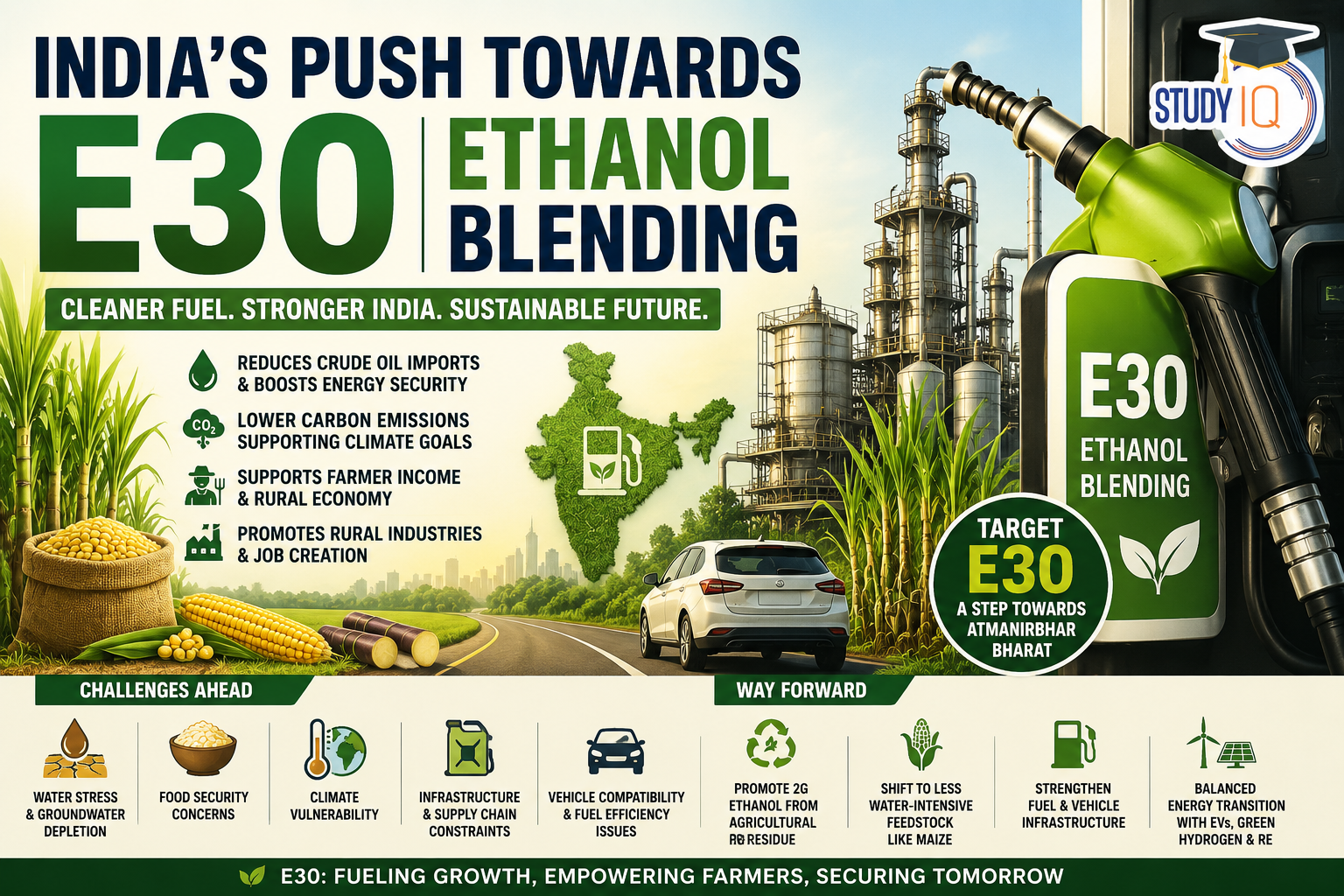
After achieving 20% ethanol blending (E20) ahead of the 2030 target, discussions have emerged on moving towards E30 (30% ethanol blending).
Read Also: UPSC Daily Current Affairs 2026
Benefits of E30
- Reduced Crude Oil Dependence: Higher ethanol blending can reduce reliance on imported crude oil (India imported ~85% of its crude oil needs in 2025).
- Energy Security: Greater domestic fuel substitution provides resilience against geopolitical oil shocks (West Asia conflicts, OPEC supply disruptions).
- Lower Carbon Emissions: Ethanol blending reduces carbon monoxide and hydrocarbon emissions from vehicles (supports India’s net-zero and climate goals).
- Farmer Income Support: Ethanol creates an additional market for sugarcane, maize and grain farmers (sugar mills earned ₹94,000+ crore from ethanol sales during 2014–24).
- Rural Industrial Growth: Expansion of distilleries and biofuel infrastructure boosts rural employment and agro-processing industries.
- Diversification of Feedstock: Shift towards maize and second-generation ethanol may reduce overdependence on sugarcane-based ethanol.
Challenges in Transitioning to E30
- Water Stress: Sugarcane-based ethanol is highly water intensive (~2,860 litres of water required per litre of ethanol), aggravating groundwater depletion in states like Maharashtra and Uttar Pradesh.
- Food Security Concerns: Use of rice and food grains for ethanol can affect food availability (government restricted rice diversion in 2023 due to lower output).
- Climate Vulnerability: Poor monsoons and possible El Niño conditions may reduce sugarcane and paddy output, affecting ethanol supply and food stocks.
- Land Use & Cropping Distortion: Large-scale maize or sugarcane expansion may alter cropping patterns and increase pressure on agricultural land.
- Infrastructure Constraints: E30 requires major investments in distilleries, storage and transportation systems (estimated ethanol demand: 1,700–1,800 crore litres).
- Automobile Compatibility Issues: Most vehicles in India are not fully E20-compliant; E30 would require further engine modifications and may reduce fuel efficiency.
- Limited Impact on Import Bill: Despite E20 achievement, crude oil substitution reduced India’s import bill by less than 3% due to rising fuel demand.
- Risk of New Dependency: Without second-generation ethanol, India may replace oil dependence with dependence on water-intensive crops and food-based feedstocks.
Way Forward
- Promote Second-Generation (2G) Ethanol: Use agricultural residue and non-food biomass to reduce food security and water stress concerns.
- Shift Towards Less Water-Intensive Feedstock: Encourage maize and alternative biofuel crops instead of excessive sugarcane dependence.
- Strengthen Vehicle & Fuel Infrastructure: Expand E-compatible vehicle ecosystem, storage capacity and distribution networks.
- Balanced Energy Transition: Combine ethanol expansion with EV adoption, green hydrogen and renewable energy for long-term energy security.
 UAPA Act 1967: Key Provisions, Supreme C...
 Sarus Crane: Habitat, Features, Conserva...














 WhatsApp