Table of Contents
Context
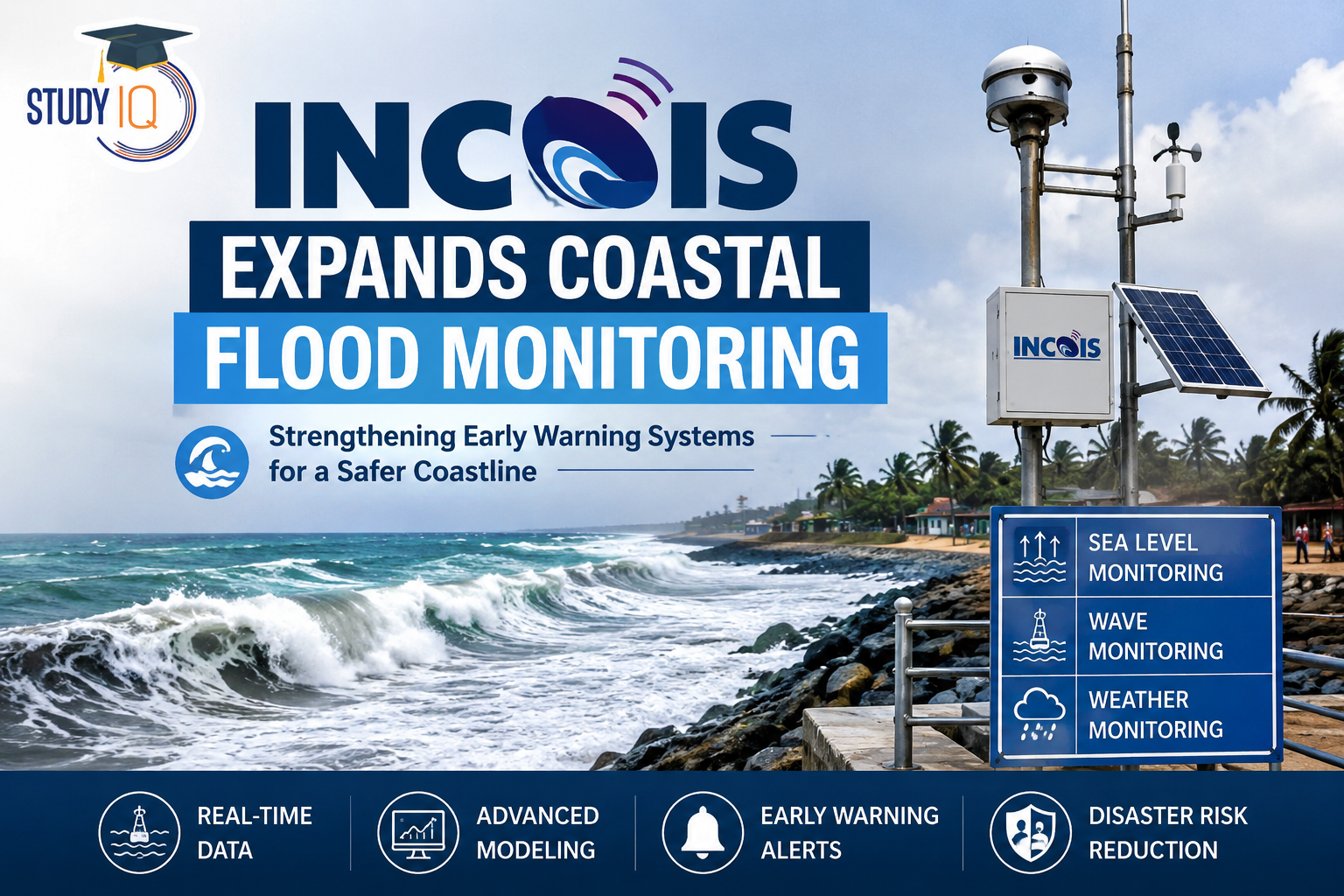
Indian National Centre for Ocean Information Services (INCOIS) installed a second Coastal Flood Monitoring System (CFMS) near Kollam Harbour to improve forecasting of “Kallakkadal” swell surge events
Read Also: UPSC Daily Current Affairs 2026
About Kallakkadal Surges
- Meaning: “Kallakkadal” refers to sudden coastal flooding caused by high-energy swell waves generated by distant storms in the southern Indian Ocean.
- Cause: Triggered by long-period ocean swells generated nearly 10,000 km away in the southern Indian Ocean.
- Scientific Basis: Linked to low-frequency infragravity waves formed through interactions among shorter waves in the open ocean.
- Shoaling Effect: Wave height increases as waves move from deep to shallow waters.
- Role of Coastal Bathymetry: Underwater topography amplifies wave energy near the shore.
- Wave Characteristics: These are long-period swells with wave periods ranging from 30–300 seconds.
- Vulnerable Regions in India: India’s southwest coast, especially Kerala, is highly vulnerable during the pre-monsoon season.(February–May).
- Impact: Threatens fishing communities, harbours, coastal infrastructure and low-lying settlements.
Coastal Flood Monitoring System (CFMS)
- A monitoring system integrating weather stations and high-frequency pressure sensors in shallow waters to track nearshore wave transformation and coastal water-level changes in real time.
- Developed and operated by INCOIS under the Ministry of Earth Sciences (MoES)
- CFMS Locations: First CFMS was installed at Vizhinjam and the second near Kollam Harbour.
- Significance of CFMS: Strengthens early warning systems, improves forecast accuracy and enhances coastal disaster preparedness and resilience.
|
Read More Notes |
|
| Environment Notes | Art and Culture Notes |
| Science and Tech | History Notes |
| Geography Notes | Indian Polity Notes |
| General Knowledge | International Relation |
|
Explore StudyIQ Courses |
|
 UAPA Act 1967: Key Provisions, Supreme C...
 Sarus Crane: Habitat, Features, Conserva...














 WhatsApp