Table of Contents
Context
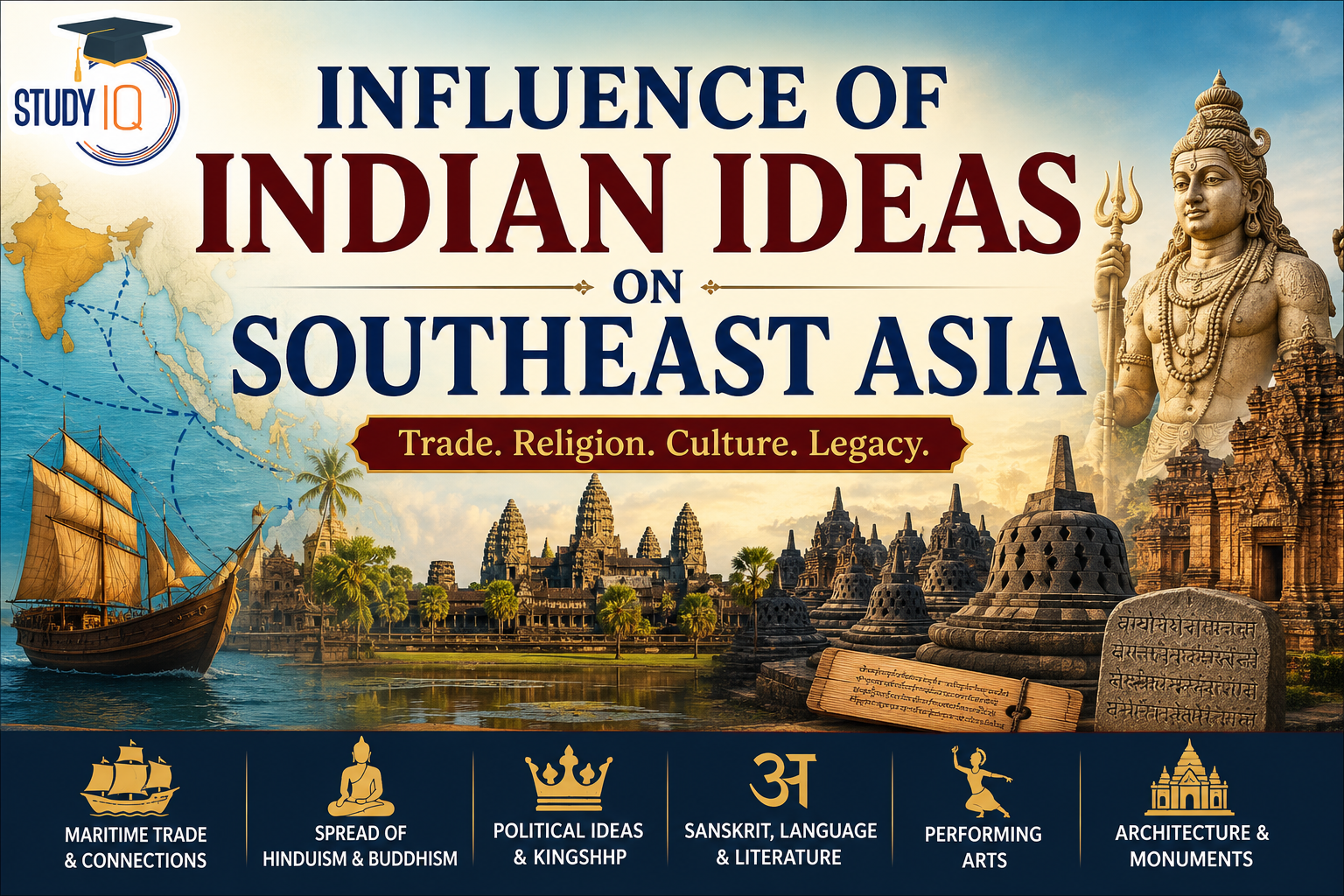
Ancient maritime trade (500–1500 AD) between India and Southeast Asia led to the exchange of cultural, religious, and political ideas, shaping civilisations from Cambodia to Java.
How Did Indian Ideas Spread to Southeast Asia?
- Maritime Trade Routes: Indian merchants sailing the Bay of Bengal established port polities across Southeast Asia, carrying Brahmanical and Buddhist ideas embedded in everyday cultural practice.
- g., Funan (Mekong Delta, 1st–6th century AD) emerged directly along Indian oceanic trade routes; Chinese records describe its rulers adopting Sanskrit titulature and Indian court customs.
- Brahmin Priests and Buddhist Monks: Religious intermediaries travelled voluntarily to Southeast Asian courts, transmitting Sanskrit learning, ritual practice, and iconographic traditions without any accompanying military force.
- g., Yupa pillar inscriptions (Kutai, Borneo, 4th century AD) — the earliest Sanskrit records in Southeast Asia — document a Brahmanical Ashvamedha sacrifice performed by a local king, confirming Brahmin court presence through invitation, not conquest.
- Court Patronage: Southeast Asian rulers actively invited Indian Brahmins and Buddhist scholars to legitimise their authority through Indian political theology — making cultural transmission a deliberate top-down choice.
- g., Jayavarman II (802 AD) invited a Brahmin ritualist to consecrate him as Devaraja, unifying the Khmer polity under a single divine sovereign through an explicitly Indian-derived ceremony.
- Monastic and Dynastic Networks: Buddhist pilgrimage corridors and inter-dynastic monastic ties deepened theological and artistic exchange over centuries.
- g., The Sailendra dynasty of Java maintained active ties with the Pala dynasty of Bengal, channelling Mahayana Buddhist theology and artistic styles into Java.
Latest UPSC Updates
| Resource | Link |
|---|---|
| UPSC Prelims Result 2026 | Check Here |
| UPSC Exam Calendar 2027 | View Calendar |
| UPSC Question Paper 2026 | Download PDF |
| UPSC Prelims Answer Key 2026 | Check Answer Key |
| UPSC Cut Off 2026 | View Cut Off |
| UPSC Syllabus 2026 | Read Syllabus |
| Daily Current Affairs 2026 | Read Updates |
| StudyIQ UPSC IAS Foundation 2027 (English) | Join Course |
| StudyIQ UPSC IAS Foundation 2027 (Hindi) | Join Course |
| StudyIQ UPSC IAS Foundation 2027 (Bilingual) | Join Course |
What Was the Impact of Indian Ideas in Southeast Asia?
- Religion
- Shaivism: Shiva worship and Linga veneration spread into Cham and Khmer territories through Brahmin networks, becoming state religion under royal patronage.
- g., My Son Sanctuary (Vietnam, 4th–13th century AD) was continuously built and maintained by Cham rulers as a royal Shaiva centre, featuring Linga worship and Sanskrit inscriptions spanning nearly a thousand years.
- Vaishnavism: Vishnu worship shaped the cosmological imagination of Khmer rulers, directly informing monumental temple architecture.
- g., Angkor Wat (Suryavarman II, 12th century AD) replicates Mount Meru as the cosmic centre, with concentric enclosures and cardinal orientation derived from Vastu Shastra tradition.
- Buddhism: Mahayana and Theravada Buddhism spread deeply across both mainland and island Southeast Asia through monastic networks and royal sponsorship.
- g., Borobudur (Java, 8th–9th century AD), the world’s largest Buddhist monument, was built under direct Pala-influenced artistic and theological guidance; Bagan Plains (Myanmar) contain over 2,000 temples built through royal patronage between the 11th and 13th centuries.
- Political Ideas-Devaraja (God-King): Indian political theology provided Southeast Asian rulers a ready framework to centralise authority by presenting the king as an earthly manifestation of Vishnu or Shiva.
- g., The Khmer Devaraja cult institutionalised through Jayavarman II’s consecration ceremony became the ideological cornerstone of Khmer kingship for centuries.
- Language and Literature: Sanskrit reshaped Southeast Asian scripts and literary traditions; Indian epics were indigenised rather than merely translated, reflecting active local creative engagement.
- g., Thai, Khmer, Malay, and Javanese scripts derive from Brahmi; the Ramayana was recast as the Ramakien (Thailand) and Kakawin Ramayana (Java).
- Performing Arts: Indian aesthetic theory and dance vocabulary were absorbed and localised into distinct Southeast Asian art forms.
- g., Cambodian Apsara dance and Thai classical dance trace their grammar to the Natya Shastra tradition.
- Architecture: Indian sacred spatial planning, concentric cosmological layouts, mountain-temple symbolism, cardinal orientation governed monumental construction across the region.
- g., Angkor Wat, Borobudur, and My Son Sanctuary all reflect Indic cosmological design, each simultaneously expressing local dynastic identity.
- Shaivism: Shiva worship and Linga veneration spread into Cham and Khmer territories through Brahmin networks, becoming state religion under royal patronage.
|
PRELIMS FACT BOX |
| 1. Funan: 1st–6th century AD; Mekong Delta; one of the earliest Indianised states
2. Srivijaya: 7th–13th century AD; Sumatra; major maritime Buddhist empire and Sanskrit learning centre. 3. Sailendra Dynasty: 8th–9th century AD; Java; built Borobudur; maintained Pala dynasty links. 4. Yupa Inscriptions: Kutai, Borneo (4th century AD); the earliest Sanskrit inscriptions in Southeast Asia; record Ashvamedha sacrifice. |
 Ain-ul-Mulk Multani: Conquest of Malwa i...
 16 Mahajanapadas: List, Capitals, Locati...
 Ghaznavid Empire in Punjab: History, Rul...











 WhatsApp