
Table of Contents
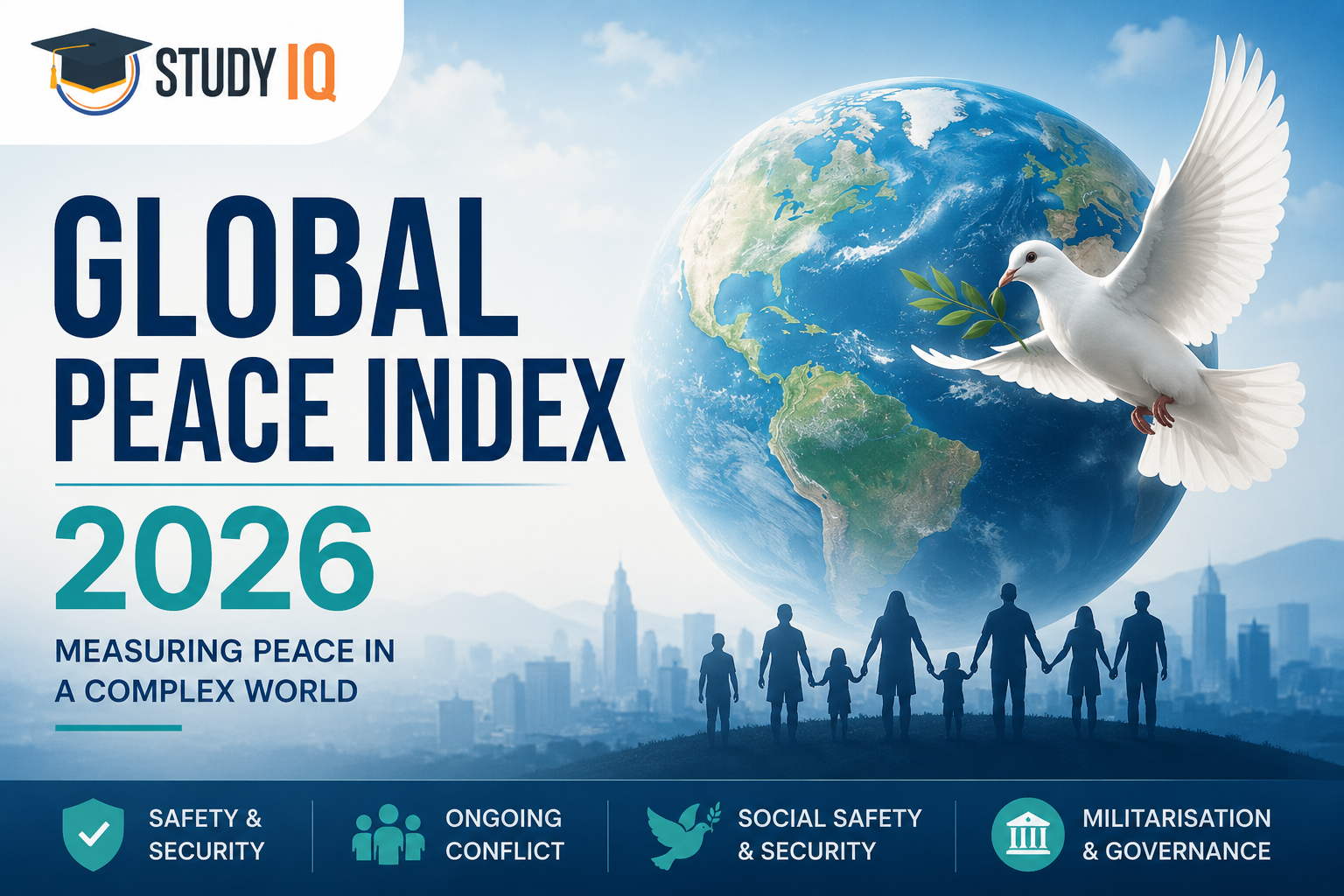
The Global Peace Index (GPI) 2026 has once again highlighted the growing challenges facing global stability. Released by the Institute for Economics & Peace (IEP), the latest report shows that global peacefulness has declined for the twelfth consecutive year, reflecting increasing geopolitical tensions, armed conflicts, political instability, terrorism, and social unrest across various regions.
The 2026 edition marks the 20th anniversary of the Global Peace Index and evaluates 163 countries and territories, covering approximately 99.7% of the world’s population. Iceland retained its position as the world’s most peaceful country for the nineteenth consecutive year, while South Asia recorded the sharpest deterioration in peacefulness among all global regions.
What is the Global Peace Index (GPI)?
The Global Peace Index is an annual report published by the Institute for Economics & Peace that measures the relative peacefulness of nations worldwide. The index serves as one of the most comprehensive assessments of global peace and security.
The GPI evaluates countries using 23 qualitative and quantitative indicators grouped under three broad domains:
1. Societal Safety and Security
- Crime rates
- Violent crime levels
- Homicide rates
- Terrorism impact
- Political instability
- Perceptions of criminality
2. Ongoing Domestic and International Conflict
- Internal conflicts
- External conflicts
- Conflict-related deaths
- Intensity of organized conflicts
- Relations with neighboring countries
3. Militarization
- Military expenditure
- Armed forces personnel
- Weapons imports and exports
- Nuclear and heavy weapons capabilities
A lower score indicates a higher level of peacefulness.
Key Highlights of Global Peace Index 2026
The Global Peace Index 2026 presents several significant findings:
- Global peace declined for the 12th consecutive year.
- Nearly 99 countries recorded a deterioration in peacefulness.
- The world witnessed 61 active state-based conflicts, the highest number since World War II.
- Iceland remained the world’s most peaceful nation for the 19th consecutive year.
- Russia ranked as the least peaceful country globally.
- South Asia experienced the largest decline in peacefulness among all regions.
- Rising geopolitical tensions, conflicts, and internal unrest contributed significantly to the global deterioration.
Top 10 Safest Countries in the World 2026
The following countries ranked as the most peaceful nations according to the Global Peace Index 2026:
| Rank | Country | GPI Score |
|---|---|---|
| 1 | Iceland | 1.161 |
| 2 | New Zealand | 1.343 |
| 3 | Switzerland | 1.363 |
| 4 | Slovenia | 1.369 |
| 5 | Ireland | 1.371 |
| 6 | Austria | 1.421 |
| 7 | Portugal | 1.427 |
| 8 | Singapore | 1.435 |
| 9 | Finland | 1.478 |
| 10 | Japan | 1.489 |
Why is Iceland the Safest Country in the World?
Iceland has maintained the top position since 2008 due to several unique characteristics:
Factors Behind Iceland’s Success
- No standing military force
- Extremely low crime rates
- Strong democratic governance
- High social trust
- Effective welfare system
- Low levels of corruption
- Strong rule of law
With a population of around 382,000, Iceland continues to serve as a global model for peace, stability, and security.
Overview of Other Top-Ranked Countries
New Zealand
New Zealand secured the second position due to transparent governance, low corruption levels, strong institutions, and minimal involvement in international conflicts.
Switzerland
Known for its longstanding neutrality, Switzerland benefits from strong institutions, political stability, and high living standards.
Slovenia
Slovenia remains among Europe’s most peaceful nations because of its political stability, social welfare systems, and low crime rates.
Ireland
Ireland continues to perform strongly due to low militarization, economic stability, and effective governance.
India’s Rank in Global Peace Index 2026
India ranked 127th out of 163 countries in the Global Peace Index 2026, with a score of 2.409.
Compared to the previous year, India’s ranking declined by three positions.
Reasons for India’s Decline
The report identified several factors contributing to India’s lower ranking:
- Border tensions with Pakistan
- Security concerns along the Myanmar border
- Continuing ethnic violence in Manipur
- Internal security challenges
- Regional geopolitical instability
- Communal and social tensions
Despite these challenges, India continues to remain one of the world’s fastest-growing major economies and has undertaken significant initiatives to strengthen internal security and governance.
South Asia in Global Peace Index 2026
South Asia emerged as the worst-performing region globally, recording a 2.3% deterioration in peacefulness.
South Asia Rankings 2026
| Country | Global Rank |
| Bhutan | 16 |
| Sri Lanka | 67 |
| Nepal | 111 |
| Bangladesh | 117 |
| India | 127 |
| Pakistan | 152 |
| Afghanistan | 157 |
Regional Trends
Bhutan
Bhutan remains South Asia’s most peaceful country and ranks among the top twenty globally.
Sri Lanka
Sri Lanka recorded the region’s biggest improvement due to economic recovery and enhanced political stability.
Nepal
Nepal experienced one of the world’s steepest declines in peacefulness due to political unrest and large-scale protests.
Pakistan
Pakistan’s ranking deteriorated because of terrorism, internal conflict, and cross-border tensions.
Afghanistan
Afghanistan remains South Asia’s least peaceful country despite some improvement in political stability indicators.
Latest UPSC Updates
| Resource | Link |
|---|---|
| UPSC Prelims Result 2026 | Check Here |
| UPSC Exam Calendar 2027 | View Calendar |
| UPSC Question Paper 2026 | Download PDF |
| UPSC Prelims Answer Key 2026 | Check Answer Key |
| UPSC Cut Off 2026 | View Cut Off |
| UPSC Syllabus 2026 | Read Syllabus |
| Daily Current Affairs 2026 | Read Updates |
| StudyIQ UPSC IAS Foundation 2027 (English) | Join Course |
| StudyIQ UPSC IAS Foundation 2027 (Hindi) | Join Course |
| StudyIQ UPSC IAS Foundation 2027 (Bilingual) | Join Course |
How Does the Global Peace Index Measure Peace?
The Global Peace Index uses a data-driven methodology that combines information from international organizations, think tanks, and expert assessments.
Major Indicators Used
- Homicide rate
- Violent crime rate
- Political instability
- Terrorism impact
- Internal conflicts
- External conflicts
- Military spending
- Number of prisoners
- Weapons imports and exports
- Deaths from organized conflict
The methodology enables policymakers, researchers, and governments to identify emerging security risks and improve peace-building efforts.
Significance of the Global Peace Index
The Global Peace Index is widely used for:
- Policy formulation
- Security assessments
- International relations research
- Investment decisions
- Economic planning
- Conflict prevention strategies
Studies conducted by the Institute for Economics & Peace consistently demonstrate a strong relationship between peace, economic prosperity, human development, and social progress.
 Cyclone Arnab 2026: Andhra Pradesh on Re...
 Operation Trident 2026: Drug Trafficking...
 Ladakh Governance Crisis 2026: Statehood...














 WhatsApp





