Table of Contents
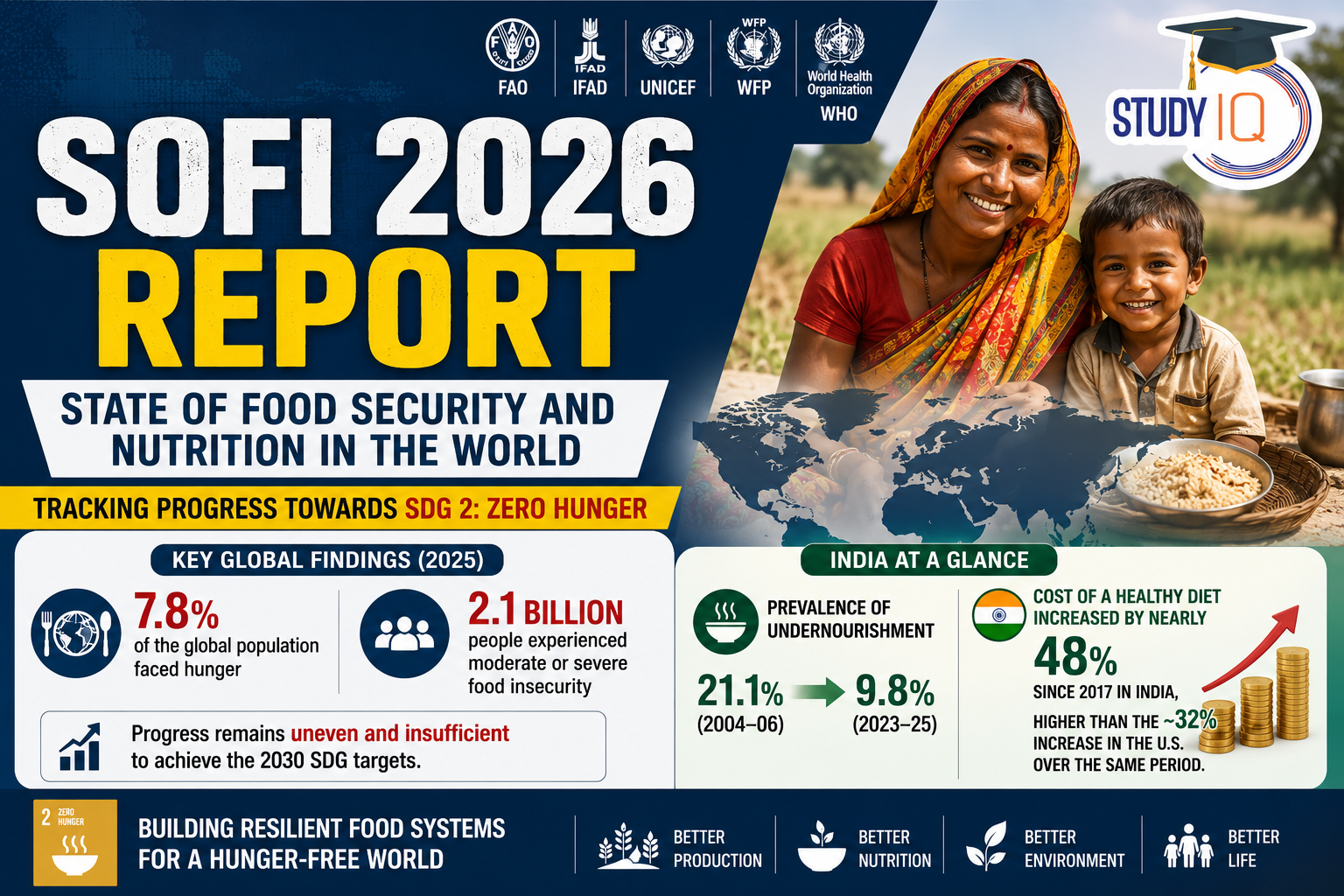
The State of Food Security and Nutrition in the World (SOFI) 2026 Report has been released, presenting the latest assessment of global hunger, food insecurity, and nutrition. The report evaluates progress towards Sustainable Development Goal (SDG) 2: Zero Hunger and highlights that, despite some improvements, the world remains off track to eliminate hunger by 2030.
For India, the report records a significant decline in undernourishment over the past two decades but also highlights the rising cost of healthy diets.
Why is the SOFI 2026 Report in News?
The SOFI 2026 Report is in the news because it:
- Assesses global progress towards SDG 2 (Zero Hunger).
- Highlights that 7.8% of the global population faced hunger in 2025.
- Reports that 2.1 billion people experienced moderate or severe food insecurity.
- Notes India’s improved nutritional indicators while raising concerns about increasing food costs.
What is the State of Food Security and Nutrition in the World (SOFI) Report?
The State of Food Security and Nutrition in the World (SOFI) is an annual global report that tracks hunger, food insecurity, and nutrition trends across countries.
It serves as one of the most authoritative assessments of global food security and provides evidence for policymakers to formulate strategies for ending hunger and malnutrition.
Published By
The report is jointly prepared by:
- Food and Agriculture Organization (FAO)
- International Fund for Agricultural Development (IFAD)
- United Nations Children’s Fund (UNICEF)
- World Food Programme (WFP)
- World Health Organization (WHO)
Objectives of the SOFI Report
The report aims to:
- Monitor progress towards SDG 2: Zero Hunger.
- Assess hunger and food insecurity worldwide.
- Measure access to nutritious and healthy diets.
- Evaluate global nutrition indicators.
- Support evidence-based policymaking.
- Identify regional and global challenges in food systems.
Key Global Findings of SOFI 2026
According to the report:
1. Global Hunger
- 7.8% of the world’s population experienced hunger in 2025.
- Millions continue to suffer from chronic undernourishment.
2. Food Insecurity
Approximately 2.1 billion people faced:
- Moderate food insecurity, or
- Severe food insecurity
This means many households lacked consistent access to sufficient, safe, and nutritious food.
3. Uneven Progress
The report notes that:
- Some regions have improved significantly.
- Others continue to experience worsening food insecurity due to conflict, climate change, economic shocks, and inflation.
Overall, progress remains insufficient to achieve SDG 2 by 2030.
India’s Performance in SOFI 2026
The report highlights encouraging improvements in India’s nutritional indicators.
Decline in Undernourishment
India’s prevalence of undernourishment declined substantially:
| Period | Prevalence of Undernourishment |
|---|---|
| 2004–06 | 21.1% |
| 2023–25 | 9.8% |
This reflects improvements in food availability, nutrition programmes, agricultural production, and social welfare initiatives.
Rising Cost of Healthy Diet
Despite nutritional progress, affordability remains a challenge.
Since 2017:
- Cost of a healthy diet in India increased by nearly 48%.
- In comparison, the increase in the United States was around 32%.
The report highlights that rising food prices can limit access to nutritious diets, particularly for low-income households.
Challenges Highlighted by the SOFI Report
The report identifies several factors contributing to global food insecurity:
- Climate change and extreme weather events
- Armed conflicts
- Economic slowdowns
- Inflation in food prices
- Supply chain disruptions
- Income inequality
- Limited access to nutritious food
- Population growth
Importance of the SOFI Report
The SOFI Report is important because it:
- Tracks progress towards SDG 2.
- Provides globally comparable food security data.
- Helps governments design nutrition policies.
- Guides international organisations in allocating resources.
- Supports evidence-based agricultural and food system reforms.
- Highlights emerging challenges affecting food security.
India’s Efforts to Improve Food Security
India has implemented several major initiatives aimed at reducing hunger and improving nutrition, including:
- National Food Security Act (NFSA)
- PM Garib Kalyan Anna Yojana (PMGKAY)
- POSHAN Abhiyaan
- Integrated Child Development Services (ICDS)
- Mid-Day Meal (PM POSHAN) Scheme
- Public Distribution System (PDS)
- PM-KISAN
- National Nutrition Mission
These programmes have contributed to improved food access and nutritional outcomes, although affordability of healthy diets remains an area of concern.
Significance for UPSC & Competitive Exams
The SOFI 2026 Report is important for:
- UPSC Prelims (International Reports)
- UPSC GS Paper II (Social Justice)
- GS Paper III (Agriculture & Food Security)
- SDGs and Sustainable Development
- Nutrition and Public Health
- Government Welfare Schemes
- International Organisations
Key Facts at a Glance
| Particular | Details |
|---|---|
| Report Name | State of Food Security and Nutrition in the World (SOFI) 2026 |
| Published By | FAO, IFAD, UNICEF, WFP & WHO |
| Main Objective | Track progress towards SDG 2 (Zero Hunger) |
| Global Hunger (2025) | 7.8% of world population |
| Food Insecurity | 2.1 billion people faced moderate or severe food insecurity |
| India’s Undernourishment | Declined from 21.1% (2004–06) to 9.8% (2023–25) |
| Healthy Diet Cost in India | Increased by nearly 48% since 2017 |
| Major Concern | World remains off track to achieve Zero Hunger by 2030 |
 Species in News: Cheetah | Project Cheet...
 Quantum Computing: RRI Scientists Demons...
 Artificial Intelligence in Warfare: How ...














 WhatsApp