
Table of Contents
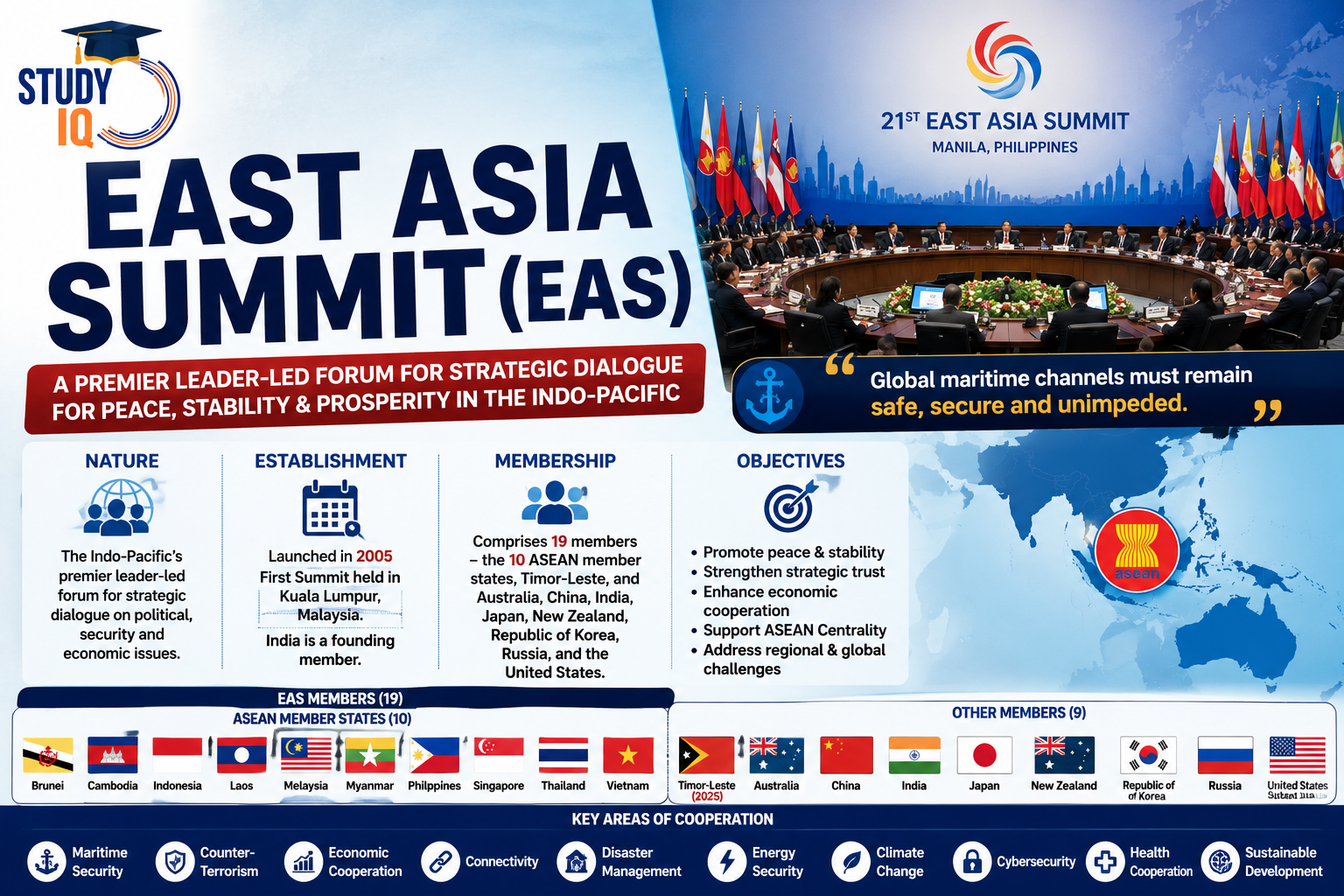
At the 21st East Asia Summit (EAS) in Manila, India’s External Affairs Minister emphasized that global maritime channels must remain safe, secure, and unimpeded, highlighting the importance of freedom of navigation and a rules-based Indo-Pacific order.
The statement comes amid growing geopolitical competition and concerns over maritime security in the Indo-Pacific region.
What is the East Asia Summit (EAS)?
The East Asia Summit (EAS) is the Indo-Pacific’s premier leader-led forum for dialogue and cooperation on strategic, political, security, and economic issues.
It provides a platform for leaders to discuss regional and global challenges while promoting peace, stability, and prosperity in the Indo-Pacific.
History of the East Asia Summit
- Established: 2005
- First Summit: Kuala Lumpur, Malaysia
- Founding Members: ASEAN countries along with key regional partners, including India
- India: Founding member of the East Asia Summit
Since its inception, EAS has evolved into one of the region’s most important strategic forums.
Members of the East Asia Summit
The East Asia Summit currently comprises 19 members.
ASEAN Member States (10)
- Brunei
- Cambodia
- Indonesia
- Laos
- Malaysia
- Myanmar
- Philippines
- Singapore
- Thailand
- Vietnam
Other Members (9)
- Australia
- China
- India
- Japan
- New Zealand
- Republic of Korea (South Korea)
- Russia
- United States
- Timor-Leste
Timor-Leste became a member after joining ASEAN in 2025.
Objectives of the East Asia Summit
The EAS seeks to:
- Promote regional peace and stability.
- Strengthen strategic trust among member countries.
- Enhance political and security cooperation.
- Promote economic integration.
- Support ASEAN Centrality.
- Address emerging regional and global challenges.
- Strengthen maritime cooperation.
- Encourage sustainable development.
Key Areas of Cooperation
The East Asia Summit focuses on several priority areas, including:
- Maritime security
- Counter-terrorism
- Non-proliferation
- Regional security
- Economic cooperation
- Connectivity
- Disaster management
- Energy security
- Climate change
- Cybersecurity
- Health cooperation
- Sustainable development
Significance of the East Asia Summit
The East Asia Summit is important because it:
- Brings together major Indo-Pacific powers.
- Promotes dialogue instead of confrontation.
- Supports a rules-based international order.
- Enhances regional economic cooperation.
- Addresses traditional and non-traditional security challenges.
- Strengthens ASEAN’s central role in regional architecture.
India’s Role in the East Asia Summit
India is a founding member of the East Asia Summit and actively participates in shaping the Indo-Pacific agenda.
India promotes:
- A free, open, inclusive, and rules-based Indo-Pacific.
- Freedom of navigation.
- Respect for international law, including UNCLOS.
- Maritime security.
- Regional connectivity.
- Counter-terrorism cooperation.
- Disaster resilience.
- Sustainable development.
India’s Act East Policy and Indo-Pacific Oceans Initiative (IPOI) complement its engagement within the EAS framework.
Maritime Security and the Recent Summit
At the 21st East Asia Summit in Manila, India’s External Affairs Minister highlighted the need to:
- Keep global maritime trade routes safe.
- Ensure freedom of navigation.
- Maintain unimpeded maritime commerce.
- Uphold international law.
- Preserve peace and stability in the Indo-Pacific.
The remarks are particularly significant amid growing tensions in strategic maritime regions.
Importance for the Indo-Pacific
The East Asia Summit contributes to:
- Regional stability.
- Peaceful dispute resolution.
- Supply chain resilience.
- Maritime security.
- Economic growth.
- Strategic dialogue among major powers.
As geopolitical competition intensifies, the EAS has become increasingly important for maintaining regional balance.
Challenges Before the East Asia Summit
The forum faces several challenges:
- Strategic rivalry among major powers.
- Maritime disputes.
- Geopolitical tensions.
- Economic fragmentation.
- Cybersecurity threats.
- Climate change.
- Supply chain disruptions.
- Regional conflicts.
Way Forward
To strengthen the East Asia Summit, member countries should:
- Reinforce ASEAN Centrality.
- Enhance maritime cooperation.
- Promote dialogue over conflict.
- Improve regional connectivity.
- Strengthen disaster preparedness.
- Expand economic partnerships.
- Ensure adherence to international law.
- Build resilient supply chains.
 Species in News: Cheetah | Project Cheet...
 Quantum Computing: RRI Scientists Demons...
 Artificial Intelligence in Warfare: How ...














 WhatsApp





