Table of Contents
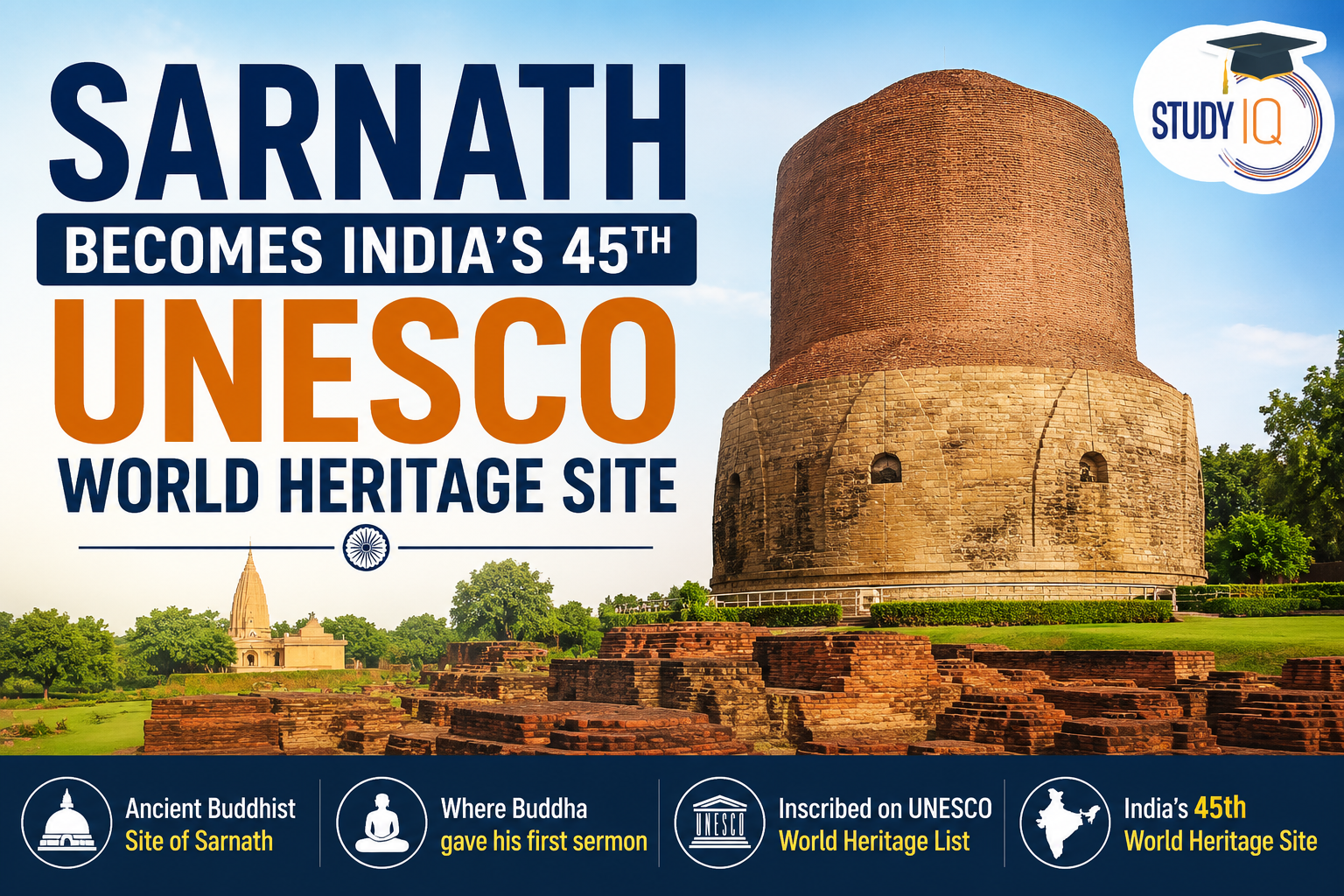
In a landmark achievement for India’s cultural heritage, the Ancient Buddhist Site of Sarnath in Uttar Pradesh has been inscribed on the UNESCO World Heritage List, becoming India’s 45th World Heritage Site. The announcement was made on 25 July 2026 during the 48th Session of the UNESCO World Heritage Committee held in Busan, South Korea.
The recognition celebrates Sarnath’s extraordinary historical, archaeological, and spiritual significance as the place where Gautama Buddha delivered his first sermon after attaining enlightenment, marking the beginning of Buddhism as an organised religion. The inscription also reinforces India’s position as the birthplace of Buddhism and highlights its commitment to preserving its rich cultural heritage.
Read Also: UPSC Daily Current Affairs 2026
Sarnath Added to UNESCO World Heritage List
The Ancient Buddhist Site of Sarnath was India’s official nomination for the 2025–26 UNESCO World Heritage cycle. Following an 18-month evaluation process involving technical assessments by the International Council on Monuments and Sites (ICOMOS), UNESCO approved its inscription under Criteria (iii) and (vi).
With this achievement:
- India now has 45 UNESCO World Heritage Sites.
- India ranks 6th globally and 2nd in the Asia-Pacific region for the highest number of UNESCO World Heritage Sites.
- Sarnath joins other renowned Indian World Heritage Sites such as the Mahabodhi Temple Complex at Bodh Gaya, Ajanta Caves, Sanchi Stupa, and Nalanda Mahavihara.
Where is Sarnath?
Sarnath is located about 10 kilometres northeast of Varanasi in Uttar Pradesh.
Known in ancient Buddhist texts as Rishipatana, Isipatana (Ishipatana), and Mrigadava (Deer Park), Sarnath is one of the holiest pilgrimage destinations for Buddhists worldwide.
Why is Sarnath Important?
Sarnath holds immense religious and historical significance because it is the place where Lord Buddha delivered his first sermon, known as the Dharmachakra Pravartana (Turning of the Wheel of Dharma), after attaining enlightenment at Bodh Gaya.
This event marked:
- The beginning of Buddhist teachings.
- The establishment of the first Buddhist Sangha (monastic community).
- The introduction of the Noble Eightfold Path.
- The spread of Buddhism across Asia and eventually the world.
Recognising its importance, Buddha himself identified Sarnath as one of the four principal places of Buddhist pilgrimage, alongside Lumbini, Bodh Gaya, and Kushinagar.
Components of the UNESCO World Heritage Property
The UNESCO-inscribed property comprises two major components:
1. Chaukhandi Stupa
The Chaukhandi Stupa commemorates the meeting between Buddha and his first five disciples before he delivered his first sermon. It marks a pivotal moment in Buddhist history.
2. Archaeological Remains of Sarnath
This component includes several remarkable monuments:
- Dhamekh Stupa
- Dharmarajika Stupa
- Mulagandhakuti Vihara
- Ashokan Pillar
- Ancient monasteries (Viharas)
- Temples
- Archaeological remains dating from the 5th century BCE to the 12th century CE
Together, these monuments preserve the architectural evolution of one of the world’s oldest and most sacred Buddhist centres.
Historical Development of Sarnath
Sarnath flourished for nearly 1,600 years, receiving patronage from kings, monks, merchants, and pilgrims.
Its development spans several historical periods:
- Pre-Mauryan Period
- Mauryan Empire
- Kushana Empire
- Gupta Empire
- Early Medieval Period
During the reign of Emperor Ashoka, numerous stupas, monasteries, and pillars were constructed to commemorate Buddha’s teachings.
Sarnath declined after the 12th century CE due to invasions and gradually disappeared from public memory before being rediscovered during the 18th century. Since then, extensive archaeological excavations by the Archaeological Survey of India (ASI) have revealed one of the richest Buddhist archaeological landscapes in the world.
UNESCO Criteria for Inscription
Sarnath has been inscribed under Criteria (iii) and (vi) of the UNESCO World Heritage Convention.
Criterion (iii)
Sarnath bears an exceptional testimony to Buddhist civilisation through its remarkable collection of monasteries, stupas, temples, and archaeological remains that reflect centuries of continuous religious devotion.
Criterion (vi)
The site is directly associated with events of outstanding universal significance, particularly:
- Buddha’s first sermon
- Establishment of the Buddhist Sangha
- Meeting of Buddha with his first disciples
These events fundamentally shaped one of the world’s major religions.
Outstanding Universal Value (OUV)
UNESCO recognised Sarnath for its Outstanding Universal Value (OUV) because it:
- Is directly associated with the life of Gautama Buddha.
- Represents one of humanity’s greatest spiritual traditions.
- Preserves exceptional archaeological remains spanning more than two millennia.
- Continues to inspire millions of pilgrims from across the world.
- Influenced philosophy, education, art, and architecture throughout Asia.
Major Monuments at Sarnath
Dhamekh Stupa
The Dhamekh Stupa is the most iconic structure at Sarnath and is believed to stand near the exact location where Buddha delivered his first sermon. Its intricate stone carvings and massive cylindrical design make it one of India’s finest Buddhist monuments.
Dharmarajika Stupa
Traditionally attributed to Emperor Ashoka, this stupa is among the oldest Buddhist structures in India and symbolises Ashoka’s efforts to spread Buddhism.
Mulagandhakuti Vihara
This monastery marks the place where Buddha is believed to have spent his first rainy season after enlightenment.
Ashokan Pillar
The Ashokan Pillar at Sarnath once supported the famous Lion Capital, which later became the National Emblem of India.
Archaeological Importance
Sarnath is among the most extensively excavated archaeological sites in India.
Excavations have revealed:
- Monastic complexes
- Brick stupas
- Temples
- Sculptures
- Ancient inscriptions
- Residential quarters of monks
The site preserves a continuous archaeological sequence from the 5th century BCE to the 12th century CE.
Sarnath Museum
Established in 1904, the Sarnath Museum is India’s oldest site museum.
It houses some of India’s most significant archaeological treasures, including:
- Ashokan Lion Capital
- Dharmachakrapravartana Buddha sculpture
- Gupta-era sculptures
- Stone inscriptions
- Buddhist relics
Journey to UNESCO Recognition
The road to UNESCO recognition was a long one.
| Milestone | Year |
|---|---|
| Added to UNESCO Tentative List | 1998 |
| Nomination Submitted | January 2025 |
| ICOMOS Evaluation Mission | September 2025 |
| UNESCO Inscription | 25 July 2026 |
The nomination underwent rigorous scrutiny involving technical reviews, site inspections, conservation assessments, and consultations before receiving final approval.
Significance for India
The inscription of Sarnath as a UNESCO World Heritage Site has far-reaching implications.
- Strengthens India’s global cultural profile by adding the 45th UNESCO World Heritage Site.
- Reinforces India’s identity as the birthplace of Buddhism and its rich civilisational heritage.
- Boosts Buddhist pilgrimage and heritage tourism, generating local employment and economic opportunities.
- Enhances cultural diplomacy with Buddhist-majority countries such as Japan, Thailand, Sri Lanka, Myanmar, Vietnam, Cambodia, South Korea and Mongolia.
- Recognises the conservation efforts of the Archaeological Survey of India (ASI) in preserving the site.
- Promotes international cooperation for heritage conservation and sustainable tourism management.
- Increases global awareness and research on India’s archaeological and Buddhist heritage.
- Supports the development of the Buddhist Circuit, improving connectivity and tourism infrastructure.
- Strengthens India’s soft power by showcasing its spiritual and cultural legacy on the global stage.
- Encourages long-term protection of Sarnath’s Outstanding Universal Value (OUV), authenticity and integrity through scientific conservation and regulated development.
India’s UNESCO World Heritage Sites
Following the inscription of Sarnath:
- Total UNESCO World Heritage Sites: 45
- Tentative List: 69 sites
- Global Rank: 6th
- Asia-Pacific Rank: 2nd
India continues to be one of the world’s leading custodians of cultural and natural heritage.
Key Facts About Sarnath
| Particular | Details |
|---|---|
| Location | Varanasi, Uttar Pradesh |
| UNESCO Inscription Date | 25 July 2026 |
| UNESCO Committee Session | 48th Session, Busan, South Korea |
| India’s World Heritage Site Number | 45th |
| UNESCO Criteria | (iii) and (vi) |
| Ancient Names | Rishipatana, Isipatana, Mrigadava |
| Famous Monument | Dhamekh Stupa |
| National Emblem Origin | Ashokan Lion Capital |
| Site Museum | Established in 1904 |
| Nodal Agency | Archaeological Survey of India (ASI) |
 Species in News: Cheetah | Project Cheet...
 Quantum Computing: RRI Scientists Demons...
 Artificial Intelligence in Warfare: How ...














 WhatsApp