
Table of Contents
Context
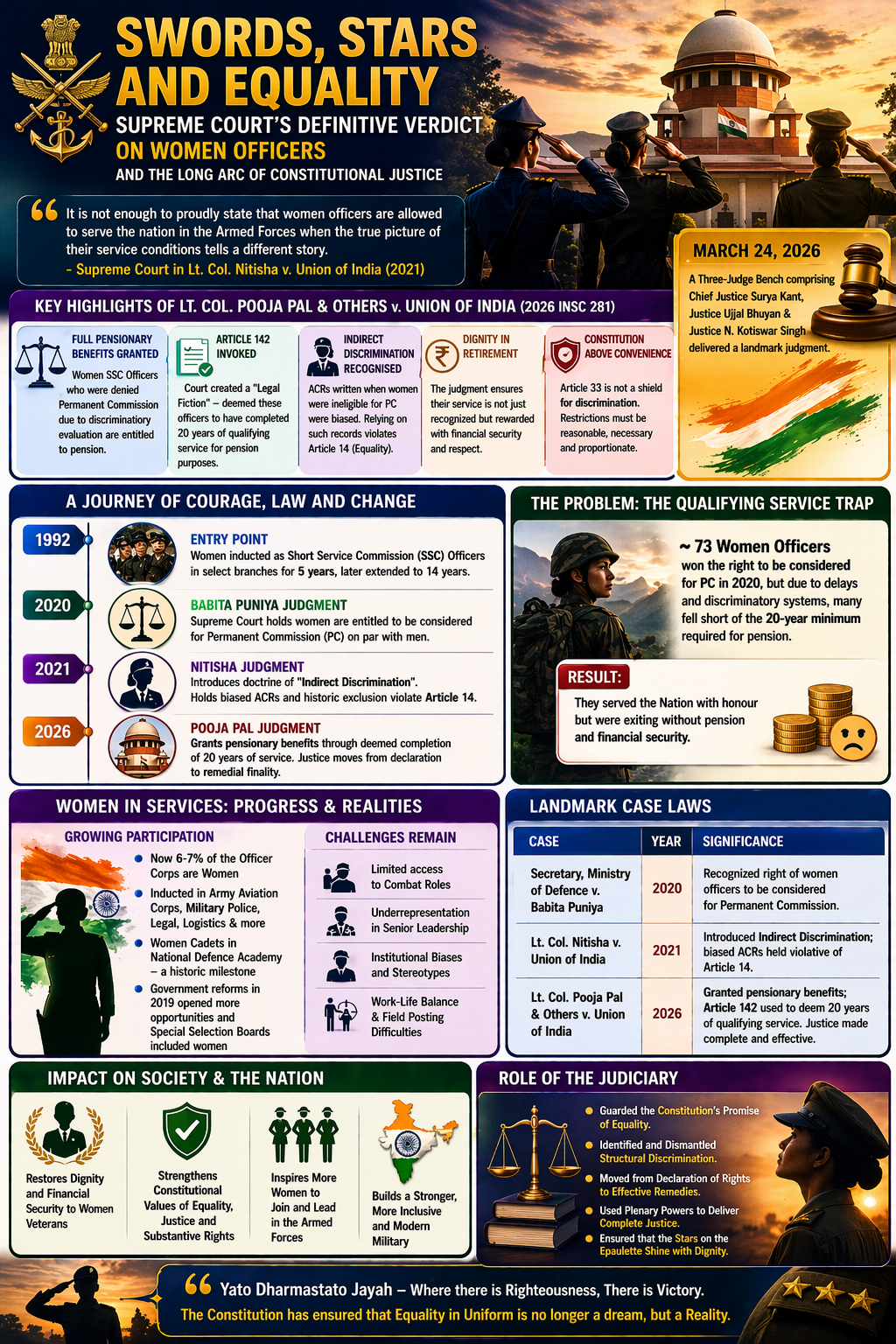
The trajectory of women’s involvement in the Indian Armed Forces illustrates a wider constitutional conflict between official inclusion and substantive equality. The Supreme Court’s pivotal decision in Lt. Col. Pooja Pal v. Union of India signifies a definitive conclusion to this odyssey. It expands upon prior judgements, including Secretary, Ministry of Defence v. Babita Puniya and Lt. Col. Nitisha v. Union of India, shifting the jurisprudence from mere recognition of rights to their substantive execution.
The 2026 decision not only broadens the legal rights of women officers but also reconfigures the interplay between constitutional assurances and institutional practices in the military. By invoking Article 142 of the Constitution, the Court reconciles the enduring disparity between legal recognition and experience, guaranteeing that equality transcends mere symbolic pronouncements to encompass concrete results such as pension payments and dignified retirement.
The Historical Background: Female Participation in the Indian Armed Forces
The official integration of women into the Indian Armed Forces commenced in 1992 by executive notifications pursuant to Section 12 of the Army Act, 1950. Women were first appointed as Short Service Commission (SSC) officers in specific fields, including education, logistics, and legal services. Their tenure was initially five years, later extended to ten, and subsequently to fourteen years.
Notwithstanding this incremental increase, women were consistently barred from the Permanent Commission (PC), which is crucial for sustained professional advancement, leadership roles, and pension eligibility. This exclusion was warranted based on “operational requirements,” “unit cohesion,” and “administrative constraints,” highlighting entrenched gender preconceptions inside military organisations.
The lack of PC resulted in a structural disadvantage. Women officers, irrespective of their qualifications, were forced to leave the army without pension benefits, thereby jeopardising their professional ambitions and financial stability. This institutional system established the basis for extended constitutional litigation.
Judicial Intervention: From Babita Puniya to Nitisha
The initial significant advancement occurred in Babita Puniya (2020), wherein the Supreme Court determined that female officials are eligible for consideration for Permanent Commission on equal footing with their male counterparts. The Court dismissed the government’s assertions on physiological disparities and societal roles, underscoring that these rationales were founded on stereotypes rather than empirical data.
The decision constituted a substantial endorsement of Articles 14 and 15 of the Constitution, acknowledging gender equality as an essential constitutional principle. Nonetheless, it predominantly retained a declarative character, delegating implementation to administrative procedures.
The Court remedied this lacuna in Nitisha (2021) by introducing the notion of indirect discrimination into Indian service jurisprudence. It asserted that evaluation standards, although appearing impartial, could yield discriminatory outcomes when applied to historically marginalised groups. The Court determined that the dependence on historical Annual Confidential Reports (ACRs), compiled during a time when women were ineligible for PC, sustained systemic inequality.
Notwithstanding these advancements, a significant issue persisted: the denial of pension benefits to women officers who received Permanent Commission late in their careers or not at all due to discriminatory practices.
The “Qualifying Service Trap” and Its Implications
The notion of “qualifying service” is fundamental to pension eligibility within the armed forces. According to current regulations, an officer is required to fulfil a minimum of twenty years of service to be eligible for a pension. Women SSC officers who were either denied PC or received it late in the process frequently did not meet this criterion.
This created a dilemma. Although the courts acknowledged their right to serve, administrative delays and discriminatory procedures prevented numerous women from meeting the statutory pension requirements. Consequently, their legal triumphs were made meaningless.
The 2026 decision in Pooja Pal explicitly confronts this discrepancy. The Court acknowledged that withholding pension benefits in these circumstances would constitute a continuation of the discrimination that previous decisions aimed to eradicate.
Article 142 and the Principle of “Complete Justice”
The 2026 decision is characterised by the Supreme Court’s invocation of Article 142, which authorises it to issue orders essential for achieving “complete justice.“ This provision has traditionally been employed in extraordinary situations where modern legal frameworks fail to resolve intricate matters.
In Pooja Pal, the Court utilised Article 142 to establish a “legal fiction“ of presumed service. It was determined that female officers who were refused promotion owing to discriminatory practices would be regarded as having fulfilled the necessary twenty years of service for pension eligibility.
This novel solution signifies a transition from formal adjudication to substantive justice. It recognises that legal rights necessitate practical procedures for their realisation. By guaranteeing pension benefits, the Court converts the right to serve into the right to retire with dignity.
Indirect Discrimination and Systemic Inequality
The decision enhances the Court’s involvement with the notion of indirect discrimination, already introduced in Nitisha. It acknowledges that systemic biases frequently manifest through apparently neutral policies and procedures.
Within the military framework, ACRs and assessment standards were influenced by an institutional presumption that women were transient participants. Reporting officers, cognisant that women were ineligible for PC, had minimal motivation to evaluate them for long-term leadership positions. As a result, these statistics did not accurately represent the real potential of female officers.
The Court determined that utilising such compromised documents to withhold PC or pension benefits contravenes Article 14. This rationale emphasises the significance of contextual analysis in evaluating equality claims, beyond mere formal neutrality, to scrutinise real results.
Article 33 and the Constraints of Military Exceptionalism
The State has historically cited Article 33 of the Constitution to rationalise limitations on fundamental rights in the military forces. This provision permits Parliament to alter the implementation of fundamental rights to guarantee discipline and operational efficacy.
The Supreme Court in Pooja Pal establishes that Article 33 is not an unconditional protection. Any limitation on rights must meet the criteria of rationality and proportionality. Gender-based exclusions cannot be rationalised merely on the grounds of institutional convenience or historical precedent.
This approach corresponds with prior decisions, like Anuj Garg v. Hotel Association of India, in which the Court dismissed protected discrimination that reinforces stereotypes. Utilising the same reasoning within the military environment, the Court reiterates that constitutional principles must not be compromised by institutional inertia.
Women in Services: Broadening Perspectives
The involvement of women in the Indian Armed Forces has experienced considerable expansion in recent years. Women are now integrated into many branches, including the Army Aviation Corps, Military Police, and specific combat-support positions. The inclusion of female cadets in the National Defence Academy signifies a significant milestone.
Notwithstanding these gains, difficulties endure. Women continue to be under-represented in senior leadership roles, and their involvement in combat jobs remains restricted. Institutional biases, infrastructural limitations, and societal perceptions persist in influencing their experiences.
The 2026 judgement pertains to a significant element of this overarching context- financial stability and professional longevity. Ensuring pension benefits fortifies the basis for enhanced gender equity within the military forces.
The Transformative Application of Article 142: Transitioning from Declaratory Rights to Substantive Justice
A salient aspect of the Supreme Court’s decision in Lt. Col. Pooja Pal and Others v. Union of India (2026) is its novel invocation of Article 142 of the Constitution of India. This article enables the Court to issue any decree or order essential to achieve “complete justice” in a case. Historically, Article 142 has been employed in extraordinary situations where legislative frameworks fail to address systemic injustice.
In this case, the Court’s invocation of Article 142 rectified a structural anomaly known as the “qualifying service trap.” Women officers, despite obtaining acknowledgement of their right to Permanent Commission in Secretary, Ministry of Defence v. Babita Puniya, were nonetheless barred from pension benefits owing to delays and biased evaluation systems. The Court’s resolution- establishing a legal fiction of “deemed completion“ of 20 years of service- surpasses conventional adjudication and demonstrates a dedication to substantive equality.
This method illustrates that constitutional courts function not just as arbiters of legality but also as architects of justice. By reconciling fiscal constraints (capping arrears as of January 1, 2025) with equitable relief, the Court ensured that its intervention was both principled and pragmatic.
Indirect Discrimination and the Reassessment of Equality
The 2026 judgement represents a significant theoretical progression by addressing the notion of indirect discrimination, as earlier articulated in Lt. Col. Nitisha v. Union of India. The Court acknowledged that ostensibly impartial evaluation criteria- such as Annual Confidential Reports (ACRs)- were situated within an institutional framework that assumed the transient character of women’s service.
This led to systemic disadvantages:
- Women officers were assessed during intervals when they were disqualified for long-term service, diminishing motivations for positive evaluations.
- Opportunities for promotion and command were systematically constrained.
- Institutional biases resulted in diminished comparative merit rankings.
The Court determined that dependence on such documents contravened Article 14 of the Constitution of India, as it sustained historical prejudice under the pretence of impartiality.
This acknowledgement matches Indian constitutional interpretation with international equality standards, where indirect discrimination is being recognised as a significant obstacle to substantive equality.
Women in the Military: Historical Development and Current Contexts
The involvement of women in India’s armed services has progressed incrementally.
- In 1992, women were appointed as Short Service Commission Officers in specific branches.
- 2008: Limited Permanent Commission awarded for specific non-combat positions.
- 2019-2020: Modifications in policy and court involvement broadened opportunities.
- 2026: Recognition of pensionary parity and substantive equality.
Notwithstanding these advancements, women continue to represent around 6-7% of the officer ranks within the Army, Navy, and Air Force. Structural challenges endure:
- Restricted entry to combat positions.
- Gendered conceptions of leadership and physical competence.
- Concerns with work-life balance, especially in field assignments.
The 2026 decision addresses a crucial aspect- post-retirement dignity- yet comprehensive institutional improvements are still required.
The Illusion of Field Necessity and Organisational Opposition
A prevalent argument opposing gender parity in the military is the concept of “field exigency,” which asserts that operational demands warrant limitations on women’s involvement.
The Supreme Court has persistently scrutinised this assertion:
- Babita Puniya challenged assumptions regarding women’s physical and emotional capacities.
- Nitisha emphasised that structural impediments cannot be rationalised by operational considerations.
- In Pooja Pal, the same rationale was applied to post-service rights.
The Court’s precedent indicates that “field exigency” frequently serves as a substitute for institutional inertia. Genuine operational efficiency, as implied by the Court, resides in leveraging the complete capabilities of all people, regardless of gender.
Judicial Review and the Function of the Armed Forces Tribunal
A significant element of the 2026 ruling is its evaluation of the Armed Forces Tribunal (AFT). The Tribunal had previously rejected the applications of numerous female officers based on “lower comparative merit.”
The Supreme Court reversed these determinations, claiming that:
- The evaluation process itself was structurally flawed.
- The Tribunal neglected to consider historical discrimination.
- Judicial entities must employ a contextually aware methodology when addressing equality allegations.
This highlights the Supreme Court’s hierarchical function in maintaining consistency and adherence to the Constitution throughout judicial venues.
Unresolved Questions and Prospective Pathways
The 2026 decision represents a notable milestone; nonetheless, other issues persist unresolved:
Military Engagement Positions for Women
The Court has abstained from requiring the participation of individuals in combat roles, delegating the decision to administrative authority.
Central Armed Police Forces (CAPFs)
Gender equity in paramilitary forces is still evolving, as seen by current legislative initiatives like the CAPF (General Administration) Bill, 2026.
Organisational Culture
Legal reforms necessitate corresponding alterations in organisational attitudes and procedures.
Intersectionality
Future jurisprudence must consider the experiences of women from many social, economic, and regional contexts.
The Judiciary as the Custodian of Transformative Constitutionalism
The progression from Babita Puniya to Nitisha to Pooja Pal exemplifies the judiciary’s function as a catalyst for societal change. The Supreme Court has rendered a decision.
- Recognised and eradicated systemic discrimination.
- Broadened the scope of fundamental rights.
- Guaranteed the accountability of governmental institutions.
This corresponds with the overarching ideology of transformative constitutionalism, which perceives the Constitution as a fluid tool for attaining social justice.
Conclusion
The Supreme Court’s 2026 decision signifies the apex of an extensive constitutional progression towards gender equality within the military. By confronting the “qualifying service trap” and providing pension benefits, the Court has progressed beyond mere symbolic acknowledgement to substantive justice.
The resolution confirms that:
- Equality must be both substantive and enforceable.
- Institutional procedures must conform to constitutional principles.
- The judiciary has a crucial role in rectifying structural injustices.
The court’s decision ultimately reinstates respect for women officers who devoted their lives to national service. It guarantees that the “sword“ of military obligation is complemented by the “shield“ of social security, ensuring that the commitment to equality is realised rather than postponed.
By doing so, the Supreme Court has not only settled a legal contention but also reiterated the fundamental principles of the Indian Constitution- that justice, in all its facets, must prevail.

 Supreme Court Dowry Enforcement Order 20...
 Supreme Court Modifies 3-Year Practice R...
 Doctrine of Per Incuriam Explained: Supr...





 WhatsApp





